Small Bathroom Organization Ideas: What Goes Where
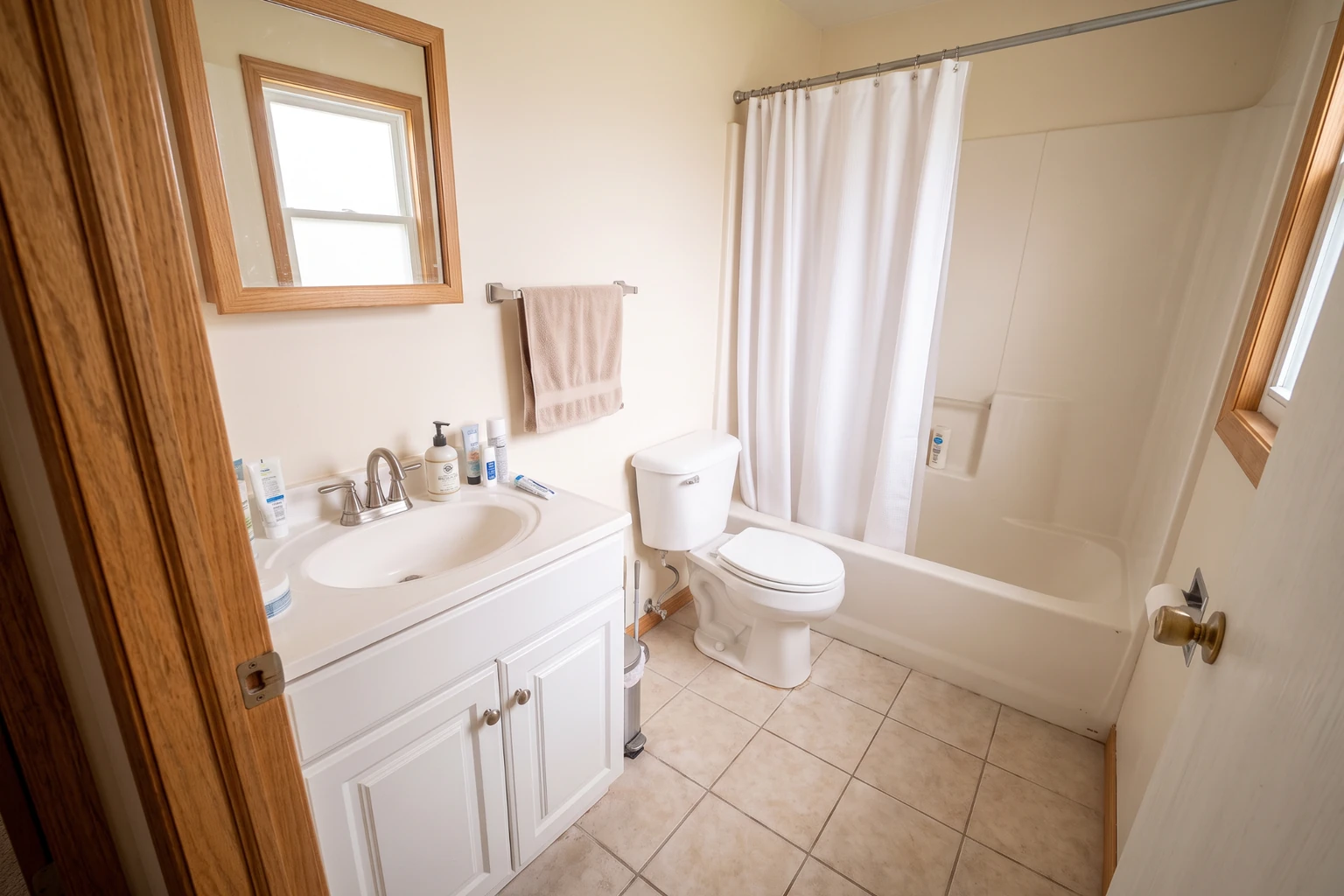
A small bathroom can feel crowded even when everything is technically put away. The countertop holds everyone’s grooming products, spare shampoo bottles compete for shower space, and extra towels end up wherever there’s an empty corner.
But more organizers aren’t always the answer.
Sometimes the better solution is to give everyday essentials a convenient home, move backup supplies somewhere appropriate, and leave the spaces you actually use clear.
These small bathroom organization ideas will help you make practical decisions across the whole room, whether you have a vanity, a pedestal sink, a shared bathroom, or almost no built-in storage.
Affiliate disclosure: This guide contains affiliate links. If you purchase through one of our links, OrganizeSmartly may earn a commission at no additional cost to you. We recommend products based on problem-solution fit, dimensions, and practical usefulness. Read the disclosure.
Quick Navigation
- Start With the Bathroom Problem That’s Getting in Your Way
- Give Your Bathroom Supplies Three Possible Homes
- Small Bathroom Organization Ideas for Each Zone
- Where Should Backup Bathroom Supplies Go?
- What These Ideas Look Like in Different Small Bathrooms
- Five Questions to Ask Before Buying Another Organizer
- Frequently Asked Questions
Start With the Bathroom Problem That’s Getting in Your Way
Before adding storage, identify which part of your bathroom is making everyday use difficult.
| What’s happening? | What to try first | More detailed help |
|---|---|---|
| The sink counter is crowded | Keep everyday sink essentials convenient and find another home for less-used products. | Bathroom vanity organization |
| There’s no cabinet beneath the sink | Decide which supplies need to stay nearby before choosing another storage location. | Pedestal sink storage |
| Too many products stay in the shower | Separate regular-use bottles from occasional products and backups. | Shower storage ideas |
| The space above the toilet looks unused | Consider whether adding storage would actually help without compromising access or cleaning. | Over-the-toilet storage ideas |
| You can’t make permanent changes | Look at existing storage and movable options that work with your rental restrictions. | Renter-friendly bathroom storage |
| Several people share limited space | Give personal supplies predictable homes while keeping shared essentials accessible. | See the shared-bathroom example below. |
| Backup supplies crowd everything else | Move suitable reserves to an appropriate dry shelf or closet, if available. | See the backstock section below. |
You may have several of these problems at once. Start with the one that interrupts your routine most often.
You don’t need to reorganize the entire room before making one useful improvement.
Give Your Bathroom Supplies Three Possible Homes
A practical organization system doesn’t require every bathroom-related item to live inside the bathroom.
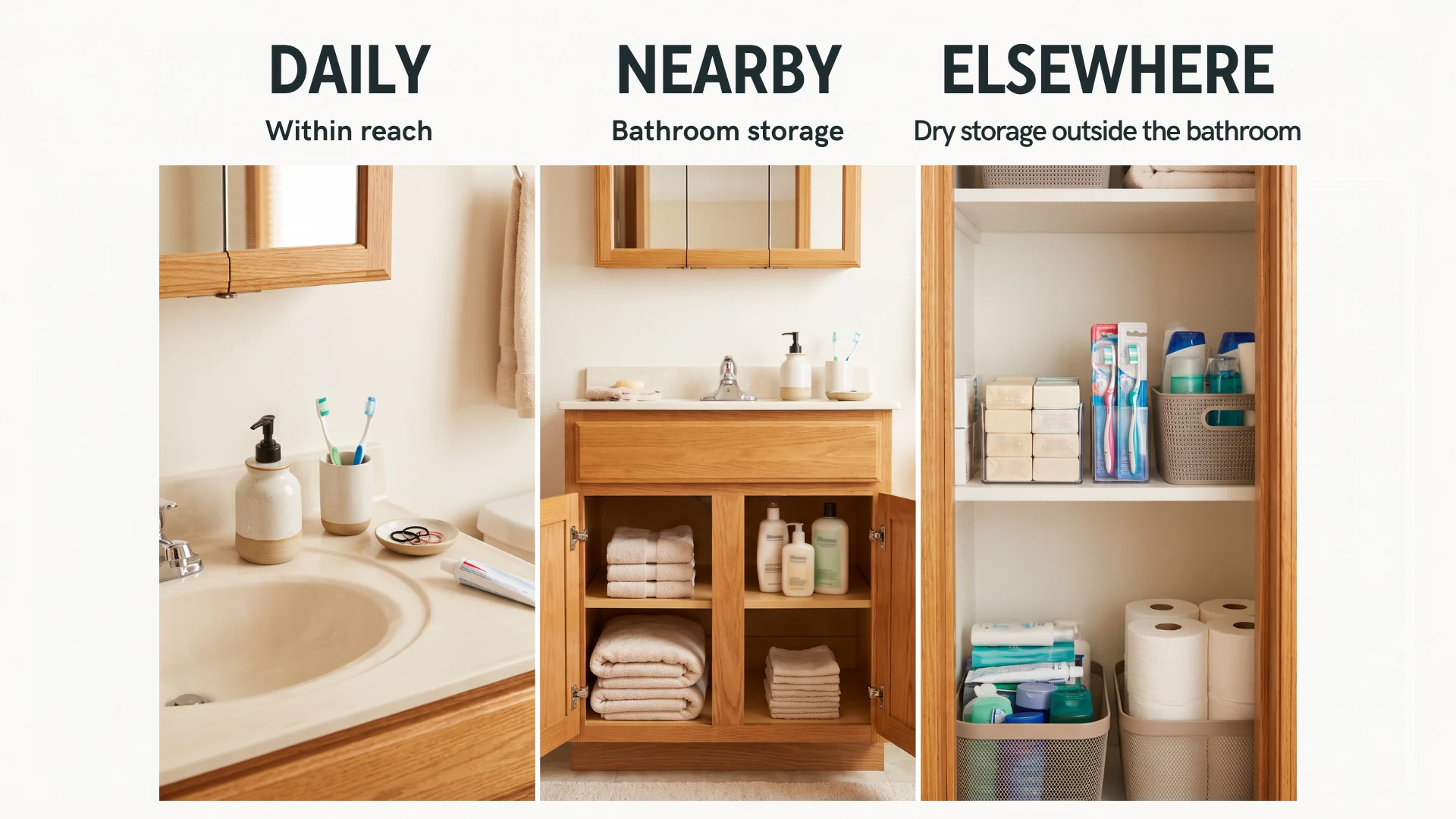
Instead, think about three destinations.
Daily: The Items You Need Within Reach
These are the things you use during ordinary bathroom routines.
Hand soap belongs conveniently near the sink. Shower products should be accessible when they’re needed. A few personal grooming essentials might need a defined location near the vanity.
The goal isn’t to display everything. It’s to make the active routine convenient without letting products take over the available surfaces.
Nearby: Useful Items That Don’t Need Prime Storage Space
Some supplies belong in the bathroom but don’t need to occupy the most convenient locations.
A small reserve of toilet paper, clean towels, or occasionally used grooming items may fit in existing cabinetry or another suitable location.
Consider how easily you can retrieve them. Storage isn’t especially useful if you have to empty half a cabinet whenever you need a clean towel.
Elsewhere: Supplies That Don’t Need Bathroom Space
Ordinary backup toiletries, extra linens, and other suitable reserves can sometimes live on an accessible closet or utility shelf outside the bathroom.
This frees up room for the things actually used there.
Don’t automatically move every product into the same container. Follow its original storage instructions, particularly for medicines, cleaning chemicals, and other products with specific requirements.
The principle is simple: Give convenient bathroom space to the activities that happen there, not necessarily to the largest collection of supplies.
Small Bathroom Organization Ideas for Each Zone
Different bathroom fixtures create different storage opportunities and limitations.
Start with the zones you already have. You don’t need a new organizer in every one.
Sink and Vanity: Keep the Working Area Useful
A crowded sink can make ordinary routines more difficult.
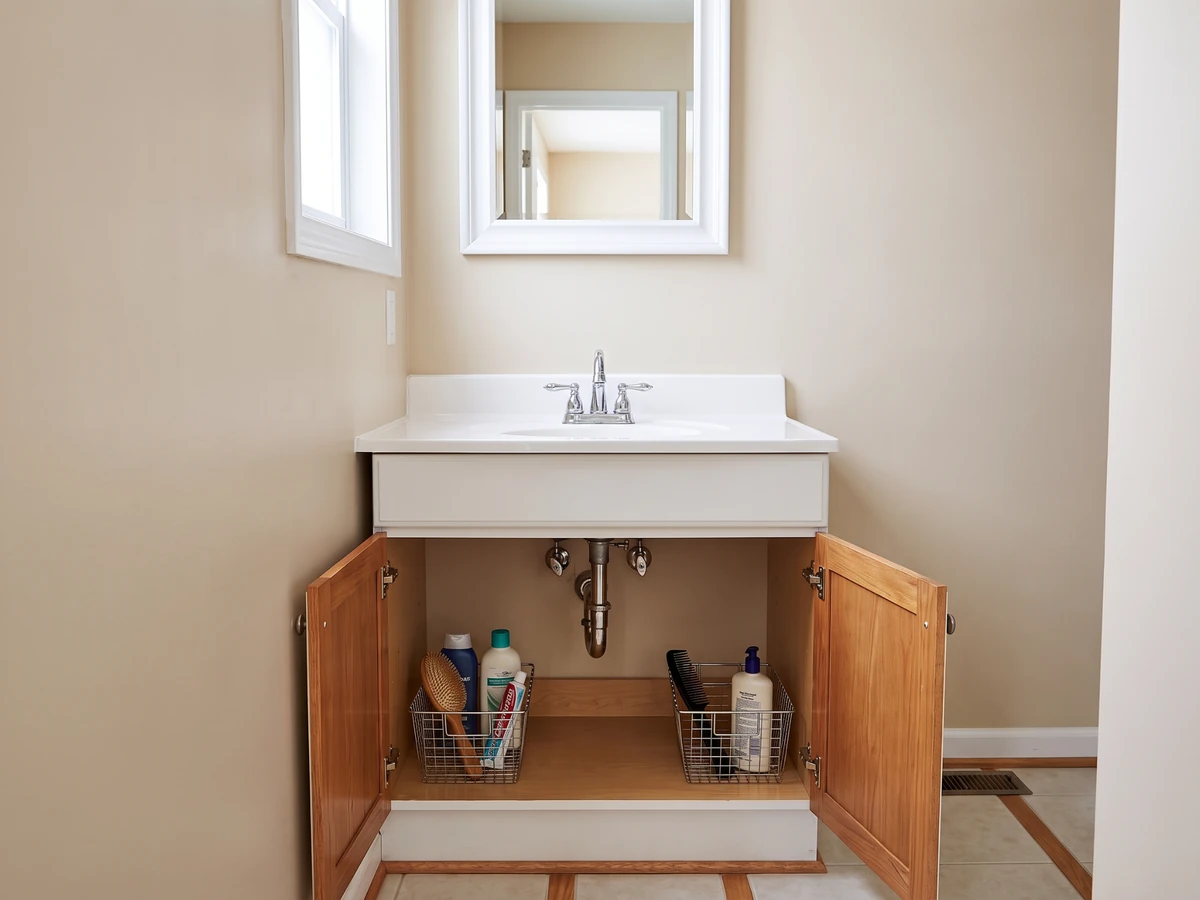
Start with the items you regularly need there. Keep hand soap accessible, give frequently used personal-care products a predictable home, and move unnecessary backups away from the countertop.
A small tray can help group items, but it isn’t automatically an improvement. If the tray takes up space needed for washing, grooming, or cleaning, it may simply turn scattered clutter into organized clutter.
For detailed drawer, cabinet, and under-sink decisions, see our bathroom vanity organization guide.
If your sink has no vanity, the available choices are different. Our pedestal sink storage guide compares alternatives around, beside, and away from the sink.
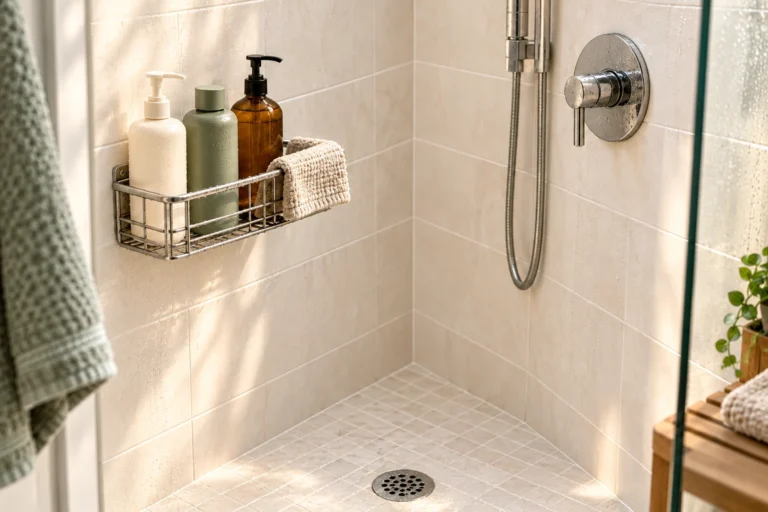
Shower: Make Room for the Products You Actually Use
A small shower can quickly become crowded with bottles that aren’t needed during every bathing routine.
Start by identifying what needs a convenient place inside the shower.
Occasional-use products and unopened backups can be considered separately. In some households, carrying appropriate items into the shower when needed is more practical than adding permanent storage.
If you’re considering mounted or freestanding storage, don’t assume that an empty wall or corner is automatically usable.
Reach, cleaning, water exposure, fixture access, and the specific installation method all matter.
Our shower storage ideas guide explains those choices in more detail.
Toilet Area: Leave Access and Cleaning Space Available
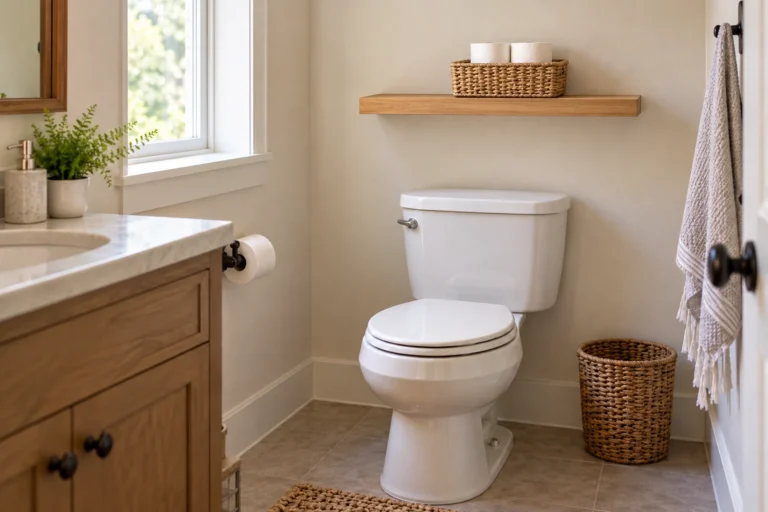
The wall above the toilet can look like unused storage space.
However, a shelf or cabinet may complicate tank access, cleaning, or everyday movement if it isn’t appropriate for the actual bathroom.
If you already have a convenient location for toilet paper and other necessary supplies, you may not need additional furniture here.
When above-toilet storage genuinely seems useful, compare suitable configurations rather than assuming a tall shelving unit is the only solution.
See over-the-toilet storage ideas for more detailed guidance.
Doors and Floor Space: Don’t Create New Obstacles
An over-door organizer may add storage without using another floor location, but the door still has to open and close normally.
Likewise, a narrow gap may appear large enough for a rolling cart until you consider the cabinet door, walking space, or cleaning access.
The practical question isn’t simply, "Can an organizer fit here?"
It’s whether the organizer can remain there without making the room harder to use.
For movable storage, door organizers, and rental restrictions, see our renter-friendly bathroom storage guide.
Towels and Laundry: Decide What Belongs in the Room
A small bathroom may need convenient access to the towels currently being used, but it doesn’t necessarily need to hold every clean towel in the household.
Try keeping the active towel supply accessible and storing additional clean linens in a suitable dry location elsewhere.
Used clothing creates a different problem.
If clothes regularly accumulate on the bathroom floor, first consider whether an existing laundry basket outside the room is convenient enough.
A dedicated bathroom hamper may make sense when the household genuinely needs a collection point inside the bathroom and has an unobstructed place for it.
Measure First: The Amazon listing for Mind Reader Slim Laundry Hamper, 40L gives exterior dimensions of 18 inches long × 10.4 inches wide × 23.5 inches high. Check the floor footprint, normal walking route, lid-opening space, and access to nearby fixtures or cabinetry.
Best For: A bathroom where everyday clothing collection is a recurring need and an appropriate floor location is available.
Skip If: The hamper would obstruct movement, cleaning, a door or cabinet, or duplicate an existing convenient laundry basket.
Bathroom
Mind Reader Slim Laundry Hamper, 40L — Ivory
A lidded plastic laundry hamper with handles and ventilated cutouts for collecting used clothing where floor space allows.
Check on Amazon (opens in a new tab)Ventilated cutouts don’t guarantee that wet towels or other damp fabrics will dry inside the hamper. Avoid treating a closed laundry basket as a drying solution.
Where Should Backup Bathroom Supplies Go?
Once everyday products have convenient homes, the next question is what to do with their replacements.
You might have extra shampoo, unopened soap, spare toothpaste, or other ordinary toiletries that don’t need to be within reach during today’s bathroom routine.
An existing dry closet or utility shelf can be a sensible storage location, provided it is appropriate for the actual products.
Try grouping replacements into recognizable categories so you can see what you have before purchasing more.
For example, keeping spare soap in one location can make it easier to find the next bar without searching several bathroom cabinets.
If suitable storage already exists, you may not need a new container.
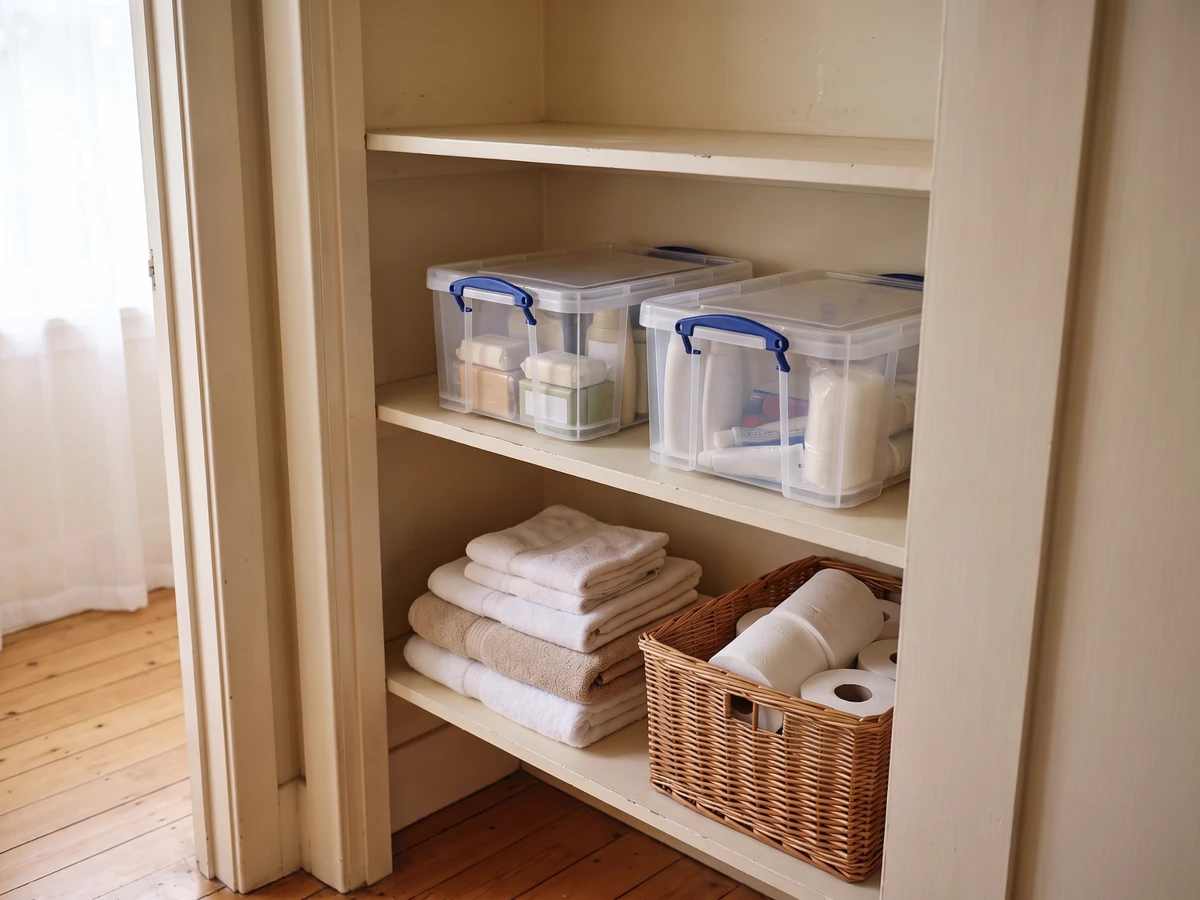
The Sterilite 15 Qt ClearView Latch Box, 2-Pack is an option when ordinary dry backstock needs a defined home on an available closet or utility shelf. Each box has a clear base and lid with colored latches. Sterilite describes the boxes as stackable, although stacking still requires suitable placement and sensible loading.
The 15-quart capacity doesn’t tell you whether a particular bottle will fit upright. Compare the actual item dimensions with the container’s usable interior space.
Measure First: Each box measures 17 inches long × 11⅛ inches wide × 6½ inches high externally. Sterilite lists interior dimensions at the bottom of 14 inches long × 9⅛ inches wide × 6⅛ inches high. Check shelf depth, usable height, and the actual backup products.
Best For: Ordinary dry reserve supplies that would be easier to find when grouped on an appropriate shelf or in a closet.
Skip If: You already have suitable containers, need upright space for taller bottles, don’t have room for the two-box purchase, or the stored products require different conditions.
Bathroom
Sterilite 15 Qt ClearView Latch Box, 2-Pack
Two clear latching storage boxes for grouping ordinary dry backup supplies on a suitable closet or utility shelf.
Check on Amazon (opens in a new tab)The latching lids are not evidence that the boxes are waterproof or that their contents are protected from every storage condition.
Follow the labels on stored supplies. For example, MedlinePlus explains that heat and moisture can damage medicines. The U.S. Environmental Protection Agency also advises following storage instructions and keeping hazardous household products in their original labeled containers.
What These Ideas Look Like in Different Small Bathrooms
The same storage principle can lead to different choices depending on the layout and who uses the room.
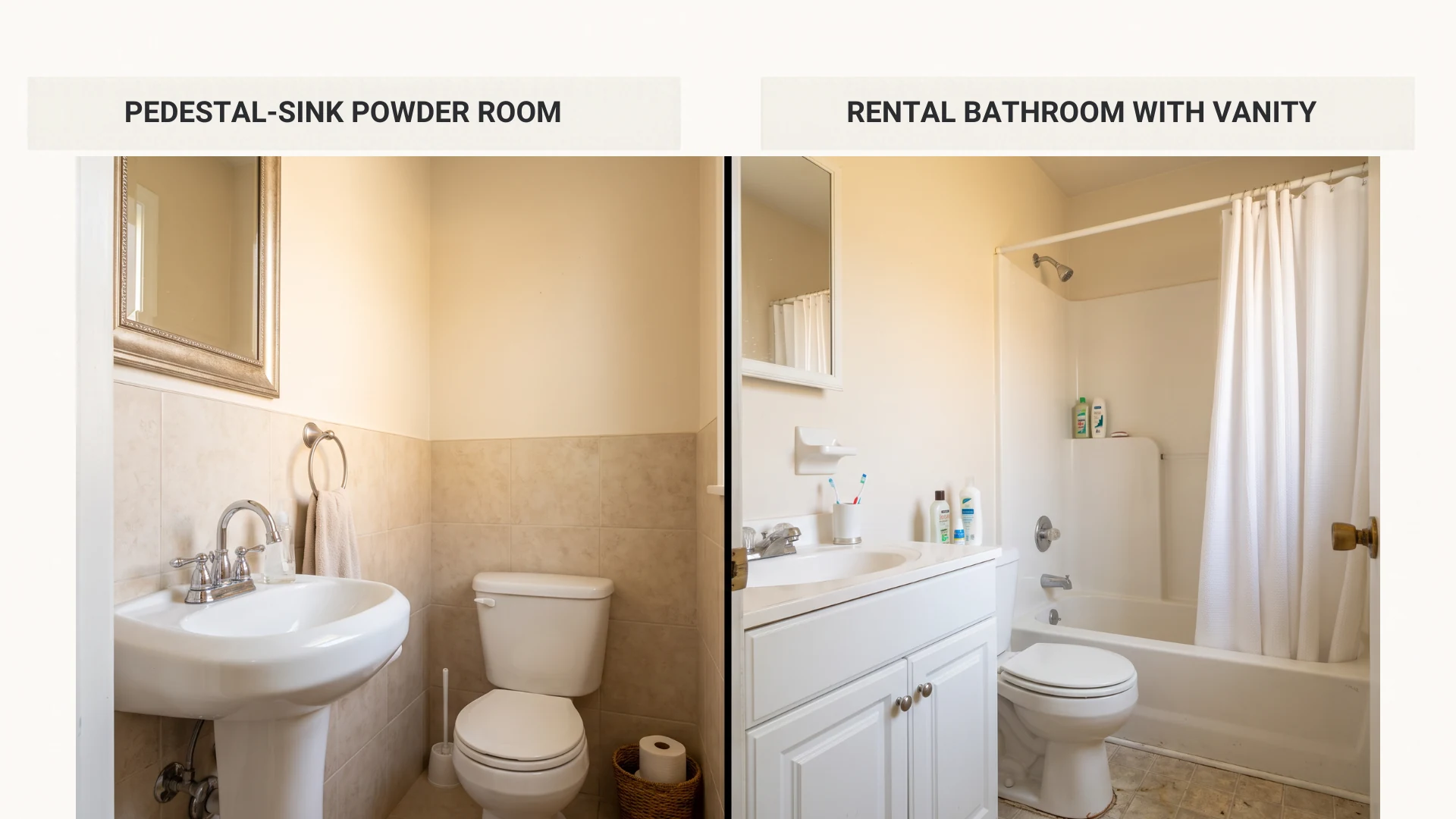
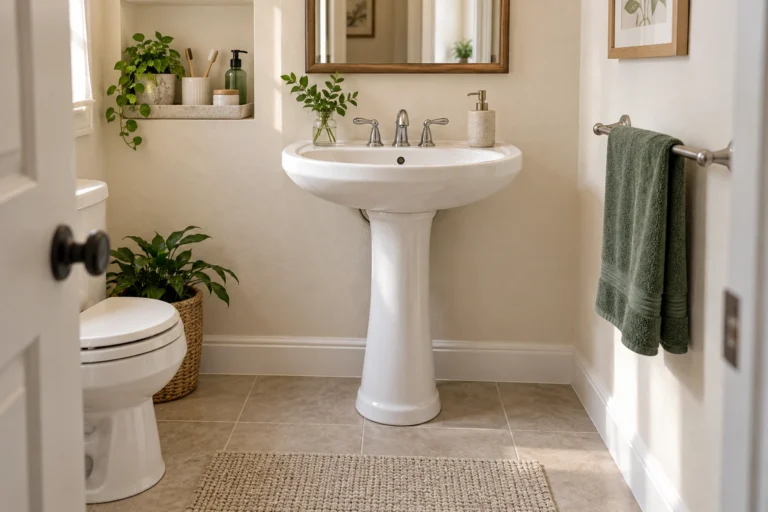
A Pedestal-Sink Powder Room
Imagine a powder room with a pedestal sink, toilet, mirror, and almost no enclosed storage.
The room may only need a few convenient items, such as hand soap, a hand towel, and a practical location for toilet paper.
Rather than surrounding the sink with furniture immediately, consider whether spare guest supplies and extra toiletries can live elsewhere.
If storage around the pedestal is still necessary, compare the remaining space and access requirements before purchasing anything.
A Rental Bathroom With a Tub and Vanity
A rental bathroom may have a usable vanity but limited shower storage.
Keep the everyday sink routine separate from the shower routine. Decide which products actually need to stay in the bathing area and which could be stored elsewhere between uses.
A portable approach may work for some households, while others will find repeated carrying inconvenient.
Any hooks, over-door systems, or other attachments also need to be appropriate for the actual surfaces and rental restrictions.
No-drill doesn’t automatically mean damage-free or permitted.
A Bathroom With Cabinets but Crowded Counters
Some small bathrooms have enough storage volume but use the convenient areas inefficiently.
If the counter is crowded while reserve products fill accessible cabinet space, moving suitable backups elsewhere may be enough to create a better arrangement.
Give frequently used products the easiest practical locations and reserve the less convenient storage for items that are retrieved less often.
This is different from filling every drawer with a divider.
If you need a detailed system for drawer and cabinet interiors, use the bathroom vanity organization guide.
A Small Bathroom Shared by Two or More People
Shared bathrooms have an additional challenge: several people’s routines compete for the same limited surfaces.
Start by separating genuinely shared essentials from personal-use products.
Hand soap and other shared necessities can remain in their appropriate locations. Personal grooming products can have predictable homes elsewhere when they don’t need to stay on the countertop.
For example, two people with different morning routines could each keep a compact collection of frequently used items on an accessible shelf outside the busiest part of the bathroom.
An existing basket may do the job. If a suitable container isn’t available, a single handled organizer is one option to evaluate.
The mDesign Clear Storage Bin with Handles is an open-top plastic container with built-in handles. It can group a compact personal collection of ordinary grooming items so they can be retrieved and returned together.
Measure First: The exact Amazon listing gives exterior dimensions of 10 inches long × 6 inches wide × 5 inches high. Check whether the intended items fit and whether there’s a practical storage location between uses.
Best For: A shared bathroom where personal product collections regularly compete for counter space and storing them separately would simplify everyday use.
Skip If: Existing baskets work, the products don’t fit, carrying the bin is inconvenient, or there is no suitable place to return it.
Bathroom
mDesign Clear Storage Bin with Handles
A clear open-top organizer with integrated handles for grouping one person's ordinary daily-use grooming supplies in a shared-bathroom routine.
Check on Amazon (opens in a new tab)The benefit is a predictable place for personal supplies, not a guarantee that the container will make every shared routine easier.
If the underlying problem is specifically drawer or cabinet organization inside a shared vanity, the vanity organization guide covers that more detailed decision.
Five Questions to Ask Before Buying Another Organizer
Before purchasing anything else, consider the practical result you want.
- What problem will this solve? A new bin doesn’t necessarily help if the real issue is keeping too many backups in the bathroom.
- Where will it go? Check whether the location is actually available and convenient during everyday use.
- What needs to fit inside it? Compare the intended contents with the product’s usable dimensions, not just its advertised capacity.
- Will anything become harder to use? Consider doors, drawers, fixture access, cleaning, and normal movement around the room.
- Could existing storage solve the problem? Rearranging or relocating suitable items may be enough.
Sometimes leaving a corner or countertop section open is more useful than adding another organizer.
Frequently Asked Questions
How do you organize a small bathroom with almost no storage?
Start with what genuinely needs to remain in the bathroom.
Keep everyday essentials conveniently located and consider moving suitable extras to another accessible storage area.
Then evaluate the available fixture-specific options. A pedestal sink, shower, and toilet area have different storage constraints, so a solution that works in one zone may not work in another.
Where should extra bathroom supplies be stored?
Ordinary backup toiletries can often be stored in an appropriately dry closet or utility area if they don’t need immediate bathroom access.
Choose a location that matches the supplies’ storage instructions and allows easy retrieval.
Medicines, cleaning chemicals, and other products with specific safety or storage requirements need more careful handling than ordinary toiletries.
How can several people share a small bathroom without cluttering it?
Keep shared essentials distinct from personal-use products.
Give each person’s everyday items a predictable location, preferably without turning the shared countertop into permanent storage for everyone’s complete collection.
A personal container may help when it fits the household’s routines, but the organization system matters more than purchasing matching bins.
Choose the Next Bathroom Storage Problem to Solve
You don’t have to organize every corner of a small bathroom at once.
Start with the area that causes the most frustration and decide which supplies really need to stay there.
Then explore the guide that matches your next priority: pedestal sink storage, shower storage, over-the-toilet storage, renter-friendly bathroom storage, or bathroom vanity organization.
The most useful small bathroom organization ideas aren’t always the ones that add more storage. They’re the ones that make the space you already have easier to use.
Keep Building a Home That Fits
Explore practical organization guides built around real measurements, everyday routines, and usable space.