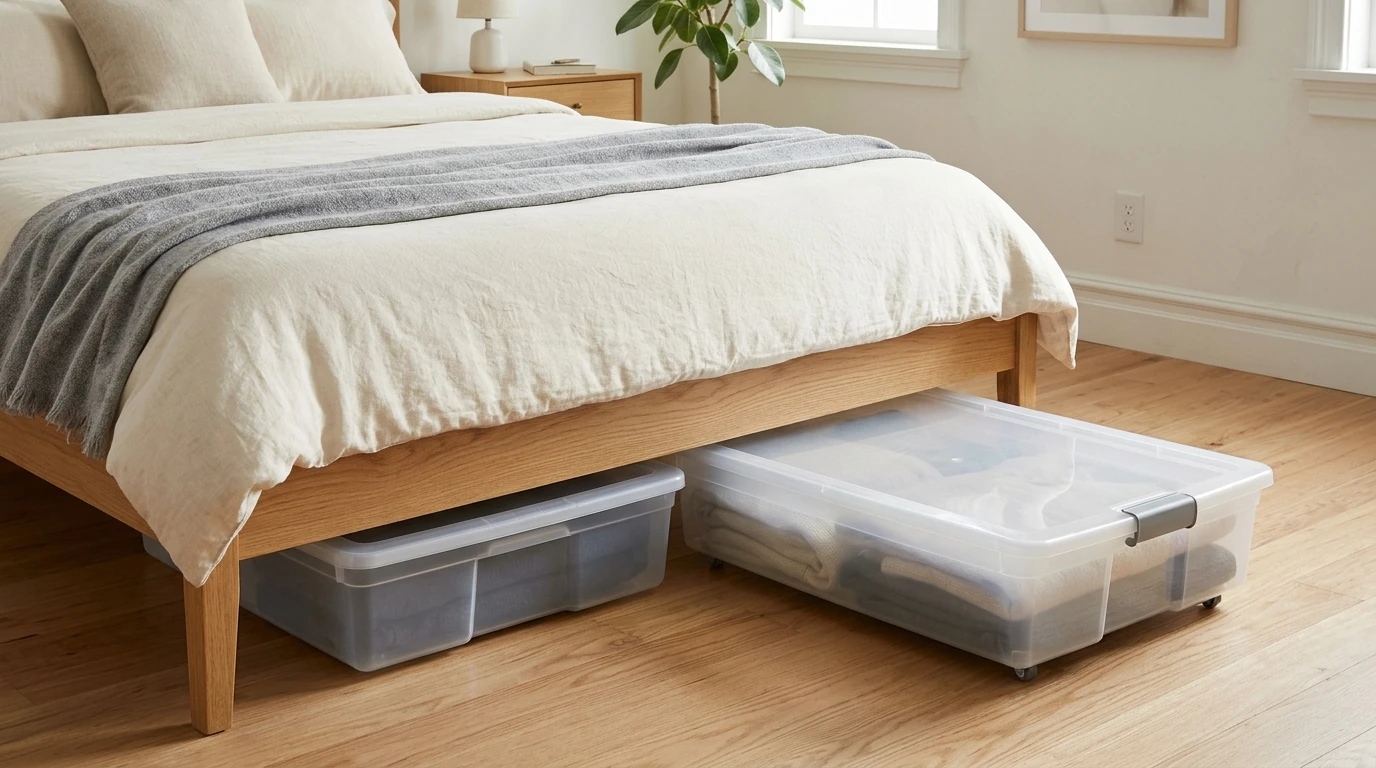
Under-Bed Storage Ideas That Fit Your Bed and Stay Easy to Access
The space under your bed may look like an easy place to add storage. But an empty gap does not automatically make a useful storage area.
A bin can fit beneath the bed frame and still be difficult to pull out. A rolling drawer may work on one floor but drag on another. A storage bag may squeeze through the opening when empty, then become too tall once you fill it with bedding.
That is why the best under-bed storage ideas start with more than choosing a container.
Before buying anything, check whether the space is practical to use, measure the clearance you actually have, and decide what belongs there.
Quick Answer: Under-bed storage works best when you have enough clearance for the entire container, a clear path to pull it out, and belongings that make sense to keep near floor level. Low-profile fabric cases, lidded bins, and wheeled containers can all work, but each has different fit and access limitations. If the setup makes items difficult to reach or return, another storage location may be the better choice.
Affiliate disclosure: OrganizeSmartly may earn a commission from qualifying purchases through affiliate links at no additional cost to you. We recommend products based on practical fit and usefulness. Read the disclosure.
In This Guide
- Is Under-Bed Storage Right for Your Bedroom?
- Measure Your Real Under-Bed Clearance
- Check Flooring and Pull-Out Space
- What Should You Store Under Your Bed?
- Under-Bed Storage Ideas for Different Needs
- Under-Bed Storage With Wheels: When It Works
- The Loaded Retrieval and Return Test
- Reuse, Buy, or Avoid
- Frequently Asked Questions
1. Is Under-Bed Storage Right for Your Bedroom?
Before measuring the space or shopping for containers, decide whether using it makes sense.
Can you comfortably reach underneath?
Think about what happens when you need something from the container.
Will you have to kneel beside the bed? Move a nightstand? Pull a heavy box across carpet? Reach deep underneath the frame?
If retrieving the container requires uncomfortable bending, difficult gripping, or repeated furniture movement, the added capacity may not be worth the effort.
A storage solution should reduce everyday problems, not create a new task every time you need a spare blanket.
Is the space accessible?
Look at the area around the bed.
A wall, dresser, nightstand, or narrow walkway may prevent you from pulling a container out, even when there is plenty of empty space beneath the frame.
Check which side of the bed you can realistically use.
The foot of the bed may offer an alternative access route, but only when the frame design and surrounding furniture allow it.
Is the storage environment suitable?
Look underneath the bed before putting fabric or other sensitive belongings there.
Check for visible dampness, musty odors, signs of water damage, or existing mold.
According to the US Environmental Protection Agency, controlling moisture is central to preventing indoor mold problems.
If moisture is already an issue, address its cause before storing belongings there. A lid or zipper should not be treated as a solution to a damp room.
Skip under-bed storage if: You cannot comfortably access the space, the retrieval route is blocked, or the conditions could damage what you intend to store.
If the space passes these initial checks, the next step is to measure it.
2. Measure Your Real Under-Bed Clearance
The most important measurement is not simply the distance between the floor and the visible side of the bed.
You need to know where a container can enter, where it can sit, and whether it can come back out.
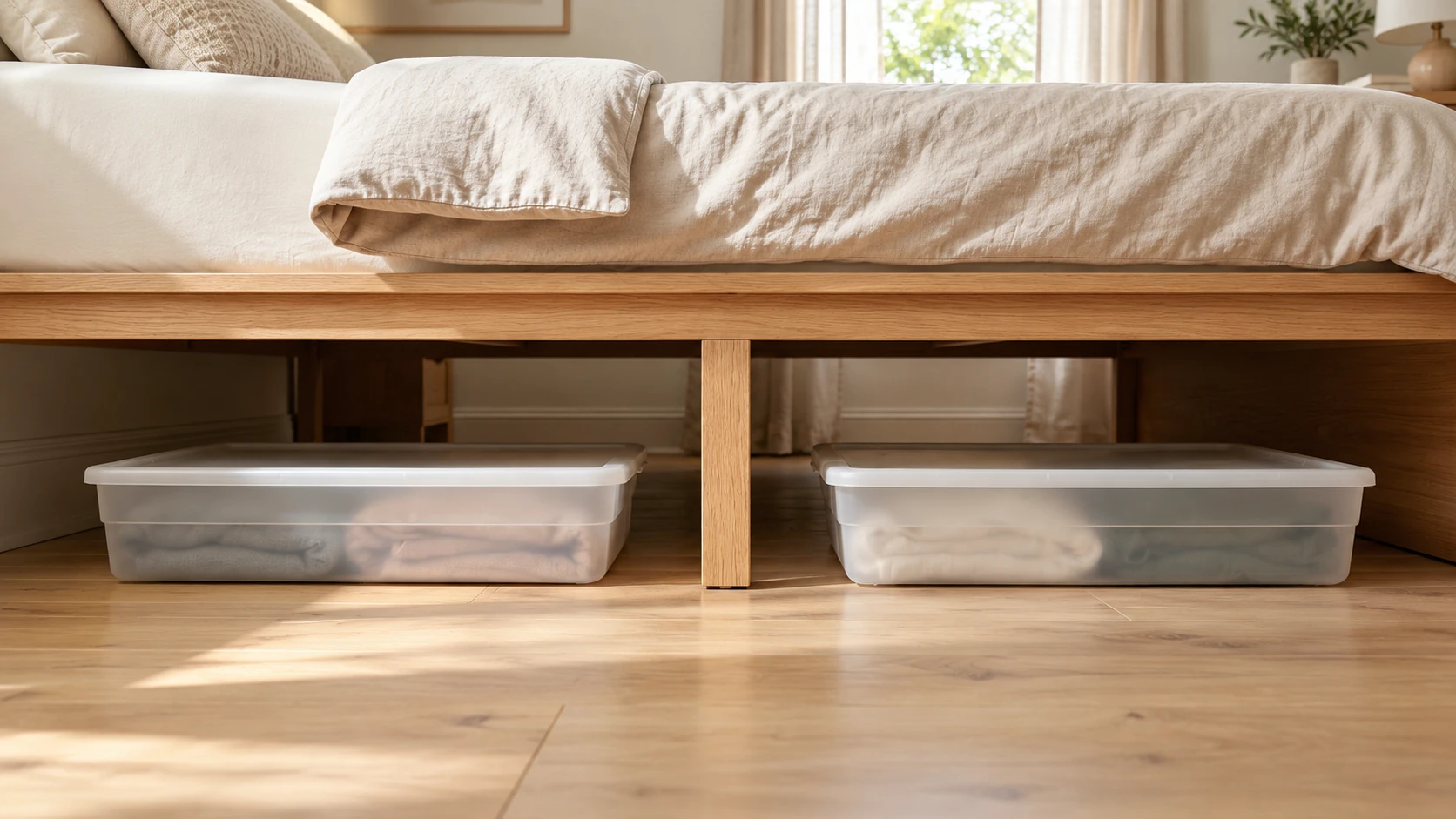
Measure these four things: usable height, entry width, usable depth, and pull-out space. Check side rails, center supports, legs, brackets, bed skirts, rugs, and floor-height changes along the route.
Measure the lowest usable clearance
Start with the opening where you intend to slide the storage container underneath.
Measure from the floor to the lowest obstruction along that route.
Check for:
- Bed-frame side rails or lower edges
- Center support rails
- Middle or corner support legs
- Low brackets or crossbars
- Bed skirts or fabric covers that may interfere with access
- Changes in floor height along the storage route
A bed may have generous space along its outer edge but less usable height farther inward.
Do not assume a container can pass beneath a center support simply because it fits through the side opening.
Measure usable width and depth
Next, check how much uninterrupted floor space exists beneath the bed.
A support leg may divide one large-looking area into several smaller spaces.
Measure each accessible section rather than treating the entire underside as one continuous storage zone.
Check whether a container can slide into the intended section without awkward turns around support legs.
Leave room to remove the container
A box may fit perfectly underneath your bed but still be unusable if there is not enough open floor space beside it.
Measure the space available to pull the container out.
Check nearby nightstands, dressers, walls, chairs, and doors.
A long storage bin that needs to come all the way out may not suit a narrow space between the bed and a dresser.
Compare external container dimensions
When shopping, compare the real available opening with the container’s complete external dimensions.
Pay attention to:
- Overall height, including wheels when present
- Lid thickness or raised edges
- Handles that extend beyond the body
- Full width and length
- The shape of a soft-sided case when filled
Do not rely on storage capacity or product photographs as substitutes for measurements.
Measure First: Record your usable entry height, accessible width and depth, lowest internal obstructions, and available pull-out space. Compare those measurements with the manufacturer’s dimensions for the exact container.
If any required measurement is missing or unclear, hold off on purchasing.
3. Check Flooring and Pull-Out Space
The floor under your bed affects how easy a storage container may be to move.
A container that slides or rolls smoothly across one surface may require more effort on another.
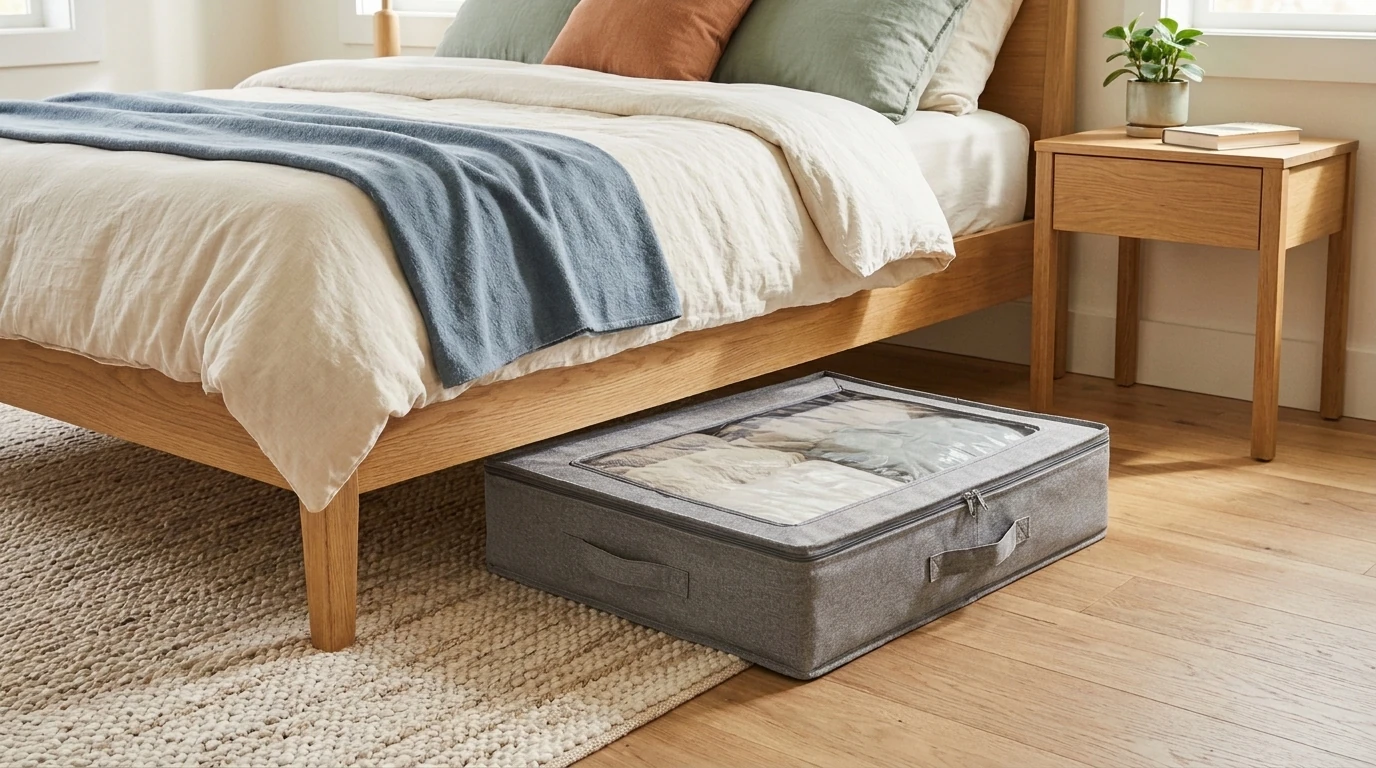
Hard floors
Rigid bins and suitable rolling containers can be practical on compatible hard floors.
However, smooth movement does not automatically mean that a particular container is appropriate for every wood, laminate, vinyl, or tile finish.
Check relevant manufacturer guidance and consider the condition of the floor.
Carpeted floors
Carpet adds another variable.
The carpet’s thickness and texture, the shape of the container, and the weight of its contents may affect how easily it moves.
Some containers may drag or catch even when their dimensions are correct.
Do not assume that fabric cases always slide more easily than plastic bins, or that wheels never work on carpet.
Actual performance depends on the specific setup.
Rugs and floor transitions
A container may move well underneath the bed but catch when it reaches a nearby rug.
The entire extraction route matters.
Do not evaluate only the surface directly beneath the bed frame.
Practical check: Before shopping, use an appropriately sized empty box or existing container to check the intended route. This may reveal obvious clearance and access problems, although it cannot prove how a future loaded product will perform.
4. What Should You Store Under Your Bed?
Now that you have checked the room and the physical space, consider the belongings you want to keep there.
The right items depend on how often you need them, whether you can retrieve them comfortably, and whether the storage method protects them appropriately.
Seasonal clothing
Clean, completely dry seasonal clothes may be suitable when stored in a container appropriate for the material and room conditions.
Keep the grouping simple so you know what is inside.
A clear label may make occasional retrieval easier.
Spare bedding and linens
Extra sheets, pillowcases, and suitable spare blankets can make sense when you need them occasionally.
Avoid packing them so tightly that the container becomes too tall or difficult to close.
Shoes and accessories
Suitable clean, dry shoes or accessories may work in a compartmented or rigid container.
Consider whether the items need their own protection or more accessible everyday storage.
Frequently used items
Under-bed storage is often convenient for belongings used occasionally, but that is not an absolute rule.
A compatible drawer or accessible container may work for regularly used items if opening, retrieving, and returning them is easy.
The deciding factor is whether the storage remains practical during normal use.
Items to think twice about
Be cautious about storing:
- Belongings that require frequent access when retrieval is difficult
- Heavy objects that make the container hard to move
- Damp or dirty fabrics
- Items that could be damaged by existing moisture conditions
- Fragile or valuable belongings without appropriate protection
- Anything that obstructs required equipment access or creates a safety concern
If your existing closet can hold some of these belongings more comfortably, improving that space may be a better choice. Our guide to small closet organization ideas explains how to make a reach-in closet easier to use.
The goal is not to put as much as possible beneath the bed.
It is to give suitable belongings a location that works.
5. Under-Bed Storage Ideas for Different Needs
Once you know that the space is usable and the belongings are suitable, choose a storage method that solves your actual problem.
Not every bedroom needs the same container.
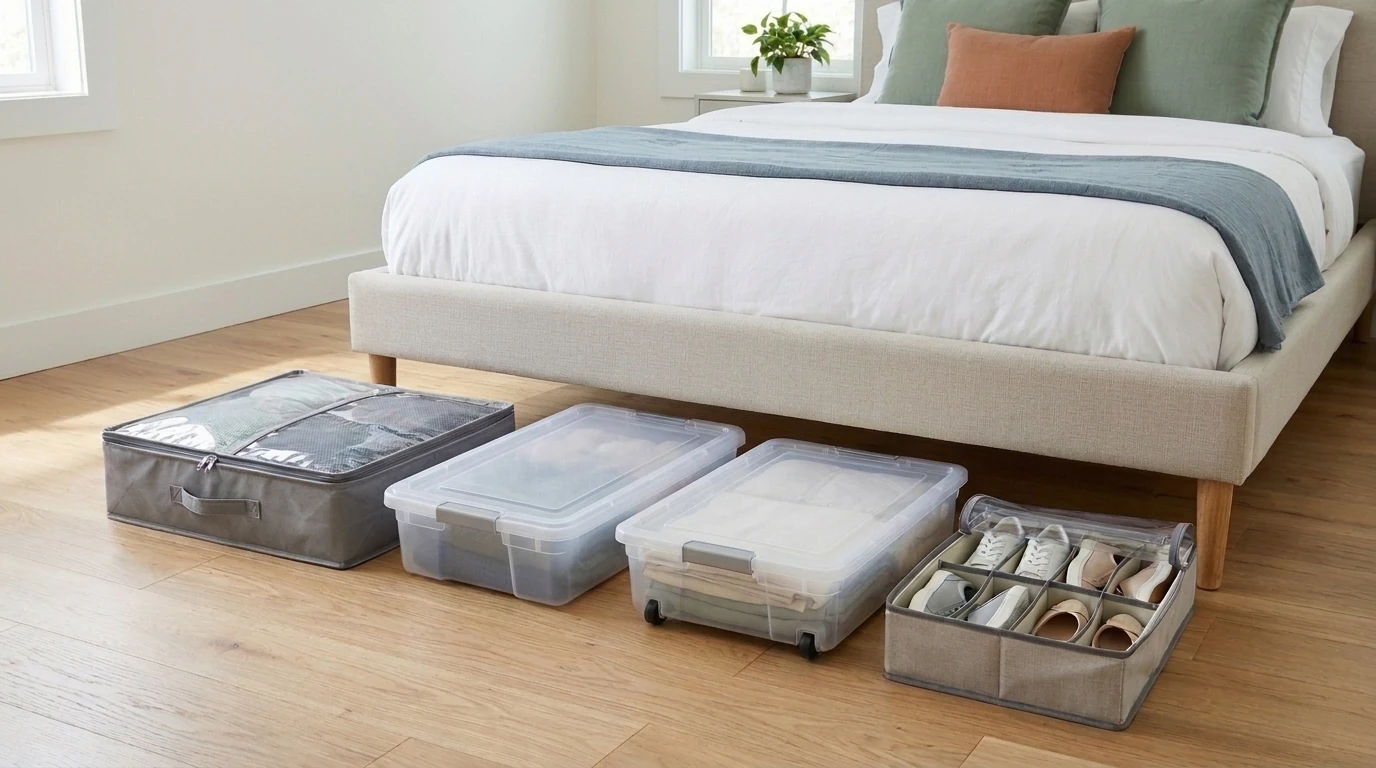
Idea 1: Low-Profile Fabric Storage Cases
A covered fabric case can be useful when you need a compact place for lightweight, compressible belongings.
Depending on the design, it may hold seasonal clothing, spare pillowcases, or clean bedding.
Some cases include handles, zippers, or a transparent section that makes their contents easier to identify.
Measure First: Check the case’s full external size and its expected filled shape.
Best For: Lightweight belongings that do not require a rigid container.
Skip If: The case bulges beyond the clearance, collapses during retrieval, or is unsuitable for the storage environment.
Compare fabric under-bed storage by listed height: Check your lowest usable clearance, support legs, filled shape and pull-out space before choosing. These are product heights, not guaranteed minimum bed clearances. Taller cases, especially the 8-inch option, need more room to enter and be removed.
- 3-inch Punemi structured under-bed case (opens in a new tab)
- 4.5-inch YearningHome structured cases (4-pack) (opens in a new tab)
- 5-inch Punemi structured cases (2-pack) (opens in a new tab)
- 6-inch TidyCorner structured cases (2-pack) (opens in a new tab)
- 6.7-inch Punemi structured cases (2-pack) (opens in a new tab)
- 8-inch TidyCorner structured cases (2-pack) (opens in a new tab)
The 8-inch TidyCorner option is listed at 38.5 inches long. Measure the extraction path and leave enough clear space to pull the filled case fully out.
Soft-sided does not automatically mean easier to use. A flexible case may fold or catch when you try to push it back underneath the bed.
No-buy alternative: Reuse an existing clean, suitable zippered storage case if it already fits and meets the contents’ storage needs.
Idea 2: Lidded Rigid Storage Bins
Rigid bins can provide structure when you want to keep items together without the container changing shape significantly.
They may be useful for suitable shoes, accessories, or seasonal belongings.
A lid can also help keep ordinary household dust off the contents, depending on the container’s design and closure.
But a rigid bin has little flexibility when the dimensions are wrong.
Measure First: Confirm the outside height with the lid installed, along with the full width, length, and usable pull-out route.
Best For: Belongings that benefit from a structured container and do not require difficult retrieval.
Skip If: The bin is too tall, blocks access to another container, or needs more opening space than you have.
One rigid option is the IRIS USA 40-qt latching bin, listed at approximately 6.3 inches tall externally with the lid in place. Confirm the complete entry and retrieval route before choosing it; a six-inch-high opening is not sufficient.
Bedroom
IRIS USA 40-Qt Under-Bed Storage Bin — Gray/Clear Single
Single clear/gray rigid under-bed storage bin with a latching lid. Use only where the fully closed bin fits and can be pulled out without forcing it.
Check on Amazon (opens in a new tab)A rigid bin should not be forced under a frame simply because it is close to fitting.
No-buy alternative: Check whether a suitable container already in your home passes the same measurements and retrieval checks.
Idea 3: Wheeled Under-Bed Storage Containers
Wheeled containers may make retrieval more convenient when the assembled product fits and the floor is compatible with its design.
They are worth considering when repeatedly lifting or dragging a container would be inconvenient.
Measure First: Check the complete assembled dimensions, including wheels, and the available extraction route.
Best For: Accessible under-bed spaces where the chosen product moves comfortably on the actual floor.
Skip If: The wheel assembly reduces clearance too much or the container remains difficult to move.
The next section explains the important checks for wheeled storage.
No-buy alternative: Test a suitable existing container before deciding that wheels are necessary.
Idea 4: Divided Under-Bed Shoe Storage
Divided storage can help keep suitable shoes in pairs instead of mixing them loosely inside one large box.
Some designs use fabric compartments, while others use rigid structures.
The useful feature is predictable organization. You should be able to find and remove a pair without emptying the container.
Measure First: Check the outer dimensions and the compartment size for the actual footwear.
Best For: Clean, dry shoes that fit the compartment layout and can be retrieved comfortably.
Skip If: The compartments distort the shoes, the container is awkward to remove, or the footwear needs different storage conditions.
For shoes that fit the individual compartments, a divided under-bed organizer such as the Onlyeasy two-piece set may make pairs easier to find. Check the organizer’s 5.9-inch external height and the dimensions of your actual footwear before considering it.
Bedroom
Onlyeasy Under-Bed Shoe Organizer — Linen-like Black, 2-Pack
Divided fabric under-bed shoe storage with two organizers, each with twelve compartments. Useful for clean, dry shoes that fit the compartments and can be retrieved comfortably.
Check on Amazon (opens in a new tab)No-buy alternative: Use an existing suitable box with simple separation if a specialized organizer would not improve access.
6. Under-Bed Storage With Wheels: When It Works
Under-bed storage with wheels solves a particular problem: moving a container in and out of a low space.
But adding wheels does not guarantee easier retrieval.
Before choosing a rolling container, check the assembled dimensions, floor conditions, contents, and how the unit opens.
Check total assembled height
The container must fit with its wheels attached and its normal lid or drawer configuration.
Do not compare the available bed clearance with an interior storage measurement or a product dimension that excludes the wheel assembly.
Check wheel and flooring compatibility
The same rolling container may behave differently on a smooth floor, low-pile carpet, or thick rug.
Wheel design, material, load, and floor conditions can affect movement.
Unless reliable manufacturer guidance or genuine physical testing supports it, avoid assuming that a particular wheel type will perform well on your floor.
Check the loaded container
A wheeled box that moves easily while empty may require more effort once it contains clothing, shoes, or bedding.
Evaluate the actual intended load without exceeding the manufacturer’s limits.
If the container catches, tips, or requires uncomfortable force, reconsider the setup.
Check drawer access
For drawer-style containers, consider what happens when you open the drawer.
Can it extend enough to reach the belongings?
Does a nearby piece of furniture block the opening?
Can the entire unit be moved for cleaning or repositioning when necessary?
Storage is less useful when the back of the drawer remains difficult to access.
Measure First: Confirm the fully assembled height, including the installed wheels and normal lid configuration, against the lowest obstruction and available pull-out space. The listed 10-inch height has not been independently confirmed to include the wheels.
Best For: Dry, suitable belongings in an accessible under-bed space where the filled unit moves comfortably on the actual floor.
Skip If: Your clearance is too low, the wheels catch or drag, the container tips, or moving it requires uncomfortable force.
For a fabric option with wheels, see Punemi 10-inch wheeled under-bed storage (2-pack) (opens in a new tab). Confirm the assembled dimensions and loaded retrieval before buying.
Avoid unsupported bed modifications
Bed risers and frame changes involve structural, stability, and manufacturer-compatibility questions.
Do not assume that lifting a bed is a universally suitable way to create storage clearance.
If the bed manufacturer’s instructions do not support the proposed change, choose another storage solution rather than improvising a structural modification.
7. The Loaded Retrieval and Return Test
Before deciding that a container is a successful storage solution, test how it works with its intended contents.
An empty container is only the beginning of the evaluation.
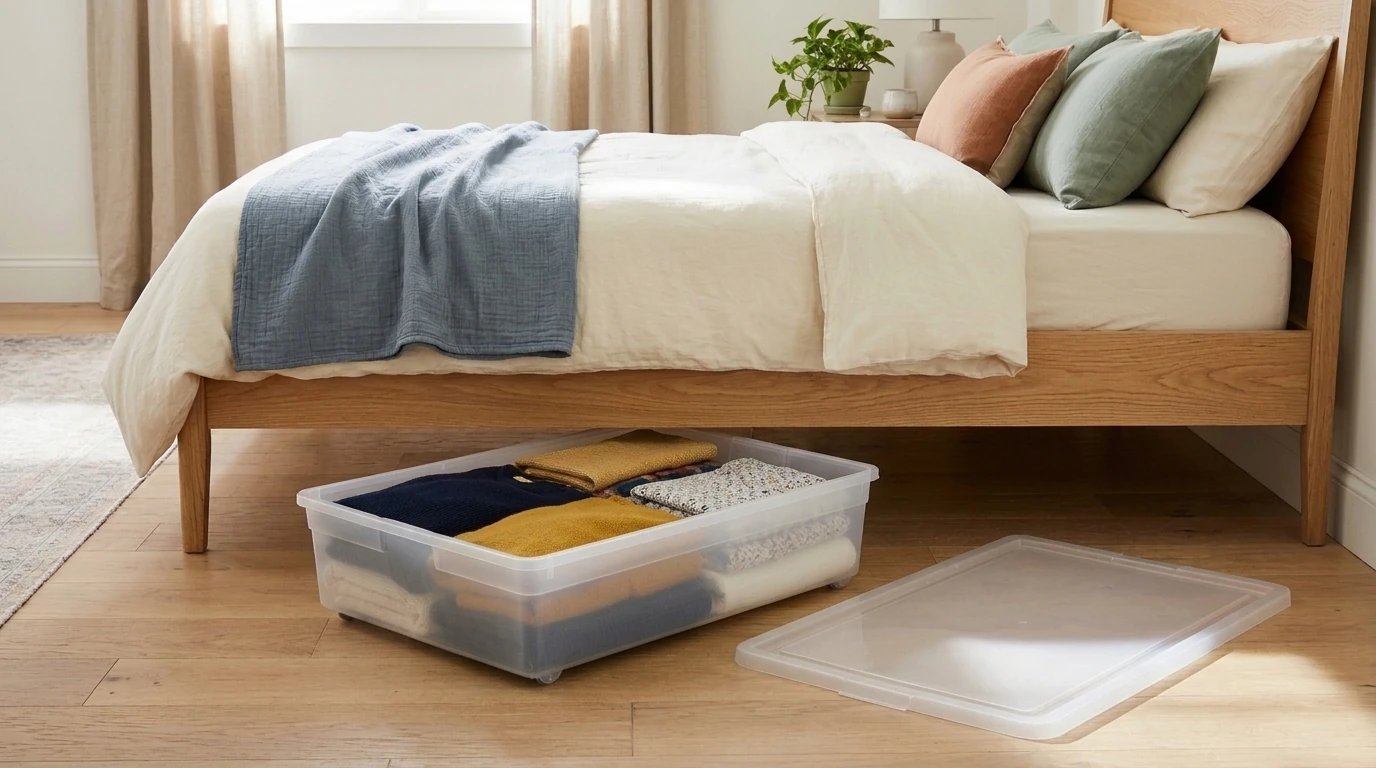
Step 1: Check the entry
Does the filled container pass through the intended opening without catching or needing to be forced?
If the contents cause a flexible container to bulge above the available clearance, the setup fails the fit check.
Step 2: Move it into position
Can the container reach its intended location without striking bed supports or requiring awkward maneuvering?
Step 3: Pull it out normally
Can the intended user retrieve it comfortably?
Watch for snagging, dragging, tipping, or contents shifting.
Stop if moving it requires unsafe or excessive force.
Step 4: Open and reach the contents
Can you open the lid, zipper, or drawer and access the item you need?
If you have to completely unpack the container to reach one item, consider whether a simpler arrangement would work better.
Step 5: Put the item back
Does the item return easily?
Can the container close without squeezing its contents into a precise arrangement every time?
Step 6: Return the container
Can you put the container back under the bed without forcing it, hitting the frame, or moving nearby furniture?
Keep: The filled container fits, moves comfortably, gives practical access to its contents, and returns to position normally.
Revise: Change the contents, placement, or container type when the problem is safely correctable.
Avoid: Choose another storage location when the physical space or retrieval effort makes the setup unsuitable.
This is a practical household self-check, not a substitute for manufacturer load ratings or product safety instructions.
8. Reuse, Buy, or Avoid
You do not need a new organizer simply because there is open space beneath your bed.
Use the actual problem to guide the decision.
| Your situation | Recommended starting point | When to skip |
|---|---|---|
| Low clearance | Measure for a low-profile covered case | No suitable container can enter or leave easily |
| Clear, accessible space | Reuse a compatible lidded container | Lid or rim catches the frame |
| Interested in wheels | Evaluate assembled height and real floor compatibility | Loaded container drags, catches, or requires excessive effort |
| Thick carpet | Test suitable containers on the actual floor | Extraction remains difficult |
| Seasonal linens | Choose suitable clean, dry storage | Room conditions threaten stored materials |
| Limited bedside room | Consider a smaller container or alternate access direction | No workable extraction path |
| Difficult floor-level access | Prefer a more accessible storage location | Retrieval causes discomfort or excessive effort |
Reuse first
An existing storage container that meets the requirements may be all you need.
Buy only to solve a specific problem
A new organizer is worthwhile when it provides something your existing setup does not, such as a compatible lower profile, a useful lid, or easier extraction.
Avoid when the space fails
If the bed clearance is too low, the route is blocked, or the container remains difficult to use, stop trying to make that location work.
A different storage area can be a better solution than a more complicated under-bed organizer.
9. Frequently Asked Questions
How do I measure under-bed storage clearance?
Measure from the floor to the lowest obstruction along the actual entry and storage route. Check bed rails, center supports, legs, and other structural features.
Compare that space with the complete external dimensions of the container, including any wheels and lid.
Also measure the floor area needed to remove it.
What under-bed storage works for low beds?
A low-profile container may work if its filled external height is within the measured clearance and it can be retrieved normally.
Soft-sided cases are one possibility, but they are not automatically compatible with every low bed.
If no suitable container can move in and out conveniently, use another storage location.
Are under-bed storage bins with wheels suitable for carpet?
Sometimes. Results depend on the container, wheel design, stored load, carpet characteristics, and extraction route.
Check manufacturer guidance when available and evaluate the actual loaded setup rather than assuming all wheeled bins perform alike.
Should under-bed storage containers have lids?
A lid can help keep ordinary dust off suitable contents, but it is not mandatory for every use.
Consider the stored items, the duration, and the protection they need.
A lid does not automatically make a container airtight, pestproof, or suitable for a damp environment.
What should not be stored under a bed?
Avoid storing damp belongings, items that could be damaged by the room’s conditions, or anything too heavy or awkward to retrieve comfortably.
Frequently used belongings may also be better elsewhere if the location is difficult to access.
How do I keep under-bed storage organized?
Keep similar belongings together, avoid overfilling containers, and use simple labels when the contents are not visible.
Most importantly, choose a system that makes items easy to remove and return.
A container that needs to be rearranged after every use is unlikely to remain convenient.
Choose Storage That Works Beyond the First Day
The best under-bed storage is not necessarily the largest bin or the container with the most compartments.
It is the option that fits the real space, suits the belongings, and remains easy to use after everything is inside.
Start by deciding whether the space should be used. Measure the clearance and extraction path. Consider what belongs there.
Then reuse what you have or choose a container that solves the actual problem.
And if the space is too difficult to access, leave it unused.
A bedroom does not become better organized simply because every available inch is filled.
Keep Building a Home That Fits
Explore practical organization guides built around real measurements, everyday routines, and usable space.