Inside Cabinet Door Storage That Fits, Closes, and Stays Easy to Use
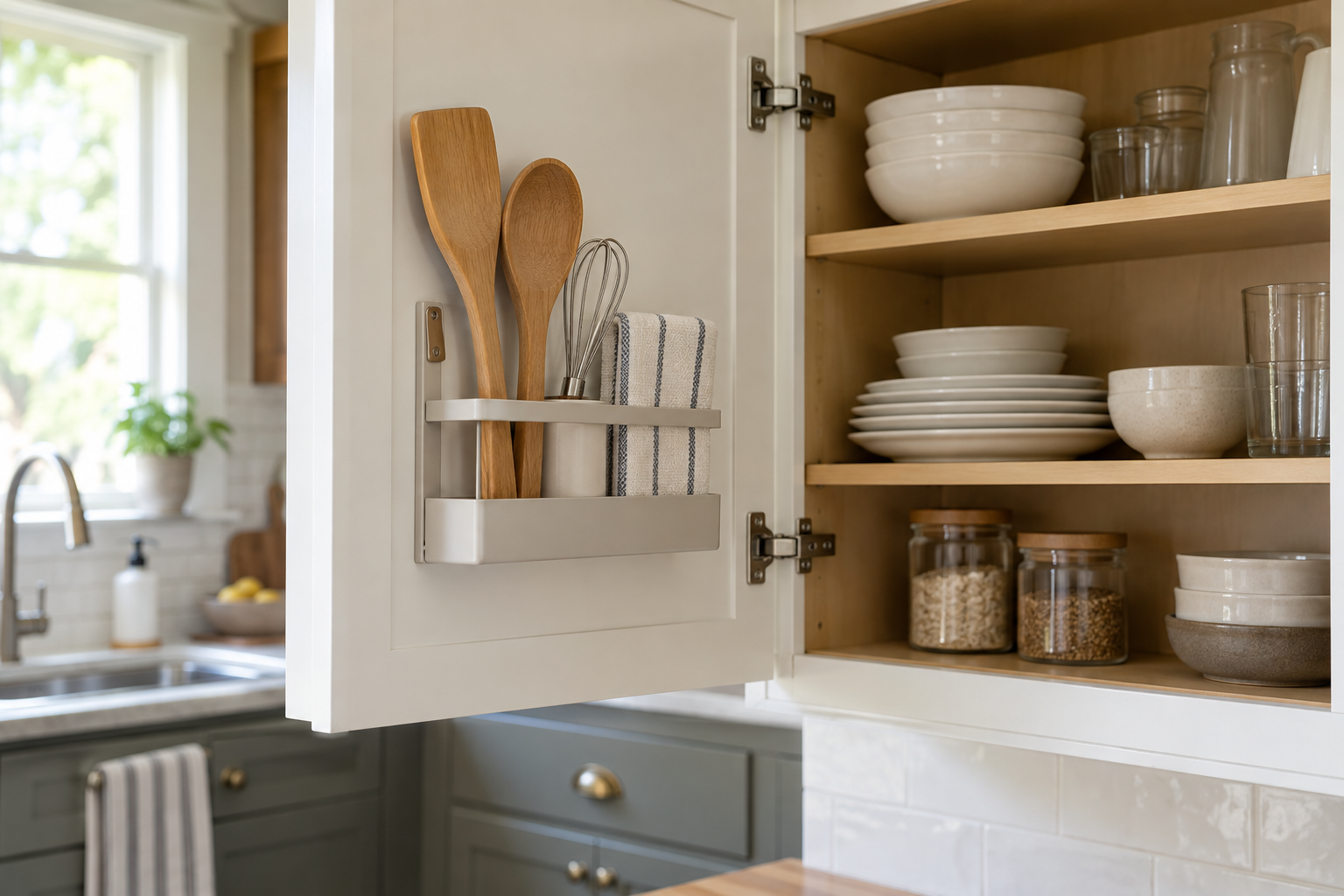
The inside of a kitchen cabinet door can look like free storage space. It is not.
Unlike a shelf or cabinet wall, the door moves. Anything you attach to it moves too. The organizer, the items inside it, the mounting method, the hinges, the cabinet shelves, and the objects already stored inside all have to work together every time the door opens and closes.
That is why good inside cabinet door storage starts with feasibility, not with finding an organizer.
Before adding anything, work through five decisions:
BELONG → FIT → MOUNT → MOVE → USE
First decide whether the item belongs on the door. Then check whether the complete loaded setup fits. Choose a mounting method that matches the actual door and surface. Test how the loaded door behaves in motion. Finally, make sure the storage is genuinely easier to use and reset.
A cabinet door does not become useful storage just because something can be attached to it. It earns that role only when the finished setup works as part of the cabinet.
Quick Navigation
Affiliate disclosure: This guide contains affiliate links. If you purchase through one of our links, OrganizeSmartly may earn a commission at no additional cost to you. We recommend products based on problem-solution fit, dimensions, and practical usefulness. Read the disclosure.
Before You Use the Door, Decide What Belongs There
The first question is not, “What organizer can I fit here?”
It is, “What should this door be responsible for?”
Moving an item from a shelf, drawer, or countertop to a cabinet door can improve access, but it can also create a new layer of clutter. Before using the door, look at the job the item already has in your kitchen.
Good door-storage candidates usually have a clear reason to be close to that cabinet or the task performed nearby. They also need to be practical to secure, retrieve, and return while the organizer moves with the door.
An item is a weaker candidate when storing it there would:
- separate it from the rest of a system that already works;
- make it harder to see or return;
- require awkward stacking or overpacking;
- create a spill, breakage, or retention problem when the door moves;
- turn the door into a miscellaneous holding area instead of solving a specific storage problem.
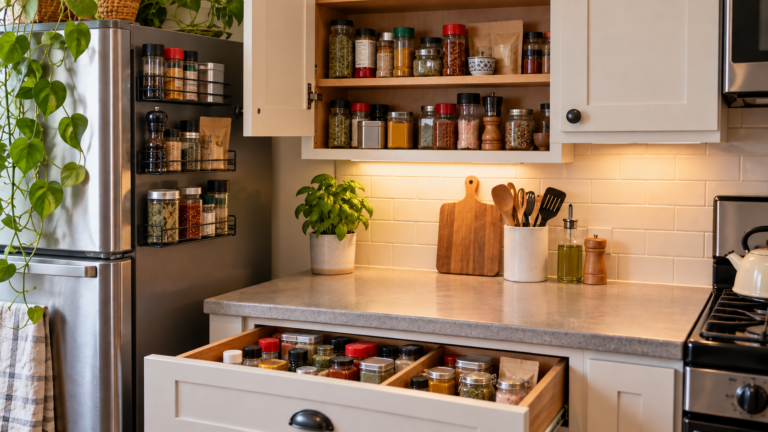
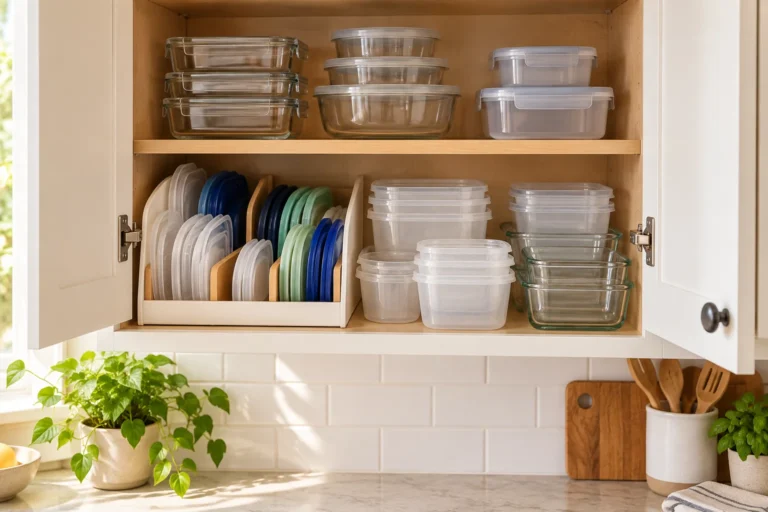
For example, spices may physically fit on a cabinet door, but whether they belong there is part of the larger spice-storage decision. Food-container lids may also fit, but their organization still needs to work with the containers they belong to. The same distinction applies to cleaning supplies, drawer tools, and trash-related storage.
This guide is concerned with whether the door surface works for the proposed storage. If the real problem is cabinet-wide rather than door-specific, start with the guide to organizing kitchen cabinets in a small kitchen.
Best For: Small, task-related items that can be securely retained and are easier to reach on the door than in their current location.
Skip If: The door would merely become another place to put unrelated things, or if moving an item there breaks a category system that already works.
Accessibility check: Think about the actual person using the cabinet. Can they see, reach, grip, remove, and return the item comfortably from the door position? There is no useful universal reach or accessibility threshold for every kitchen and every user.
Measure the Door and the Space Behind It
Once something passes the BELONG test, the next question is not simply whether the organizer fits on the visible part of the door.
It is whether the loaded organizer fits inside the complete cabinet when the door closes.
This is where many apparently clever cabinet-door ideas fail.
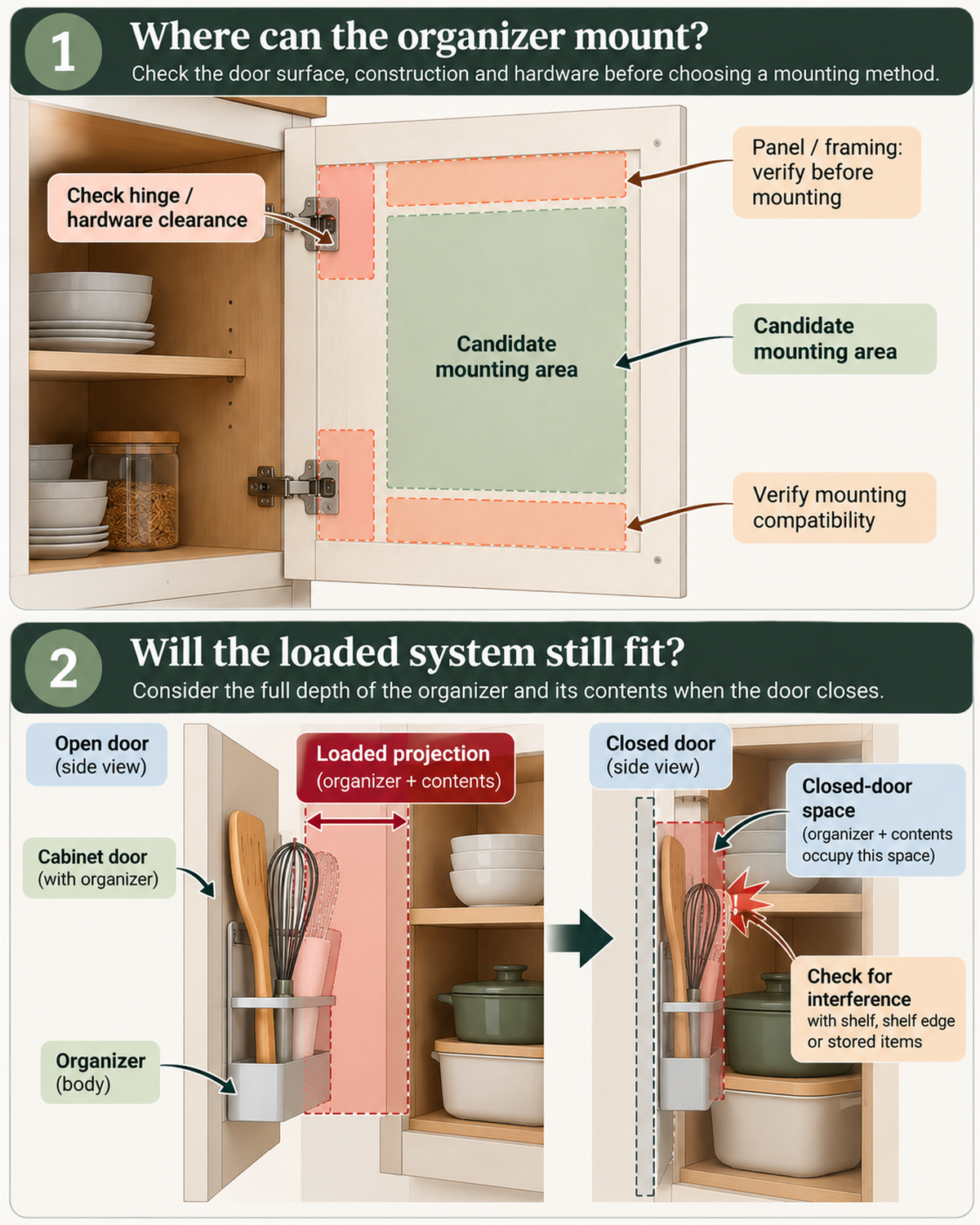
Start with the usable door area
Look at the actual inside surface rather than treating the whole door as one rectangle.
Possible obstructions can include:
- raised or recessed door details;
- rails, stiles, or framing;
- hinges and hinge hardware;
- handles or fasteners that extend through the door;
- catches, dampers, or other cabinet hardware;
- areas where the selected mounting method cannot be used.
The organizer has to fit the available mounting area, but that is only the first layer.
Measure the space the loaded organizer will occupy
Next, look inward.
A shallow organizer may appear to fit when empty but interfere with a shelf, shelf edge, face frame, or stored object once items are placed inside it.
The useful measurement is therefore not just the organizer’s depth. It is the loaded projection of the complete system.
An item can protrude above, beyond, or in front of an organizer. A pocket may bulge. A roll or container may sit farther out than the rack holding it. Those details matter when the door reaches its fully closed position.
Measure First
Before committing to a cabinet-door setup, verify:
- the usable width and height of the intended mounting area;
- hinges, framing, hardware, and other no-go zones;
- the organizer’s stated dimensions;
- the space occupied by the items once the organizer is loaded;
- shelves, shelf contents, and other interior objects that could occupy the same space when the door closes;
- any product-specific load or installation requirements supplied by the manufacturer.
Do not assume a universal amount of clearance is enough. Cabinet construction, shelves, organizers, and stored items vary too much for one number to be meaningful.
A setup passes FIT only when the intended loaded configuration can occupy the space without forcing other parts of the cabinet to accommodate it.
Choose a Mounting Method That Matches the Door
An organizer can fit perfectly and still be the wrong choice if its mounting method is incompatible with the cabinet door.
The mounting decision depends on the actual door, its surface or construction, the product instructions, and, for renters, what modifications are permitted.
Adhesive and no-drill storage
Adhesive-mounted storage can avoid drilling, but that does not make every adhesive organizer suitable for every cabinet surface.
Surface compatibility, cleaning or preparation instructions, installation conditions, cure time, removal procedure, and stated load limits are product-specific.
Terms such as “removable” or “damage-free” should not be treated as universal promises for every finish.
If you rent, verify both the product instructions and any relevant lease or property rules before treating an adhesive installation as renter-safe.
The Command Clear Large Caddy (HOM15CLR-ES) is one verified example of this route. Its value here is not that adhesive is universally better, but that the mounting method comes with specific surface, preparation, waiting, and removal requirements that need to work on the actual cabinet door.
Measure First
Confirm a compatible smooth indoor mounting surface and enough flat area for the 8.6 in W × 3.12 in H × 2.95 in D caddy. Keep the adhesive-strip tabs accessible so they can stretch at least 15 inches during removal, then compare the loaded caddy’s projection with shelves, stored items, hardware, and full door closure.
Best For
Small general supplies on a compatible smooth indoor cabinet surface when drilling is undesirable and you can follow the manufacturer’s surface-preparation, one-hour wait, and removal instructions.
Skip If
The surface is wallpaper or otherwise outside 3M’s guidance, the removal path for the strips will be blocked, the loaded caddy interferes with door closure or cabinet contents, or adhesive mounting is not permitted for the property.
Renter consideration: 3M states that the caddy removes cleanly when used as directed, but that should not be treated as a blanket guarantee for every cabinet finish or lease. Verify both surface compatibility and property rules before installation.
Kitchen
Command Clear Large Caddy (HOM15CLR-ES)
A clear adhesive caddy for compatible smooth indoor surfaces that installs without drilling or tools.
Check on Amazon (opens in a new tab)Screw-mounted storage
A screw-mounted organizer can provide a different installation route, but it requires more information about the actual door.
Before drilling, the organizer’s instructions need to be checked against the door’s construction, usable mounting location, hardware requirements, and any applicable installation limitations.
There is no universal safe screw length or minimum cabinet-door thickness that belongs in a general guide. Those values have to come from evidence relevant to the specific installation.
For renters, screw mounting should not be described as renter-safe unless the modification is explicitly acceptable for that property.
Over-cabinet-door or hook-on storage
Some organizers use the top edge of a cabinet door rather than adhesive or screws.
That still requires a fit check.
The hanger, door edge, surrounding cabinet geometry, and any protective material supplied with the organizer all need to work together without preventing normal closure or creating another interference point.
The Spectrum Grid Over-the-Cabinet Storage Basket, Large is one verified example of the hanging route. Because the basket itself is 6.5 inches deep before contents are added, the loaded fit matters more than the fact that no drilling is required.
Measure First
Check that the hanging bracket fits the cabinet door cleanly, then compare the basket’s 6.5-inch depth plus the intended contents with the shelf setback and closed-door space. Confirm that the bracket and loaded basket do not interfere with hinges, shelves, stored items, or full closure.
Best For
A cabinet door that can accept the hanging bracket cleanly and has enough interior depth for the loaded basket, especially when you want a no-drill mounting route.
Skip If
The bracket does not fit the door securely, the loaded basket collides with shelves or contents, the door no longer closes or moves normally, or you need a verified numerical product load limit.
Renter consideration: No drilling is required, but that alone does not guarantee zero finish wear or universal rental approval. Check the bracket’s contact with the door finish and any property or lease rules before treating it as renter-friendly.
Kitchen
Spectrum Grid Over-the-Cabinet Storage Basket, Large
A steel over-cabinet basket that hooks over a standard cabinet door to add storage without drilling or tools.
Check on Amazon (opens in a new tab)Renter-safe is a filter, not a product type
“Renter-safe” should be treated as a conditional decision.
The same mounting method may be appropriate on one door and unsuitable on another. Surface finish, product instructions, removal method, lease rules, and required modifications all affect the answer.
That makes renter-safe part of the MOUNT decision rather than a blanket label applied to every adhesive or non-drill organizer.
Load It, Then Test the Moving Door
A cabinet-door organizer is not finished when it is attached.
It still has to survive the part that distinguishes door storage from ordinary storage: the door moves.
LOAD matters across FIT, MOUNT, and MOVE because the behavior of an empty organizer may tell you very little about the finished setup.
Once installed according to the applicable instructions, evaluate the system with the type of items it is actually intended to hold and within any relevant manufacturer limits.
Then test the cabinet as a moving system.
Open the door gradually. Close it normally. Check the fully closed position. Repeat the movement while paying attention to what changes.
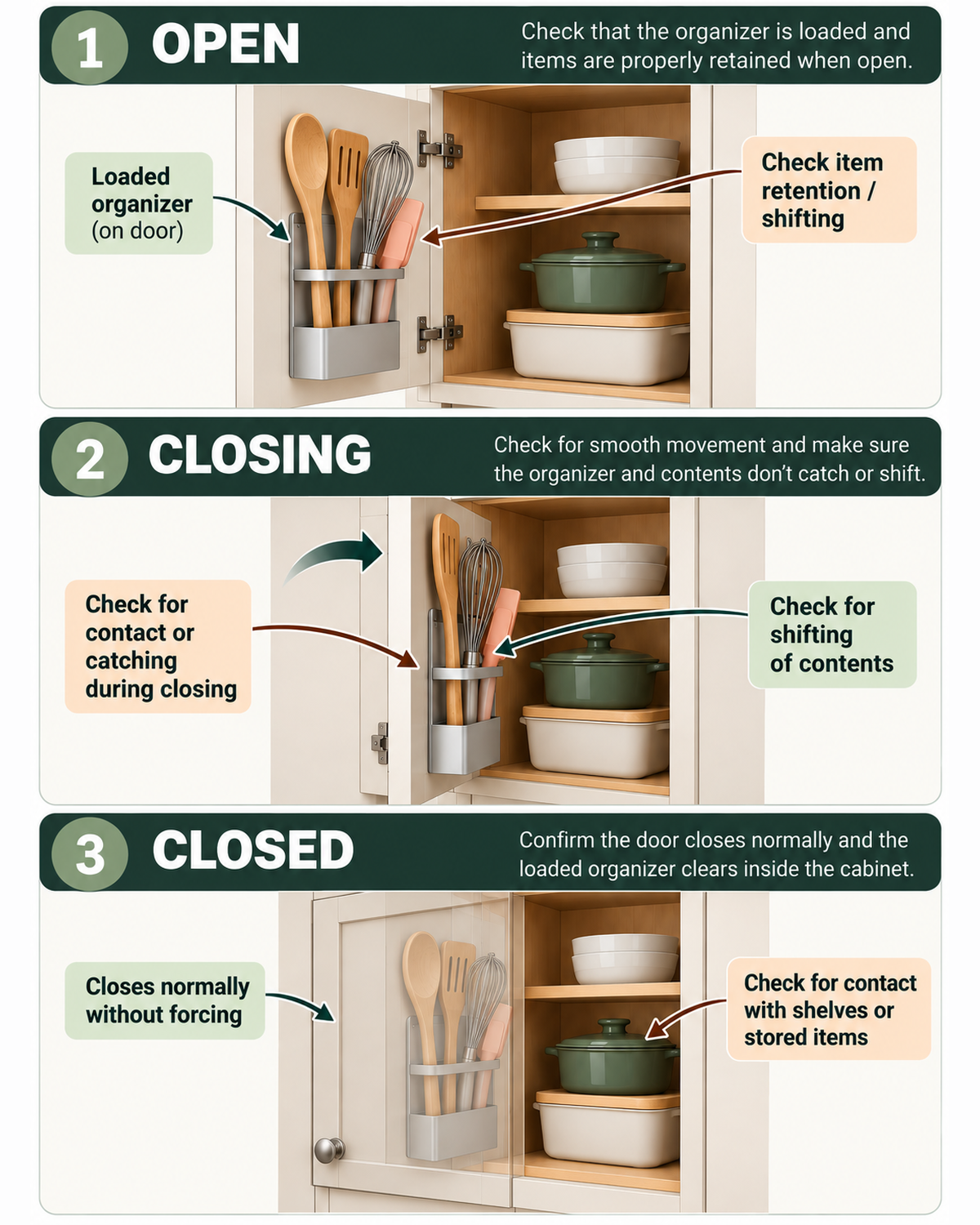
Watch and listen for:
- contact with shelves or stored items;
- dragging or catching;
- contents shifting or escaping their retainers;
- rattling or swinging that makes the setup impractical;
- mounting points that do not remain stable during normal use;
- a door that now feels or behaves noticeably different;
- an organizer or stored item that prevents normal closure.
Do not force a door closed to prove that a storage idea “fits.” That is the cabinet equivalent of sitting on an overpacked suitcase and declaring the packing strategy successful.
If the door fails only after it is loaded, the storage system fails the fit test too.
There is also no universal cabinet-door load or hinge-capacity number that can be applied here. A product-specific load claim does not automatically establish what every cabinet door or hinge can safely accommodate.
The useful goal is simpler: test the actual intended configuration and reject arrangements that depend on unsupported structural assumptions.
Make the Storage Easy to Retrieve and Reset
Passing BELONG, FIT, MOUNT, and MOVE still does not guarantee that the storage is useful.
The last test is whether someone can live with it.
Door storage should make an item easier to retrieve and reasonably easy to put back. A setup that looks tidy after installation but becomes frustrating during normal use is not solving the storage problem.
Check what happens during a real task.
Can you recognize what you need without unloading other things first? Can you remove one item without pulling several with it? Can you return it without carefully rebuilding the arrangement?
Also consider how far the door needs to open before the contents are accessible. An organizer may technically be within reach but still require an inconvenient door position or awkward body movement.
For the intended user, consider:
- visibility;
- reach;
- grip;
- removal effort;
- return or reset effort;
- whether frequently used items are placed near the task that uses them.
Accessibility should be evaluated around the actual user and kitchen. A universal “accessible height” or one-size-fits-all ergonomic rule would be misleading here.
Best For: Storage that reduces searching or reaching while remaining simple to refill and reset.
Skip If: Every retrieval disturbs neighboring items, the organizer has to be overpacked to be worthwhile, or returning items is harder than their previous storage method.
A system passes USE when it stays practical after the novelty of installing it has worn off.
Inside Cabinet Door Storage Ideas That Pass the Fit Test
The strongest inside cabinet door storage ideas are not defined by a particular product. They are defined by a problem the door can solve without failing the five-stage test.
Here are several storage roles worth evaluating.
1. A shallow pocket for small, flat supplies
A shallow pocket or caddy can turn a door into a defined home for small supplies that otherwise disappear behind larger objects.
The important word is shallow. The storage should use the door without consuming so much interior depth that it conflicts with shelves or cabinet contents.
Best For: Small, relatively flat items used near the cabinet.
Measure First: Door mounting area, pocket dimensions, loaded projection, shelf position, and the space occupied by nearby cabinet contents.
Skip If: The pocket needs to bulge outward to hold the intended items or becomes a catch-all for unrelated supplies.
2. A narrow holder for rolls, bags, or similar supplies
Longer kitchen supplies may be candidates for door storage when the holder keeps them retained during movement and the loaded depth remains compatible with the cabinet interior.
The advantage is not simply getting them off a shelf. It is giving a frequently used supply a defined location that does not interfere with the rest of the cabinet.
Best For: A small number of related items that are easy to remove individually.
Measure First: Holder dimensions, the dimensions and projection of the intended contents, nearby shelves, and closure space.
Skip If: Items can slide out as the door moves, interfere with the cabinet interior, or require overfilling the holder.
3. Small task-specific tools on a secured hook or rail
A cabinet door can sometimes work as a task station for a few lightweight tools with secure hanging points.
This is most useful when the tools naturally belong near the cabinet rather than being moved there solely to free another space.
Best For: A limited set of small tools associated with a nearby task.
Measure First: Mounting area, loaded hanging length, movement during opening and closing, and potential contact with shelves or cabinet contents.
Skip If: Tools swing excessively, detach easily, interfere with the cabinet, or would work better as part of the kitchen-drawer system.
4. A slim holder for lightweight flexible items
Flexible items such as reusable bags or similar compact kitchen accessories may work on a door when they can be retained without creating a bulky bundle.
This type of storage is most successful when the organizer controls the contents instead of allowing them to expand into the cabinet.
Best For: Lightweight flexible items that can remain contained in a shallow footprint.
Measure First: Loaded thickness, retention, door movement, and closed-door clearance.
Skip If: Contents expand unpredictably, spill out during movement, or require frequent compression to make the door close.
5. A category-specific door zone that passes its own system test
Spices, food-container lids, cleaning supplies, and trash-related supplies can all appear in cabinet-door-storage inspiration. None of them should automatically be moved to the door simply because organizers exist for them.
For each category, first decide whether the door is the right surface. Then apply the rules of the category itself.
A spice system still needs to work as a spice system, so use the spice-storage guide for the full category decision. Lids still need to stay coordinated with the container workflow, which is covered in the food-storage-container and lid guide. Under-sink door storage still has to respect plumbing and cleaning access, covered in the under-sink organization guide. A door-mounted trash solution belongs to the larger question of where to put a trash can in a small kitchen.
That separation keeps this guide focused on the door surface instead of turning it into a second version of every other kitchen-organization guide.
What to Skip Even If It Technically Fits
A door can pass a quick tape-measure test and still be a poor storage surface.
Skip or reconsider a setup when:
- the door has to be pushed, lifted, or forced into its closed position;
- the intended load depends on an unsupported assumption about the door, hinges, fasteners, adhesive, or organizer;
- items are not adequately retained while the door moves;
- breakable, spill-prone, or otherwise vulnerable contents are likely to shift during normal use;
- sharp items cannot be securely retained and safely retrieved;
- the organizer interferes with hinges, hardware, shelves, or stored items;
- the organizer fits only when it is empty;
- the storage makes other cabinet contents harder to reach;
- the mounting method conflicts with the actual surface or product instructions;
- the installation requires a modification that is not acceptable for the rental or property;
- retrieval and reset are worse than the original storage location;
- the idea requires custom woodworking or structural modification beyond the scope of this guide.
“Technically fits” is therefore not the same as “works.”
The better standard is whether the door can carry out its normal job while the storage system carries out its own.
Which Cabinet-Door Storage Method Should You Try?
There is no single best mounting method for every kitchen cabinet door.
Use the method that survives the relevant checks.
| Method | Consider it when | Skip or reconsider when | Evidence to verify |
|---|---|---|---|
| Adhesive-mounted | The product is intended for the actual surface and avoids an unwanted permanent modification | Surface compatibility, removal risk, installation conditions, or rental rules are uncertain | Manufacturer surface, preparation, installation, removal, and load guidance |
| Screw-mounted | The specific door and organizer support the required installation and modification is acceptable | Door construction, fastener requirements, installation location, or permission is uncertain | Manufacturer installation instructions and information relevant to the actual door |
| Over-door / hanging | The door edge and cabinet geometry allow the hanger and loaded organizer to operate normally | The hanger prevents closure, creates contact, or does not suit the door | Product dimensions, installation instructions, door fit, and loaded movement |
| No door organizer | Another location already works better or the door cannot pass the full test | There is no reason to force a door-storage solution | Existing storage performance and the BELONG → FIT → MOUNT → MOVE → USE test |
The last option matters.
Using no organizer is a successful result when the door is the wrong storage surface. The goal is not to maximize the number of organizers in a small kitchen. Humans have already invented enough objects whose main purpose is to hold other objects.
The goal is to improve the kitchen.
Frequently Asked Questions
What is the best way to use the inside of a kitchen cabinet door for storage?
Start with the item and the cabinet rather than the organizer.
Decide whether the item belongs on the door, verify the complete loaded fit, choose a compatible mounting method, test the loaded door in motion, and make sure the system remains easy to use.
The best method depends on the specific cabinet, item, organizer, mounting requirements, and user.
How do I know whether an inside cabinet door organizer will fit?
Measure both the usable mounting area and the space the loaded organizer will occupy when the cabinet is closed.
Account for hinges, door framing, shelves, cabinet hardware, stored items, the organizer itself, and any contents that project beyond it.
Do not judge fit from the organizer’s empty dimensions alone.
How much weight can a kitchen cabinet door hold?
There is no reliable universal number for every cabinet door.
Door construction, hinges, installation, organizer design, mounting method, and other factors vary. Product-specific load information should be verified from the relevant manufacturer, and it should not be treated as a universal cabinet-door or hinge capacity.
Are adhesive cabinet-door organizers renter-safe?
Not automatically.
Check the product’s stated surface compatibility, installation and removal instructions, the actual cabinet finish, and any relevant rental or lease rules.
“Adhesive,” “removable,” and “no drill” do not by themselves guarantee damage-free removal from every surface.
Can I use the inside of a cabinet door for spices?
Possibly, if the door passes the BELONG, FIT, MOUNT, MOVE, and USE tests.
But spice organization is a category decision as well as a surface decision. If moving spices to the door makes them harder to identify, refill, or keep together, another spice-storage route may work better. See the small-kitchen spice-storage guide for the full system.
Can I store food-container lids on a cabinet door?
A door-mounted lid holder can be evaluated with the same framework, but lid storage still has to work with the container system as a whole.
The door may be a good surface for some kitchens and the wrong one for others. For the full category workflow, use the food-storage-container and lid organization guide.
Can I use an under-sink cabinet door for storage?
The door itself still needs to pass the same surface test, but under-sink storage adds another layer of constraints.
Plumbing, cleaning access, the items stored below the sink, and the larger under-sink system remain separate considerations. See the under-sink organization guide for that full decision.
What about DIY inside cabinet door storage?
Simple low-modification approaches can still be evaluated with the same framework, but this guide does not cover custom woodworking or structural cabinet modifications.
For any mounted component, verify the relevant door, surface, fastener, adhesive, or product requirements rather than relying on a generic DIY measurement or load rule.
Treat the Door Like Part of the Storage System
Good inside cabinet door storage is not about covering every available inch.
It is about using a moving surface without making the cabinet harder to operate.
Start with what BELONGS there. Check the full loaded FIT. Use a MOUNT that matches the actual door and situation. Test how the system MOVES once it is loaded. Then make sure it remains easy to USE and reset.
If the idea fails at any stage, changing the organizer is only one option. The better answer may be a different item, a different mounting route, a different storage surface, or no door storage at all.
A useful cabinet door is not the fullest one. It is the one that still closes, moves, and works without a fight.