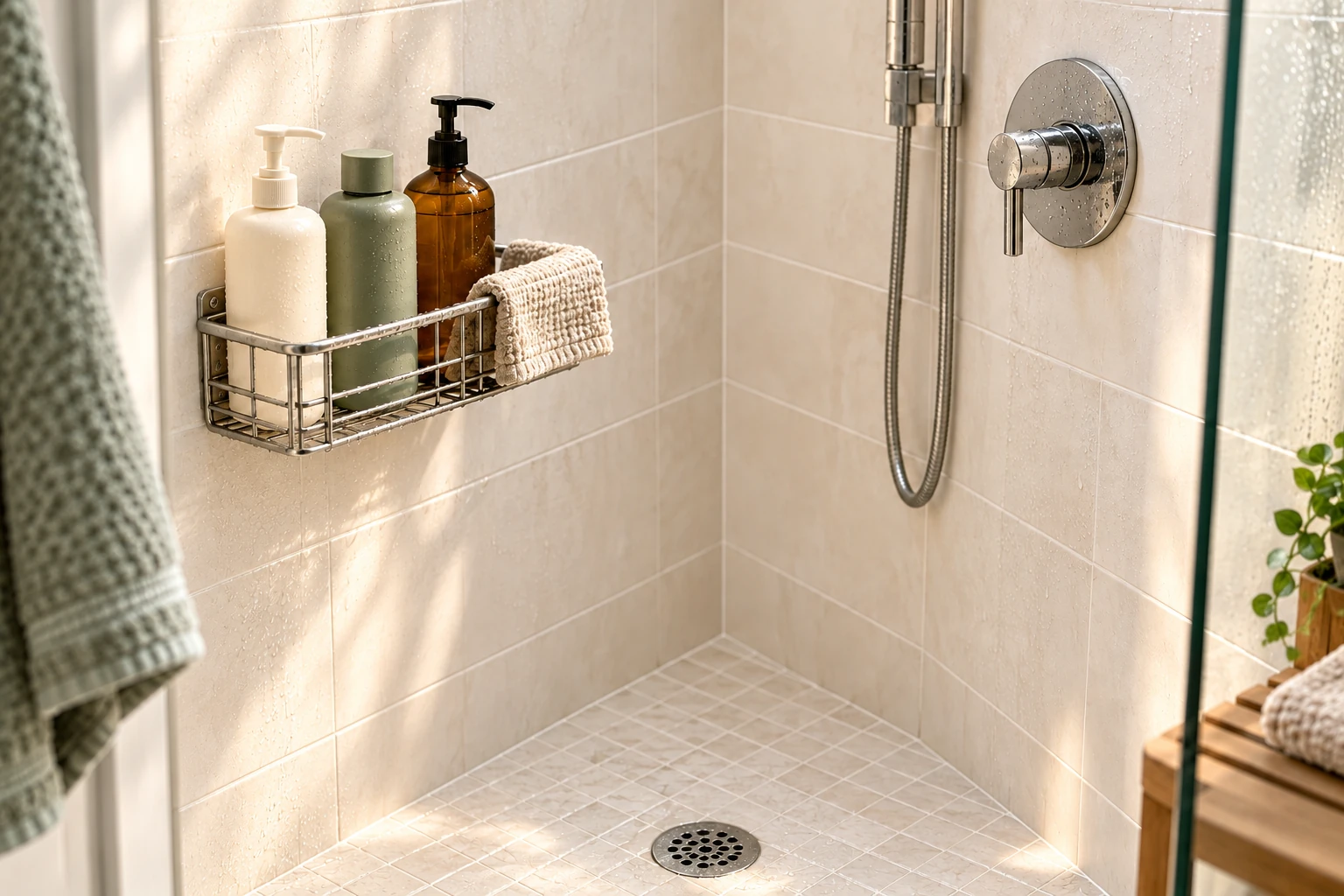
Shower Storage Ideas: What Should Stay, What Should Move Out, and What Actually Fits
A shower can look short on storage when the real problem is that too many things are competing for the same wet-zone space.
That distinction matters. The most useful shower storage ideas are not automatically the ones that add another shelf, basket, or caddy. Sometimes the better answer is to keep fewer things in the shower. Sometimes it is to carry one category in only when you need it. And sometimes you do need permanent storage, but only after you know which parts of your shower can actually support it without getting in the way.
Before you shop, work through the shower you already have: what you use, what needs to stay within reach, what can move out, and which storage routes still make sense once doors, curtains, controls, cleaning, and installation conditions are considered.
Affiliate disclosure: This guide contains affiliate links. If you purchase through one of our links, OrganizeSmartly may earn a commission at no additional cost to you. We recommend products based on problem-solution fit, dimensions, and practical usefulness. Read the disclosure.
What actually needs to be reachable in the shower?
Start with the products and tools currently stored in the shower or routinely brought in with you.
Do not start with organizers.
For each item, ask one question:
Do I need this while I am actually bathing?
If the answer is no, route it out of the retained shower inventory.
That does not mean you have to decide its permanent home right now. It simply means the shower does not need to spend space storing it.
Examples may include unopened replacements, occasional treatments, extra bottles, duplicate products, or items someone placed in the shower because there was nowhere obvious to put them.
If the answer is yes, keep the item in your bathing-use inventory and move to the next decision.
This step can reduce the problem before you add a single organizer.
In a small shower, that can keep you from adding storage capacity for items that never needed to live there in the first place.
Keep special items out of the default shower-storage pile
Not everything that is used in a bathroom should be treated like an ordinary shampoo bottle.
Medicines should be stored according to their specific label instructions. A damp bathroom environment can be unsuitable for some medications.
Ordinary plug-in electrical appliances also do not belong in generic wet-zone storage planning. A CPSC staff household-electrical-safety checklist notes the shock hazard created when a plugged-in small bathroom appliance falls into water, even when the appliance itself is switched off.
The point is not to turn shower organization into a safety manual. It is simply to keep items with special storage conditions out of an ordinary toiletries decision.
Should the items you keep stay in the shower or travel in?
Now look only at the items that truly need to be available while bathing.
For each one, decide whether it needs a permanent wet-zone home.
STAY
Choose STAY when the item needs to remain in the shower between uses and permanent storage makes the routine easier.
That may make sense when:
- the item is used during most showers;
- carrying it in and out would create more work than leaving it there;
- there is a workable storage route in the shower;
- the item can be retrieved and returned without interfering with normal use;
- the proposed storage does not create a worse cleaning problem.
CARRY-IN
Choose CARRY-IN when the item is needed during bathing but does not need to live permanently in the wet zone.
This can be especially useful when:
- the shower is very small;
- there is no suitable mounting surface;
- a hanging caddy conflicts with the showerhead or hose;
- floor storage would use needed standing space;
- several people use the same shower but do not need all products stored there at once;
- removing the storage after use makes cleaning simpler.
A portable caddy or tote is therefore not a consolation prize. In some showers, it is the most workable storage route.
The goal is not to maximize the number of items that can remain in the shower. It is to make the bathing routine work with the least unnecessary storage burden.

Map the shower you actually have
Once you know what needs to stay, stop thinking about generic “bathroom wall space.”
A shower is a moving, wet, fixture-filled space. The same organizer can be workable in one shower and unusable in another because the host surface, enclosure, controls, or hardware are different.
Record what your shower actually gives you.
Start with the enclosure
Is it:
- a tub-shower with a curtain;
- a tub-shower with sliding doors;
- a small enclosed stall with a hinged door;
- a frameless or fixed glass panel;
- an open or walk-in shower;
- a shower with an existing niche, shelf, or bench?
This changes which storage routes even exist.
Check the surfaces
Notice:
- smooth versus textured wall surfaces;
- tile and grout layout;
- seams and joints in manufactured surrounds;
- glass panels or doors;
- corners;
- ledges;
- the floor or tub edge;
- usable vertical space.
Do not assume that a product labeled “suction,” “adhesive,” or “no-drill” works on every version of those surfaces. Exact compatibility has to come from the instructions for the exact product you eventually consider.
Check the hardware
Look at:
- the showerhead and arm;
- a handheld shower and hose;
- the handheld dock or rail;
- faucet and diverter controls;
- door handles;
- curtain movement;
- sliding-door tracks;
- existing grab bars, seats, shelves, niches, or soap dishes.
A surface may appear empty but still be part of the space a hose, door, curtain, or person needs to use.
Check the space while the shower is being used
Measure the host where storage would actually sit, but also observe how the shower functions.
Where do you stand?
Where do you turn?
How do you enter and exit?
Which controls do you reach for?
What has to move?
What has to stay accessible?
For small shower storage ideas, these questions matter more than squeezing the largest possible organizer into an available-looking gap.
A storage piece can physically fit and still make the shower worse.

Shower storage routes that may fit
Once you know the retained inventory and the shower configuration, compare only the storage routes your shower can physically support.
| Storage route | What it needs | Common conflicts to check |
|---|---|---|
| Fixture- or showerhead-hung | Compatible shower hardware and exact product fit | Showerhead shape, handheld hose, controls, swinging or tilting |
| Over-door or over-panel | A compatible door or panel and exact product requirements | Door travel, glass/panel compatibility, handles, reach |
| Tension | Suitable floor/tub-to-ceiling span and host conditions | Ceiling height, slopes, standing space, cleaning around the pole |
| Freestanding | Usable floor, tub-edge, bench, or corner footprint | Standing room, entry, water accumulation, movement |
| Suction | Exact supported surface and product conditions | Texture, grout, seams, product-specific surface restrictions |
| Adhesive | Exact supported substrate and installation conditions | Surface type, preparation, removal conditions, permission |
| Mechanically fastened | Verified structure and installation method | This requires deeper mounting decisions outside this guide |
| Existing niche or recessed storage | An existing usable host | Bottle fit, reach, pooling, cleaning |
| Portable / carry-in | A practical place to keep and transport the items | Carry burden, drying, reset routine |
These are route families, not endorsements.
A showerhead caddy is not automatically the answer because a showerhead exists. An adhesive shelf is not automatically feasible because the wall is tiled. An over-door caddy is not automatically suitable because the shower has glass.
The details of the exact configuration still decide.
Check the fit while the shower is actually being used
For every route you are seriously considering, test more than its outer dimensions.
Can you still enter and move normally?
A floor or corner unit should not consume space you rely on for standing, turning, stepping over a tub wall, or moving through a small enclosure.
An over-door system should not create a new conflict when the door opens, closes, slides, or swings.
A hanging system should not turn a handheld shower hose into an obstacle course.
Can you still use the controls?
Storage should not make normal access to the faucet, diverter, handheld shower, or other controls awkward.
If a user relies on a seat, grab bar, handheld shower, or particular movement path, protect those functions rather than treating nearby space as automatically available storage.
This is an actual-user usability check, not an ADA compliance certification for a private home.
Can you retrieve and return the items?
Think about the whole action.
Can you take out the bottle you need without knocking down three others?
Can you put it back easily with wet hands?
Does reaching for it require turning across a hose or curtain?
Does the location work at the point in the routine when you use the item?
A shelf that looks tidy when staged may be less useful if everyday retrieval and return are annoying.
What evidence state is the route in?
It can help to label the specific configuration you are evaluating:
FEASIBLE
The information you need has been established well enough for this configuration to remain a realistic candidate.
REJECTED
You have identified a real conflict. Perhaps the organizer blocks a control, the shower door cannot operate normally, or the route would consume needed standing space.
NEEDS EVIDENCE
You still need a required fact, such as the exact supported surface, compatible door thickness, tension span, or installation condition.
These labels apply to the configuration you evaluated.
If one suction shelf is rejected because its instructions do not support your surface, that does not prove every suction product is unsuitable. If one hanging caddy conflicts with your handheld hose, that does not eliminate every hanging arrangement.
Reject what the evidence actually rejects, not the entire category by association.
Verify the attachment conditions before treating a route as workable
This is where generic shower organization advice often becomes too confident.
The attachment method needs to match the exact product, surface, structure, and installation conditions.
Manufacturers publish different requirements for different products. Suction systems may specify particular smooth surfaces. Adhesive systems may publish their own surface, preparation, wet-use, curing, or removal requirements. Tension organizers may require a specific usable span. Over-door systems may depend on the door or panel they are designed to fit.
Do not combine those separate instructions into one universal compatibility chart.
For any product you eventually consider, verify:
- the exact model and variant;
- the surface or host it is designed for;
- any dimensional requirements that affect installation;
- the preparation or installation steps;
- removal or care instructions;
- any product-specific capacity or load information you intend to rely on.
If one of those facts is necessary to know whether the organizer will work, and you do not have it yet, the route is still NEEDS EVIDENCE.
What about no-drill shower storage?
“No drill” describes an installation characteristic. It does not automatically mean renter-safe, damage-free, removable without residue, permitted by a lease, or compatible with every wall.
If you rent, treat permission and removal conditions as separate checks.
This article can help determine whether an attachment route belongs on your shortlist. Choosing among attachment methods in depth is a separate mounting problem.
After it fits, check drainage, cleaning, and reset
A shower organizer can pass the basic fit test and still be irritating to live with.
This is the point to look at wet-zone quality.
Drainage
Can water leave the storage surface instead of collecting where bottles and tools sit?
Drainage is about where liquid goes.
It is not proof that everything will dry quickly.
Drying
Drying is the reduction of retained moisture over time.
It depends on more than whether a shelf has holes, so do not assume an organizer has a guaranteed drying time unless an exact, credible source establishes it.
Showering itself adds moisture to a bathroom, which is why ordinary moisture control and ventilation still matter. That does not make any particular organizer “mold-proof” or able to prevent mold.
Water trapping
Look for places where the storage arrangement can hold water against the organizer, product containers, wall, ledge, or surrounding surface.
A route that repeatedly creates hard-to-reach wet pockets deserves more scrutiny even if it technically holds all your bottles.
Cleanability
Can you reach the wall, shelf, floor, niche, or corner around the organizer?
Can residue be wiped away without dismantling half the shower?
Can the organizer itself be cleaned according to its care instructions?
Removal for cleaning
Some storage stays fixed. Some can be lifted, moved, or detached.
Ask whether removal is needed for routine cleaning and whether the actual installation makes that practical.
Reset burden
Finally, how difficult is it to put everything back?
A system that requires exact stacking, constant rearranging, or complicated reinstallation can turn cleaning day into a small bureaucratic exercise involving shampoo.
When two routes work equally well, prefer the one with the simpler reset.
When carry-in or no added storage is the better answer
Permanent shower storage is optional.
If every permanent route creates a problem, that is useful information.
Choose CARRY-IN when the items are genuinely needed during bathing but a portable routine creates less burden than permanent storage.
That can make sense when:
- the shower is extremely small;
- existing hardware eliminates hanging routes;
- the surfaces are poor candidates for the products you have verified;
- permanent organizers would complicate cleaning;
- different users need very different products;
- the shower already has enough room for bathing but not enough room for everyone’s bottles.
You can also decide that the shower’s existing niche, shelf, soap dish, or ledge is already enough after unnecessary items are removed.
No additional organizer is required just because you searched for shower storage ideas.
And if a potentially useful permanent route still depends on information you do not have, stopping at NEEDS EVIDENCE is better than turning uncertainty into a purchase.
Compare the choices that survived
By this point, you should be comparing only the routes that actually work with your retained inventory and shower configuration.
Use a simple comparison.
| Question | Route A | Route B | Route C |
|---|---|---|---|
| Holds the retained bathing-use inventory? | |||
| Host physically exists? | |||
| Entry and movement still work? | |||
| Controls, hose, door, or curtain stay usable? | |||
| Required installation evidence verified? | |||
| Retrieval and return are practical? | |||
| Cleaning/removal are workable? | |||
| Reset burden is reasonable? | |||
| Evidence state |
Do not turn the table into a universal points system.
For one household, a carry-in caddy may be the lowest-burden answer. For another, an existing niche plus one verified wall-mounted shelf may work better. A large shower may tolerate a freestanding route that would be ridiculous in a tiny stall.
The winning option is not the one with the most capacity.
It is the one that supports the items you truly need without making the shower harder to use.
Measure First
Measure the actual usable footprint where you plan to place it, not just the shower’s nominal size. This rack is 4.72 D × 11.02 W × 13.19 H inches. Confirm that it leaves needed standing and entry space, drain and control access, and room for any seat, hose, curtain, or door to move.
Best For
A shower where a freestanding route has already passed your fit checks, the retained items still need a permanent wet-zone home, and unusually shallow floor depth is the constraint. The two tiers are rated for 6.6 lb per tier.
Skip If
You have enough usable depth for a lower-cost freestanding organizer, existing storage already works, CARRY-IN is simpler, or this footprint would interfere with normal shower use.
SHOWER / FREESTANDING
Yamazaki Home Two-Tier Shower Caddy / Bath Rack, Short
A two-tier steel rack for showers where a freestanding route works but usable floor depth is unusually limited. Manufacturer-rated load is 6.6 lb per tier.
Check on Amazon (opens in a new tab)Shower storage FAQs
What is the best way to add storage to a small shower?
Start by reducing the inventory to items that actually need shower-time access. Then map the shower’s real hosts, such as a compatible wall, door, corner, showerhead area, usable vertical span, existing niche, or a portable carry-in route.
In a small shower, protecting standing room, entry, controls, doors, curtains, and hoses can matter more than maximizing storage capacity.
What can I use instead of a shower caddy?
Depending on the actual shower, alternatives can include an existing niche or shelf, a tension organizer, compatible over-door storage, compatible wall-mounted storage, a freestanding unit where the footprint works, or a portable carry-in caddy.
Not every route applies to every enclosure.
Is suction or adhesive shower storage better?
There is no useful universal answer.
Compatibility depends on the exact product, the actual surface, installation conditions, and manufacturer instructions. Treat the specific product and surface combination as the unit you need to verify.
Is no-drill shower storage renter-friendly?
Not automatically.
No-drill only tells you that drilling is not part of that installation method. Permission, surface compatibility, removal instructions, residue, finish damage, and lease requirements are separate questions.
Should I keep backup shampoo and toiletries in the shower?
If an unopened or reserve item does not need to be reachable while bathing, it does not need to consume retained shower-storage capacity.
This guide stops at routing that item out of the shower inventory rather than prescribing its full backstock system.
What if several people use the same shower?
First count the actual bathing-use inventory, because several users can increase the number of products competing for the same hosts.
Then decide what genuinely needs a permanent wet-zone home and what can be carried in.
If the harder problem is assigning space, ownership, or routines among users, that becomes a broader shared-bathroom organization problem rather than a shower-storage question alone.
Does better drainage prevent mold?
Do not treat drainage as a mold-prevention guarantee.
Drainage describes how water leaves a storage surface. Drying, room moisture, ventilation, cleaning, material conditions, and other factors are separate.
Can I add a new shower niche for storage?
An existing niche can be evaluated as an existing storage host.
Creating a new recessed niche involves construction and waterproofing decisions that are outside this storage guide.
Choose the simplest storage system your shower can actually support
Good shower organization does not start with buying the cleverest caddy.
Start with what truly needs to be reachable while bathing.
Route out what does not.
Decide whether the retained items should STAY or be CARRY-IN.
Then look at the shower you actually have: its enclosure, surfaces, hardware, doors or curtains, controls, standing space, existing storage, and cleaning needs.
Only compare storage routes that physically belong there, and verify the exact installation conditions before treating a mounted option as workable.
After that, check drainage, water trapping, cleanability, drying implications, and reset burden.
The final answer might be a permanent organizer.
It might be a portable caddy.
It might be the storage your shower already has, with fewer things competing for it.
That is still a successful storage decision.