Over-the-Toilet Storage Ideas: What Fits and When to Skip It
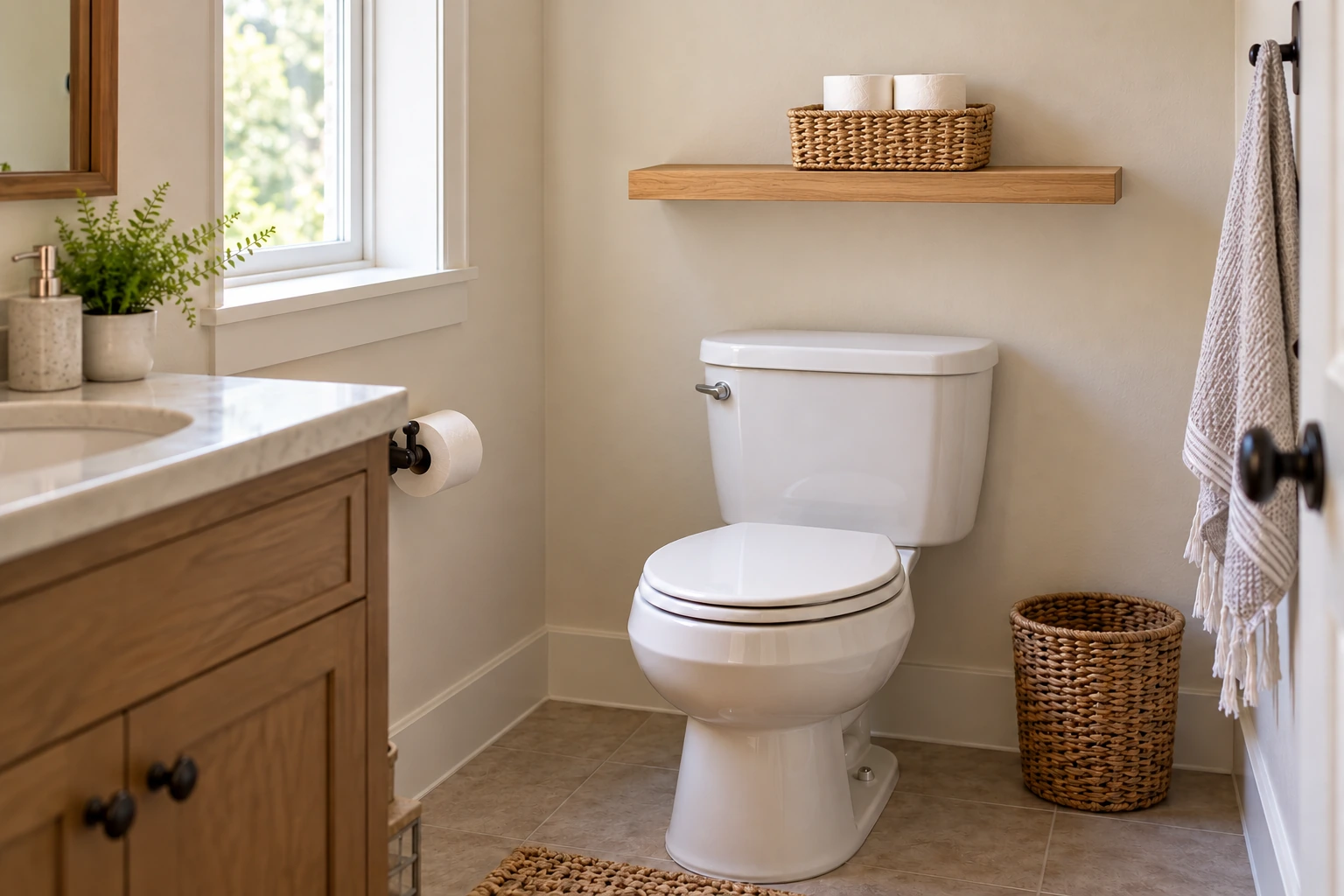
The space above a toilet looks like an obvious place for extra bathroom storage. You might picture two floating shelves, a cabinet with doors, or a tall organizer that fits around the toilet. But a setup that fits in a photo may not work around your actual tank, plumbing, or everyday routine.
The best over-the-toilet storage ideas solve a specific storage problem without making the toilet harder to use, clean, or service. That means considering more than the space available on the wall.
Start with the possible configurations, then narrow them down using your toilet’s dimensions, the items you need to store, and the access you must preserve. Sometimes the right answer is a smaller organizer. Sometimes it’s leaving the area clear.
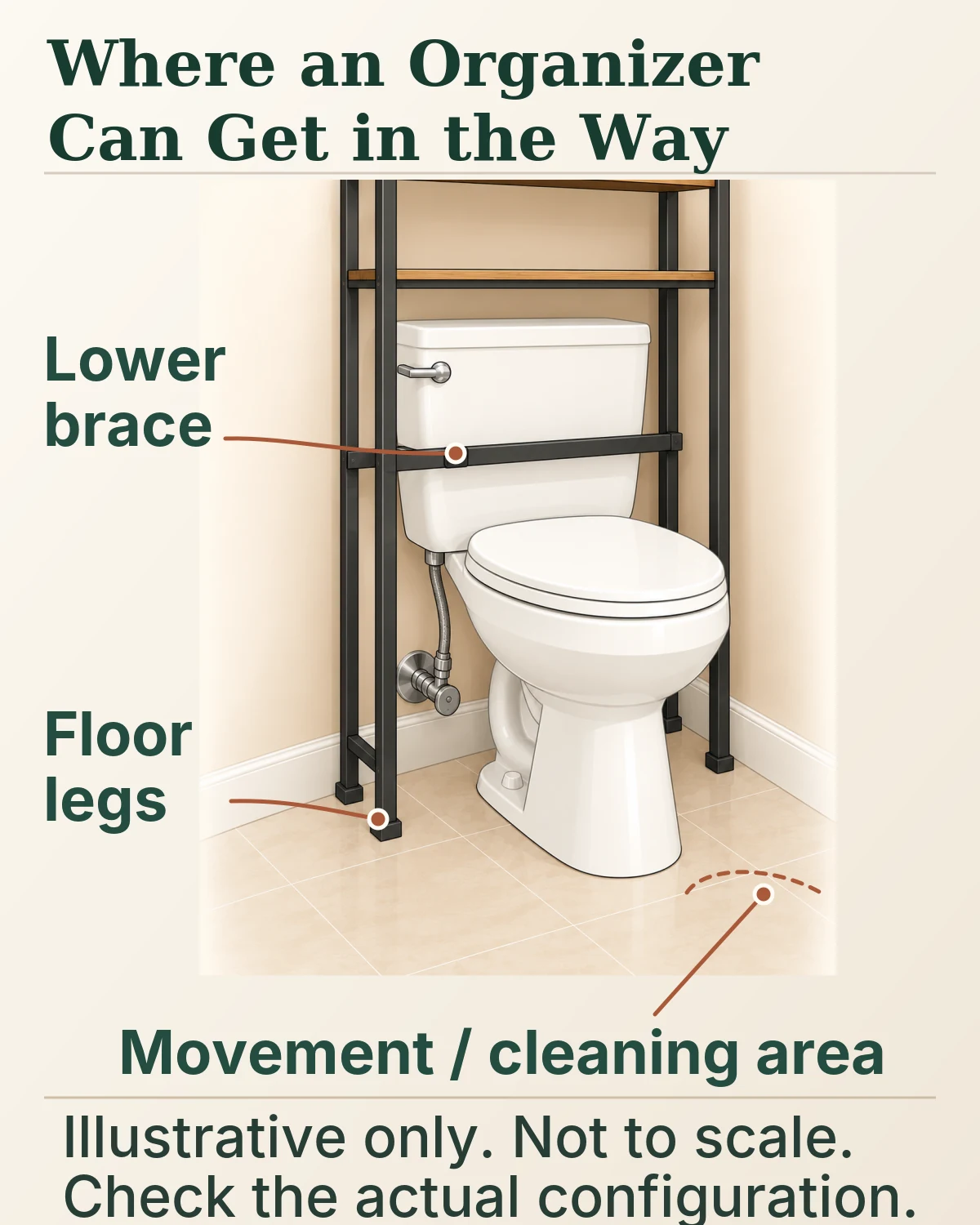
Measure First: Compare the exact organizer’s footprint, legs, braces and shelf opening with your toilet and surrounding fixtures. Check flushing, movement, cleaning, shutoff access and the actual servicing route—not width alone.
Best For: A genuine toilet-zone storage need where intended users can comfortably retrieve and return suitable supplies, and the configuration’s fit and required installation can be verified.
Skip If: The setup demonstrably obstructs use, cleaning, servicing or shutoff access, or cannot be installed as instructed. If a material requirement is unknown, pause for evidence. Leaving the area clear is valid.
In this guide
- When Does Over-the-Toilet Storage Make Sense?
- Over-the-Toilet Storage Configurations Worth Considering
- What Actually Belongs Near the Toilet?
- Measure the Toilet and the Space Around It
- Check What Happens During Normal Toilet Use
- Keep Maintenance and Water Shutoff Access Workable
- Verify Installation and Stability Before Using the Space
- Two Over-the-Toilet Organizers to Consider
- Consider Reach, Cleaning, and Everyday Effort
- When to Reject an Over-the-Toilet Storage Configuration
- When Leaving the Toilet Zone Clear Is Better
- Frequently Asked Questions
When Does Over-the-Toilet Storage Make Sense?
Over-the-toilet storage is worth considering when you have a genuine shortage of convenient storage, a suitable space around the fixture, and a configuration whose installation and everyday use can be verified.
It is less promising when a proposed unit obstructs the toilet, requires an installation you cannot complete as instructed, or creates more work than the storage is worth.
A useful decision starts with three questions:
- What needs a home? Identify the specific supplies rather than filling shelves because they’re available.
- What must remain accessible? Consider flushing, sitting and standing, toilet servicing, cleaning, and access to the water shutoff where applicable.
- Can the setup be installed and used as required? Furniture that appears freestanding may still require wall anchoring.
A good-looking cabinet is not automatically a good storage location.
Over-the-Toilet Storage Configurations Worth Considering
Different configurations solve different space problems. These are possibilities to evaluate, not recommendations that every bathroom can accommodate.
On narrow screens, scroll sideways to view all three columns.
| Storage configuration | Potential advantage | What to check first |
|---|---|---|
| Wall-mounted open shelves | Uses wall space without adding floor legs | Wall installation, shelf depth, reach, and the space needed for toilet operation or servicing |
| Wall-mounted cabinet | Conceals stored items | Door swing, mounting requirements, reach, and service-opening access |
| Freestanding unit that straddles the toilet | Creates several tiers of storage | Leg spacing, lower braces, tank clearance, floor conditions, and required anchoring |
| Ladder-style organizer | May offer a relatively open-looking arrangement | Manufacturer-approved placement, support, restraint, and access around the fixture |
| Tank-top organizer or tray | Keeps a small number of items close by | Flush controls, lid removal, object stability, and cleaning access |
| Slim cabinet or cart beside the toilet | Uses a narrow adjacent space rather than the wall above | Seated movement, floor footprint, water-supply access, stability, and neighboring fixtures |
Existing built-in shelving may also be usable if its access and storage conditions work for your toilet. Creating a new recess, moving plumbing, or changing a wall is a separate construction project, not a simple organization step.
Notice that the configurations do not have the same failure points. A wall shelf may avoid floor obstructions but need secure wall installation. A straddling unit may offer convenient tiers while placing legs or braces near the toilet’s supply connection. A cabinet may fit neatly until you try to open its doors.
The next question is which, if any, deserves space in your bathroom.
What Actually Belongs Near the Toilet?
Before measuring for new storage, identify what you want it to hold.
Start with the supplies that have a clear reason to be near the toilet. A small reserve of toilet paper may be convenient in that zone. Other items may be occasional rather than daily needs.
For each category, ask:
- How often does someone need it here?
- Can the intended user reach and return it comfortably?
- Is the item appropriate for the bathroom’s storage conditions?
- Does it already have a practical home somewhere else?
- Is the extra storage worth the space and maintenance it adds?
Store for real use, not theoretical capacity. A tall organizer with several shelves is not necessarily helpful if most of its contents are rarely needed or difficult to reach.
Keep medicines subject to their specific storage instructions. Bathroom heat and humidity can make the location unsuitable for some medicines. Cleaning products also require their own label-based storage precautions, especially around children and pets. Neither category should be moved above the toilet simply because a shelf is available.
If you cannot identify a useful toilet-zone storage function, you may not need a new organizer.
Measure the Toilet and the Space Around It
Measure the actual fixture and the available area before choosing any configuration.
Check the toilet itself
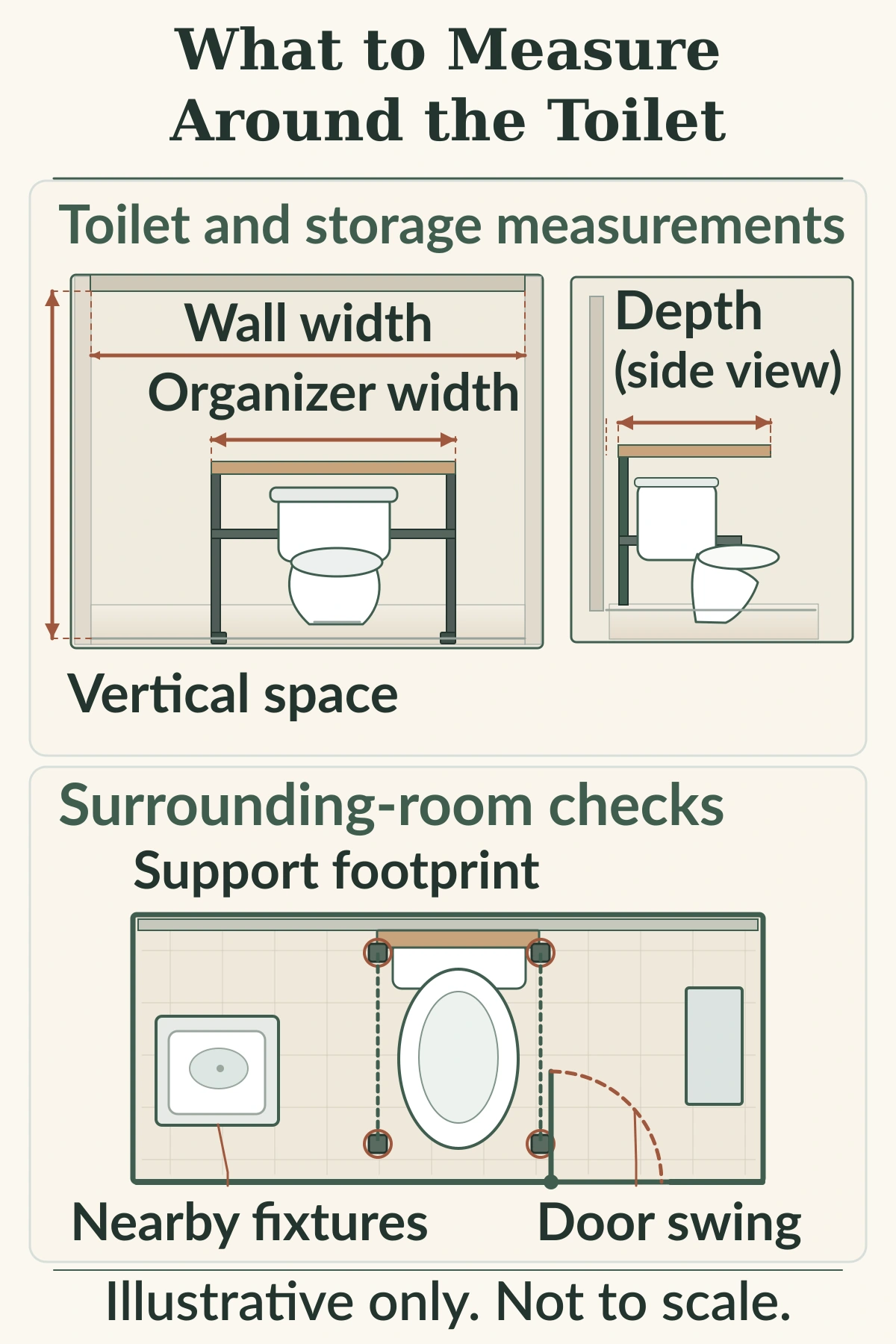
Identify the toilet’s construction and the parts that project into the proposed storage space. Depending on the fixture, this might include an exposed tank, a one-piece body, a concealed cistern, a flush button or handle, or a service opening.
For a freestanding unit, the relevant space includes more than the width across the toilet. Check where its legs, rear braces, shelves and other structural parts would sit.
For a wall-mounted shelf or cabinet, check the full depth and position of the proposed structure, not only its height on the wall.
Check the surrounding room
Look for conflicts involving:
- Baseboards, wall trim, pipes and supply connections.
- Doors, mirrors, windows and neighboring fixtures.
- Cabinet-door movement and access to stored items.
- Existing grab bars or other features that must remain usable.
- Floor and wall conditions relevant to the intended installation.
A configuration can pass a simple width check and still fail because a brace meets a pipe or a cabinet door collides with a mirror.
Use the exact dimensions and installation requirements of the configuration you are evaluating. There is no single clearance measurement in this guide that guarantees a suitable fit above every toilet.
Check What Happens During Normal Toilet Use
A storage unit has to work when the bathroom is occupied, not just when the toilet is unused.
Consider what happens as someone sits, stands, reaches for toilet paper, flushes, opens the seat or lid, and moves around the fixture. A shelf projecting into that space may be inconvenient even when it never touches the tank.
Then consider the stored items themselves.
Can someone remove a roll or container without leaning awkwardly across the toilet? Can they return it without moving other supplies? Can the cabinet door open fully enough for the contents to be useful?
Available shelf space and usable shelf space are not the same thing.
The evaluation should reflect the people who use the bathroom. A storage tier that is easy for one person to reach may be impractical for another. Avoid treating any shelf position as universally accessible.
If ordinary use depends on an uncomfortable reach, obstructed movement or unreliable retrieval, the configuration needs reconsideration.
Keep Maintenance and Water Shutoff Access Workable
One of the easiest details to miss is the space needed when something goes wrong or the toilet needs servicing.
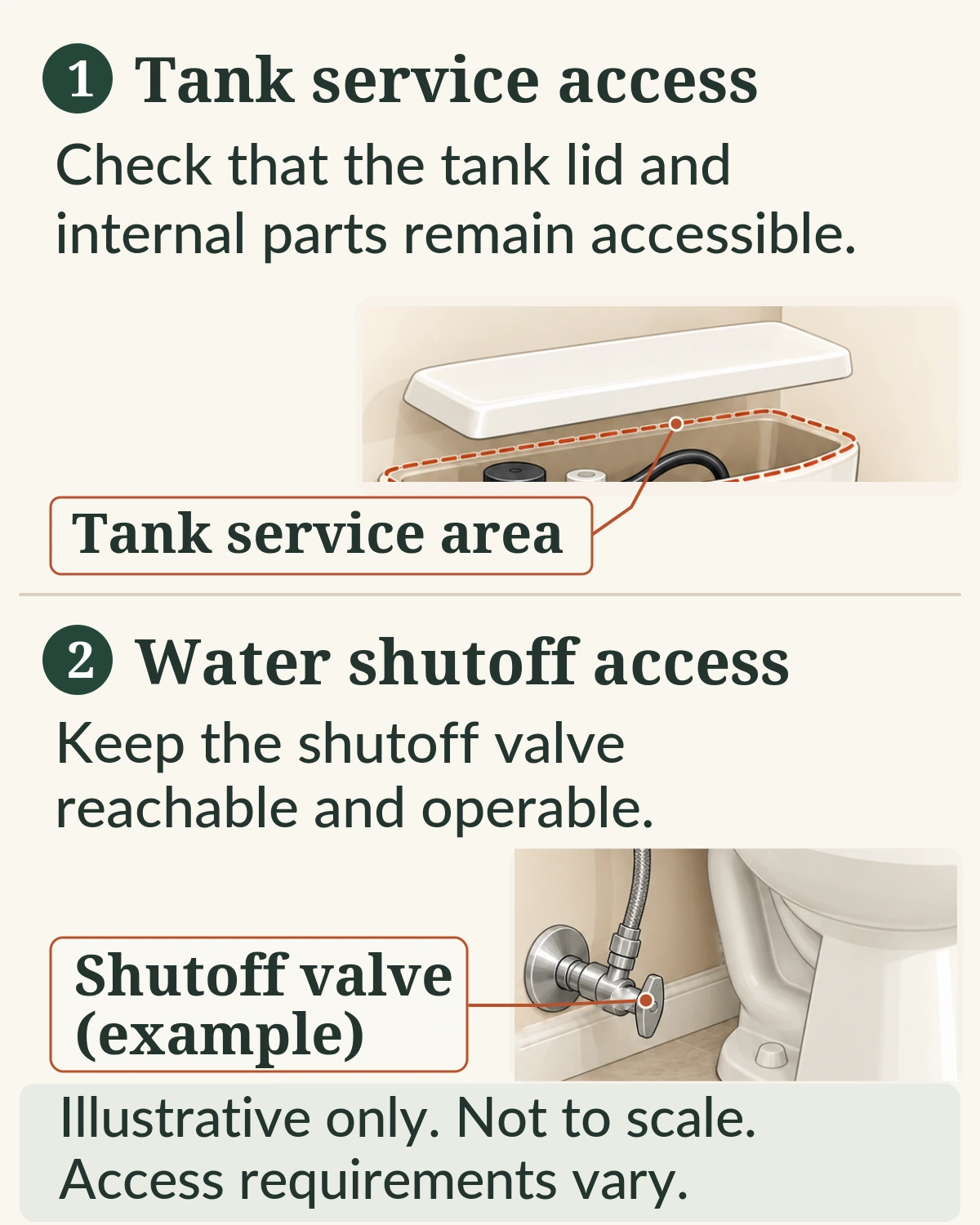
For an exposed-tank toilet, determine how its components are accessed. A storage structure above the tank may interfere with the actual cover-removal path or the access needed for repair.
A concealed-cistern system may instead have a manufacturer-defined access opening behind a flush plate. The appropriate check is the service route for your actual fixture, not a universal rule about lifting a tank lid.
Also identify the applicable water-supply shutoff and its access path. An organizer’s leg, side panel or rear brace could make it difficult to reach a valve when needed.
Before accepting a configuration, ask:
- Can the flush control still be operated?
- Can required toilet components be reached for inspection and service?
- Can the relevant supply shutoff be accessed?
- Would furniture or stored items obstruct these tasks?
- Can the arrangement be cleaned without unreasonable difficulty?
If the required service path is unknown, don’t guess that the organizer will be compatible. Treat the result as NEEDS EVIDENCE until the actual requirements are established.
Verify Installation and Stability Before Using the Space
A freestanding appearance does not necessarily mean an organizer is designed to remain unsecured.
Some over-toilet furniture requires wall anchoring even though its legs rest on the floor. Installation requirements depend on the exact design and the manufacturer’s instructions.
Before deciding a configuration is workable, establish:
- Whether it requires wall mounting, restraint or other support.
- Whether the intended wall, floor and location can satisfy those requirements.
- Whether required structural parts can be installed without interfering with the toilet.
- Whether the assembled arrangement matches the instructions.
Do not treat an omitted crossbar, an improvised restraint or an unsupported attachment as a verified solution to a fit problem.
If a required installation cannot be completed in the intended location, reject that configuration for that setup. If the required information is unavailable, record NEEDS EVIDENCE.
For renters, permission to drill and the suitability of alternative attachment methods are separate questions. A no-drill description is not a guarantee of safety, stability, surface compatibility or permission under a lease.
This guide identifies the installation decision. It does not replace the manufacturer’s instructions or provide a drilling or anchoring tutorial.
Two Over-the-Toilet Organizers to Consider
If this type of storage suits your bathroom, these two options offer different ways to organize the space.
This section contains paid links. As an Amazon Associate I earn from qualifying purchases.
Open storage: SONGMICS bamboo organizer
An option for keeping spare rolls and everyday bathroom supplies within reach. Customer experiences with sturdiness and material quality vary, so check the parts before assembly and secure the organizer to the wall with the included anti-tip kit, following its instructions.
Measure First: Check the space around the tank, the lower rear bar, and clearance for the toilet lid and flush controls. Keep the shutoff and tank accessible.
Best For: A small bathroom where open shelves would make frequently used supplies easier to reach.
Skip If: It obstructs toilet use or servicing, or you cannot complete the required wall attachment—including any permission needed in a rental.
Bathroom
SONGMICS 3-Tier Bamboo Over-the-Toilet Storage — Gray
Three open shelves, side hooks and a toilet-paper holder offer a practical home for bathroom essentials.
Check on Amazon (opens in a new tab)Enclosed storage: Yaheetech Espresso cabinet
An option when you want some bathroom supplies behind doors. Allow time for assembly and door adjustment. Some customers report wobble, finish peeling or mold; long-term bathroom durability is not established by our review sample. Secure the cabinet to the wall with the supplied anti-tip device, following its instructions.
Measure First: Check the 77-inch height, toilet and lower-bar clearance, cabinet-door movement, and nearby outlets or lights. Leave room to position the cabinet and access the tank and shutoff.
Best For: A bathroom needing a mix of concealed storage and open shelves.
Skip If: It blocks fixtures or servicing, or you cannot complete the required wall attachment—including any permission needed in a rental.
Bathroom
Yaheetech 77-inch Over-the-Toilet Storage Cabinet — Espresso
A two-door cupboard and open shelves help keep smaller bathroom supplies tucked away while leaving frequently used items accessible.
Check on Amazon (opens in a new tab)Consider Reach, Cleaning, and Everyday Effort
Even a configuration that fits and can be installed correctly may prove inconvenient.
Think about how the storage will work over time.
Reach: Put frequent-use items only where intended users can retrieve and return them comfortably. Do not count difficult-to-reach upper tiers as effortless everyday capacity.
Cleaning: Consider whether floor legs, braces, shelves or cabinets make it difficult to clean the toilet and nearby surfaces.
Moisture: Inspect the bathroom’s actual conditions, follow material-care instructions, and avoid using storage furniture to conceal leaks or dampness.
Routine effort: Consider how often the unit or its contents would need to be moved to clean or access the fixture.
A configuration that demands constant rearranging may not be worth its storage capacity. Your goal is an area that works during ordinary routines, not merely one that can hold more items.
When to Reject an Over-the-Toilet Storage Configuration
It’s useful to give a failed idea a specific reason instead of treating every unsuitable arrangement as a vague disappointment.
Use three possible outcomes for the configuration you are evaluating:
On narrow screens, scroll sideways to view all three columns.
| Outcome | What it means | What to do next |
|---|---|---|
| FEASIBLE | All material fit, operation, access and installation requirements for the specific setup have sufficient supporting evidence | Consider whether the usable capacity and daily burden justify it |
| REJECTED | A demonstrated conflict makes the configuration unsuitable under the stated conditions | Name the problem; evaluate a different configuration or leave the area clear |
| NEEDS EVIDENCE | An important measurement, service requirement or installation condition is unknown | Obtain the missing information before proceeding |
These are decision categories, not safety certifications.
Example: A brace obstructs tank servicing
Hypothetical example, not a tested product or measured bathroom.
Suppose a freestanding organizer has a lower brace that demonstrably blocks the access required to service the toilet’s exposed tank.
Outcome: REJECTED — service path obstructed.
The failure concerns that particular arrangement. It does not prove that every freestanding organizer is unsuitable. The organizer’s anchoring requirements would still need independent verification for any proposed alternative.
Example: A cabinet above a concealed cistern
Hypothetical example, not a verified installation.
Suppose a wall cabinet appears to fit above a toilet, but the required flush-plate service opening, cabinet-door travel and wall-mounting conditions have not been established.
Outcome: NEEDS EVIDENCE — service opening, door movement and mounting compatibility unverified.
The answer is not to assume that a conventional tank-lid clearance check settles the question. The actual concealed-system and cabinet instructions must be examined.
Example: A slim cabinet beside the toilet
Hypothetical example, not a verified installation.
Suppose a narrow floor cabinet appears to fit beside the toilet, but its rear projection, stability requirements and effect on water-shutoff access are unknown.
Outcome: NEEDS EVIDENCE — actual footprint, shutoff access and restraint conditions unverified.
This remains a toilet-zone decision when the toilet’s clearance, operation or servicing requirements control whether the cabinet belongs there.
A known failure may justify rejecting a particular setup even when other evidence is missing. Keep those additional unknowns recorded rather than pretending they have been resolved.
When Leaving the Toilet Zone Clear Is Better
Not every available space needs to become storage.
Leaving the area clear may be the more practical decision when no available configuration preserves the necessary access, when required installation conditions cannot be satisfied, or when the usable storage doesn’t justify the effort it creates.
You can also choose no added storage simply because the items in question already have suitable homes.
There is no need to replace one rejected organizer with another purchase just to use the space.
If the real problem is storage lost because of a pedestal sink, the decision belongs in a pedestal-sink storage plan. If it involves shower-use products, vanity interiors or the arrangement of the entire bathroom, those are different organizing problems.
The aim is not to fill every inch. It is to make the bathroom easier to use.
Frequently Asked Questions
Are over-the-toilet shelves a good idea for small bathrooms?
They can be worth considering when they solve a specific storage need and the evaluated configuration satisfies the required fit, operation, service and installation checks. Limited bathroom space alone doesn’t prove that an organizer will work.
How much clearance do I need above the toilet tank?
There is no universal number in this guide. The appropriate space depends on the actual toilet, its service requirements and the storage configuration. Check the relevant dimensions and instructions rather than relying on a generic measurement.
Can an over-the-toilet organizer be used without drilling?
That depends on the exact organizer and its instructions. A unit with floor legs may still require wall anchoring. Do not assume that a freestanding appearance, an adhesive accessory or a renter-friendly description eliminates installation requirements.
Can I put shelves above a concealed toilet tank?
Possibly, but first establish the actual servicing route, including any flush-plate access opening. Check that the shelf or cabinet and its contents would not obstruct necessary service, use or installation requirements.
What should I store above the toilet?
Start with supplies that genuinely benefit from being nearby and can be stored and retrieved appropriately. Spare toilet paper may be one candidate. For medicines, chemicals and other items with special storage conditions, follow the relevant labels and precautions instead of assuming bathroom shelving is suitable.
What if a storage unit fits but blocks the water shutoff?
Physical fit does not override an established access conflict. If the evaluated configuration blocks required shutoff access, reject that setup rather than assuming its useful shelf space compensates for the obstruction.
Is it okay to leave the wall above the toilet empty?
Yes. If no configuration meets the relevant requirements or offers a worthwhile benefit, leaving the area clear is a valid organizing decision. The most useful storage solution may be deciding not to add one.