How to Organize a Small Kitchen Without a Pantry
For broader small-kitchen organization, see our guide to small kitchen organization ideas. This guide focuses specifically on building a pantry function when dedicated pantry space is missing.
A small kitchen without a pantry can make food storage feel improvised. Cereal ends up above the refrigerator, snacks compete with plates, canned goods disappear behind appliances, and grocery overflow slowly claims the counter.
The solution is not necessarily to squeeze a pantry cabinet into a room that does not have space for one.
Instead, build the function of a pantry: one predictable place for everyday food, clear categories, visible inventory, controlled backstock, and enough access that putting groceries away does not become a puzzle every week.
If you are figuring out how to organize a small kitchen without a pantry, start with the food you actually keep at home. Then choose the smallest storage system that can handle it. Add organizers or furniture only when they solve a specific problem.
Affiliate disclosure: This guide contains affiliate links. As an Amazon Associate I earn from qualifying purchases. We recommend products based on problem-solution fit, dimensions, compatibility, and practical usefulness. Read the disclosure.
In This Guide
- Start With the Food, Not the Organizers
- Choose One Primary Pantry Zone
- Measure Before You Add Pantry Storage
- Build Food Zones That Match How You Cook
- Make Food Visible Before Adding More Capacity
- Use Doors and Vertical Space Carefully
- Create a Pantry Without Sacrificing Your Kitchen
- Keep Backstock From Taking Over
- Store Pantry Food in a Safe Place
- Use a 10-Minute Weekly Pantry Reset
- No-Pantry Setup Examples
- Frequently Asked Questions
Start With the Food, Not the Organizers
Buying containers first is tempting because containers look like progress. In a small kitchen, though, every organizer also takes up space.
Start by learning what your storage system actually needs to hold.
Pull Together Your Shelf-Stable Food
Gather the shelf-stable food currently scattered around the kitchen.
That might include:
- cereal and oatmeal
- pasta, rice, and grains
- canned and jarred foods
- baking ingredients
- snacks
- coffee and tea
- oils, vinegars, and shelf-stable condiments
- unopened backup items
You do not need to empty every cabinet in the kitchen. The point is to see the amount and types of food your pantry substitute needs to handle.
You may discover that the problem is not a total lack of storage. Food may simply be divided among several unrelated places, making it difficult to see what you have.
Separate Everyday Food From Backstock
Next, divide the food into two broad groups.
Everyday food is what you regularly reach for: breakfast items, snacks, dinner staples, coffee, cooking oils, or whatever your household uses frequently.
Backstock is the extra jar of sauce, second box of cereal, unopened bag of rice, or other backup item that does not need prime storage space yet.
That distinction matters in a small kitchen. Everyday items should be convenient. Backups only need to be accessible enough that you remember they exist.
If both groups compete for the easiest shelves, the kitchen can feel full even when much of that space is holding duplicates.
Remove What Does Not Need the Space
Check expiration or use-by guidance where applicable and get rid of food that should no longer be kept.
Then look at duplicates together. Four boxes of pasta spread across three cabinets still equal four boxes of pasta.
Also look honestly at bulk purchases.
A larger package is not automatically a better choice if your kitchen cannot store it without blocking something you use every day. In a small home, storage capacity is part of the decision.
Choose One Primary Pantry Zone
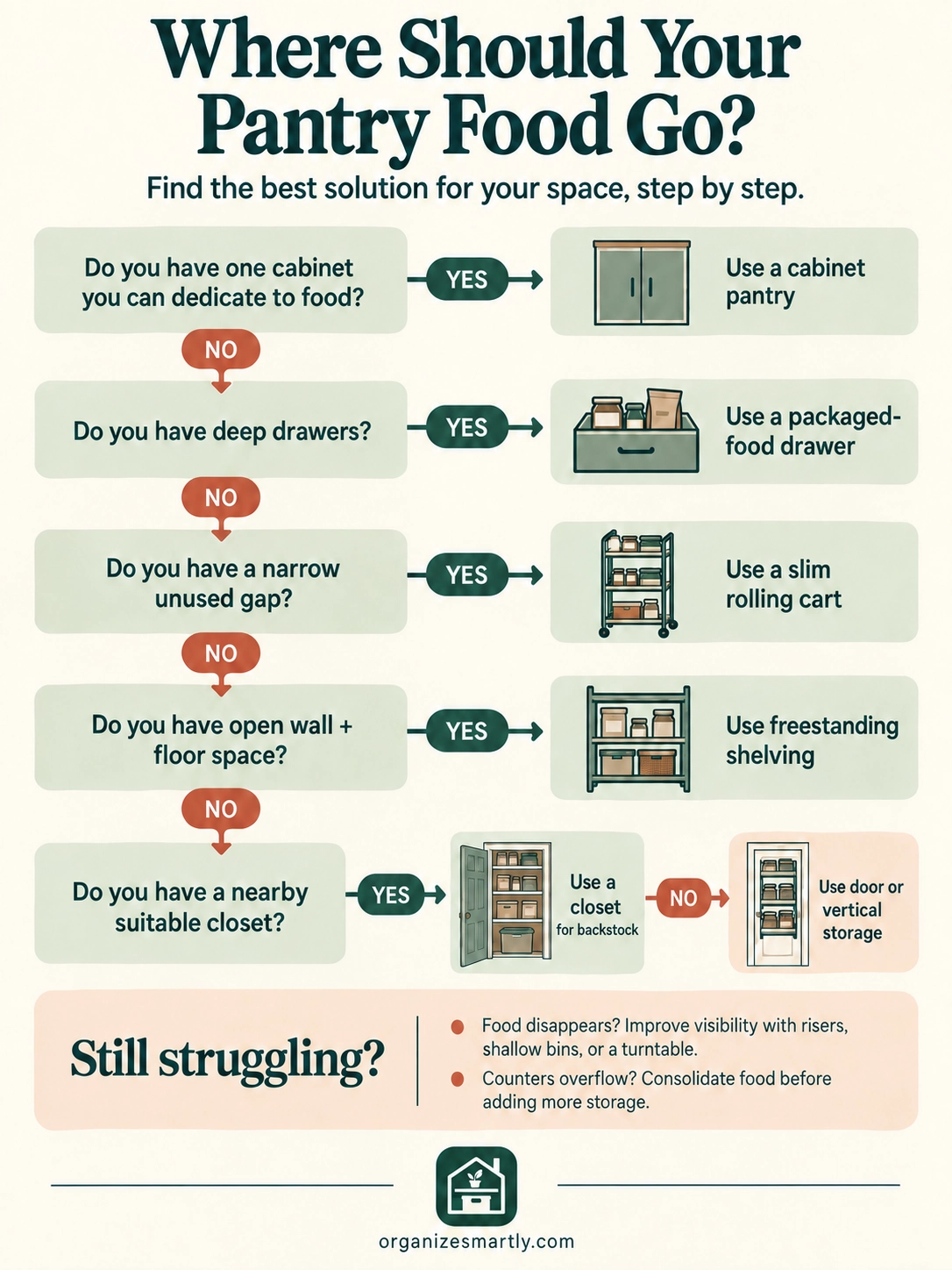
The most useful change is often not adding more storage. It is deciding where pantry food belongs.
Try to create one primary food zone first. Use secondary storage only for overflow or backstock.
A simple decision guide:
| If your kitchen has… | Start with… |
|---|---|
| One available cabinet | A cabinet pantry |
| Deep drawers | Packaged-food drawers |
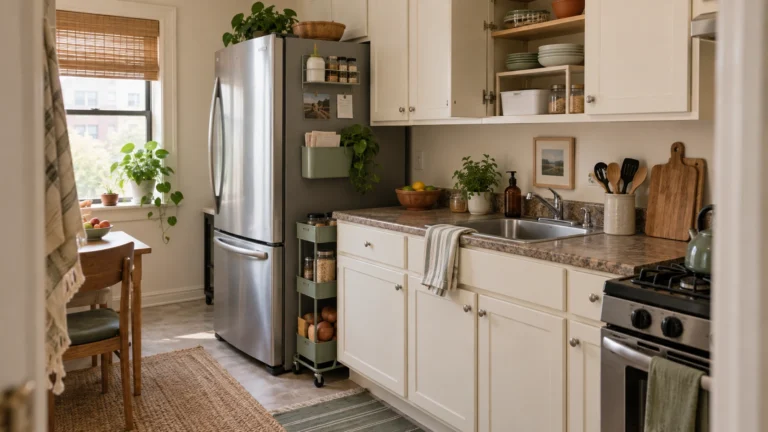
| A narrow unused gap | A slim rolling cart |
| Open wall space | Freestanding shelving or a narrow cabinet |
| A nearby suitable closet | A controlled backstock zone |
| No floor space | Door, cabinet-door, or suitable wall storage |
| Cabinets but poor visibility | Risers, shallow bins, or turntables |
| Constant counter overflow | Consolidating food before adding storage |
Use One Kitchen Cabinet if You Have One Available
If you can free one cabinet, it can become the main pantry zone even if it is not especially large.
Choose a cabinet that makes sense for food rather than automatically using the biggest one. A cabinet near your main prep area may work better than a deeper cabinet across the room.
Keep everyday foods in the easiest-to-reach area and backups in less convenient space.
For shelf-by-shelf cabinet setup, use OrganizeSmartly’s guide on how to organize kitchen cabinets in a small kitchen rather than turning this article into a second cabinet-organization guide.
Use Deep Drawers for Packaged Food
Deep drawers can work well for snack bags, breakfast foods, wraps, packets, and some dry goods.
They are especially useful when upper cabinets are already committed to dishes.
The advantage is visibility from above. The risk is creating a deep pile where the bottom disappears again. Keep categories broad and avoid stacking more layers than you can see when the drawer opens.
Use a Freestanding Shelf or Cabinet When Floor Space Allows
A narrow shelving unit or freestanding cabinet can provide a dedicated pantry zone without remodeling.
This works best when the wall space is not already needed for a walkway, an appliance door, seating, a trash can, or comfortable movement through the kitchen.
Before buying furniture, mark the proposed footprint on the floor with painter’s tape.
A cabinet that looks pleasantly slim on a product page can feel substantially less charming when it occupies the only clear path to the refrigerator.
Use a Slim Cart Only When the Gap Actually Fits
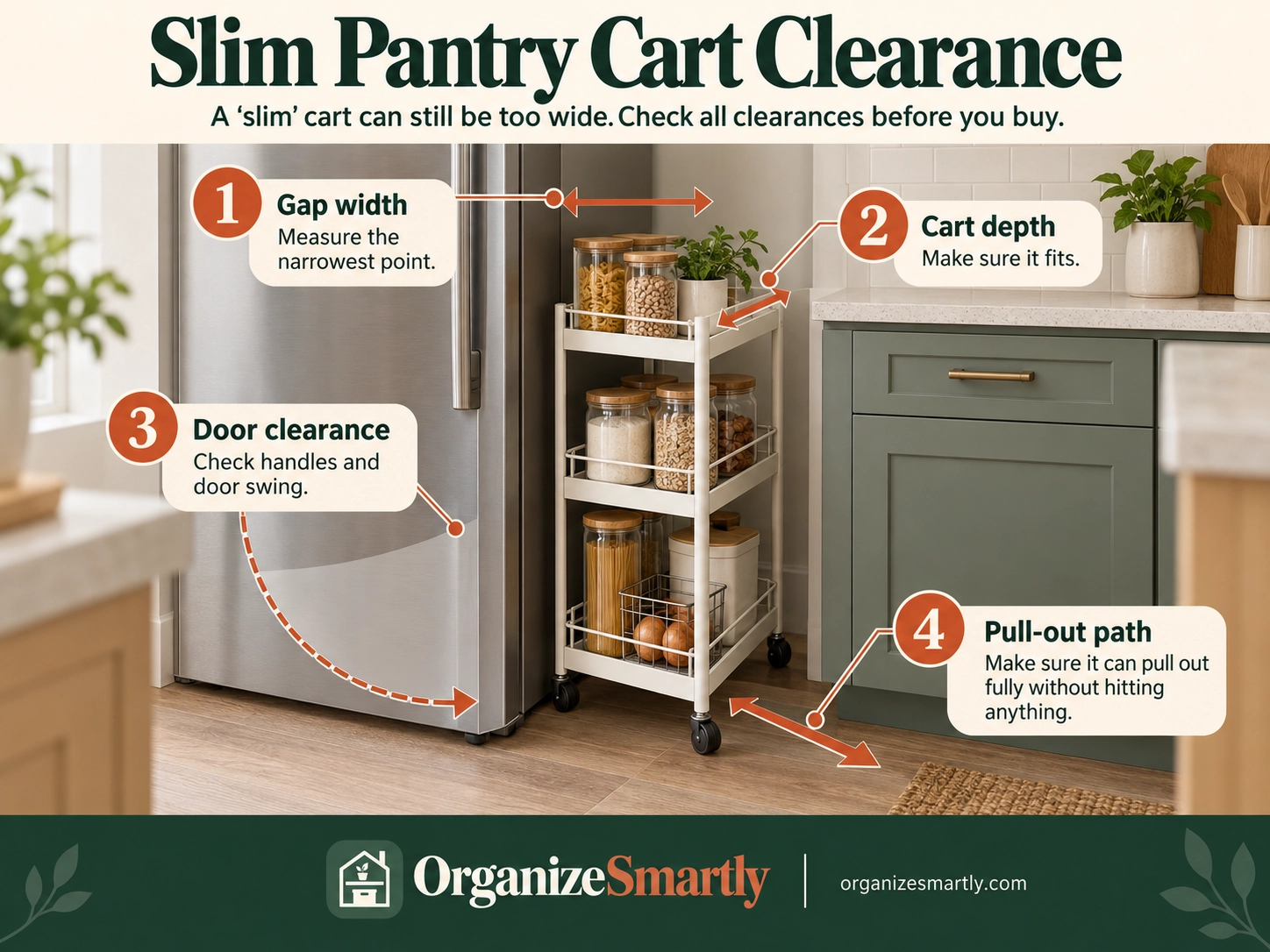
A rolling cart can turn an unused gap into useful food storage, but “slim” is not a measurement.
Check the actual width, depth, and height of the opening. Account for baseboards, handles, hinges, and anything else that narrows the usable area.
The cart also needs enough clearance to roll out without colliding with a cabinet, appliance, or walkway.
For a broader look at removable storage in rentals, OrganizeSmartly’s renter-friendly small kitchen storage ideas cover that problem in more depth.
Use a Nearby Closet for Controlled Backstock
Not every shelf-stable food item needs to live inside the kitchen.
A nearby closet can work for unopened backup items if the location is suitable for food storage and does not expose food to excessive heat, moisture, temperature extremes, or household chemicals.
Keep this area limited to backstock rather than allowing it to become a second, forgotten pantry.
Everyday food should stay closer to where you actually prepare meals.
Measure Before You Add Pantry Storage
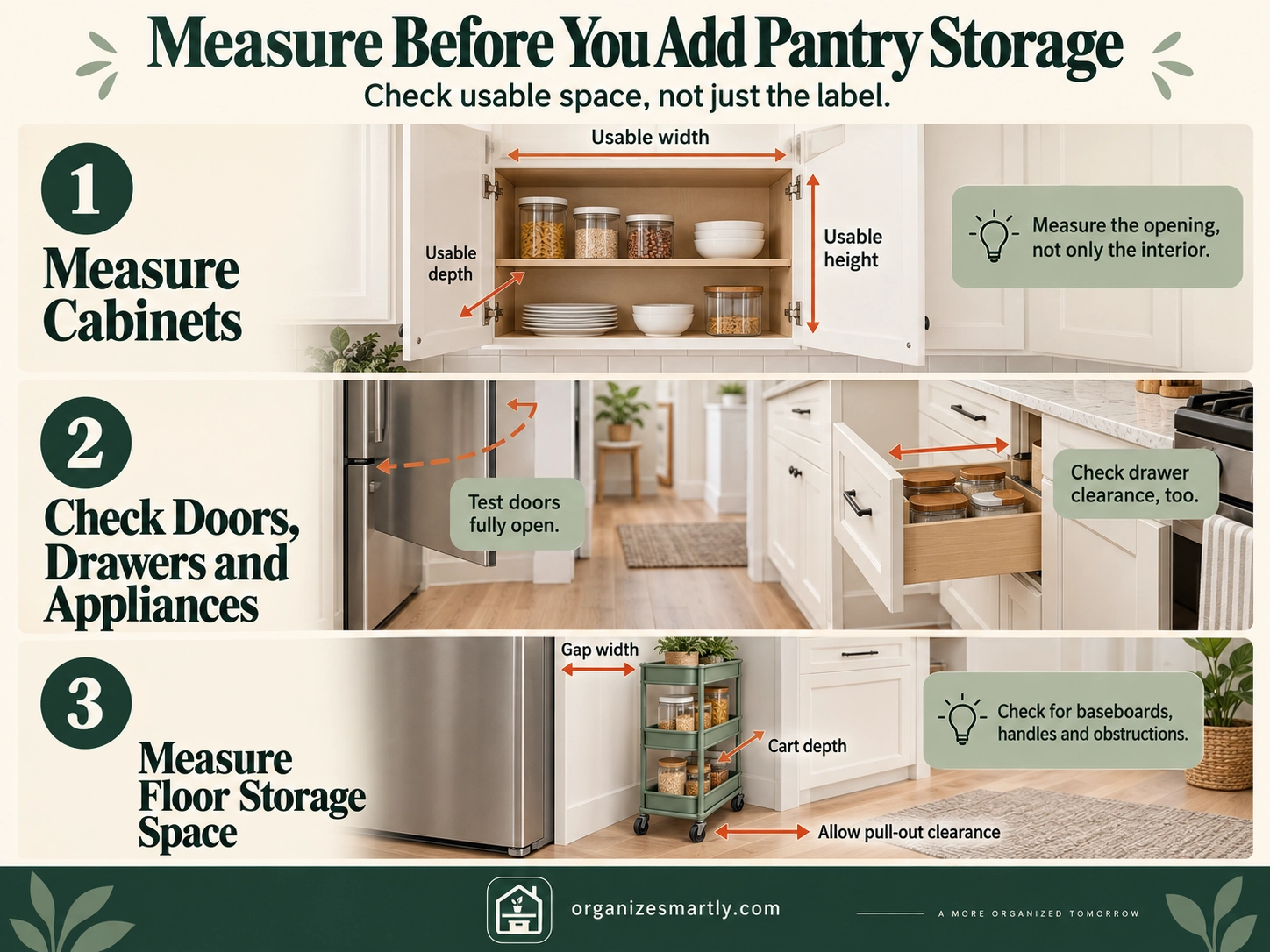
Small-space storage gets much easier when the tape measure comes out before the credit card.
Measure Width, Depth, and Usable Height
For any cart, shelf, bin, riser, or freestanding cabinet, record available width, usable depth, and usable height.
“Usable” matters. A cabinet may have plenty of interior width but a narrower door opening. A shelf organizer may technically fit yet prevent the cabinet door from closing once food is loaded onto it.
Measure both the opening and the space inside.
Check Doors, Drawers, Appliances, and Walkways
Storage does not exist in isolation.
Before placing something on the floor or attaching something to a door, test whether it interferes with refrigerator doors, oven or dishwasher doors, nearby drawers, cabinet handles, room doors, chair movement, or the normal walking path.
Open nearby doors and drawers while measuring.
That catches many storage ideas that fit perfectly only when nothing else in the kitchen is allowed to move.
Measure the Packages You Actually Buy
Your groceries deserve measurements too.
If your household regularly buys tall cereal boxes, large rice bags, wide snack packages, or specific jars, your storage needs to accommodate those real items.
Do not design the whole system around matching containers unless transferring the food genuinely improves storage or use.
Original packaging can be perfectly practical.
Build Food Zones That Match How You Cook
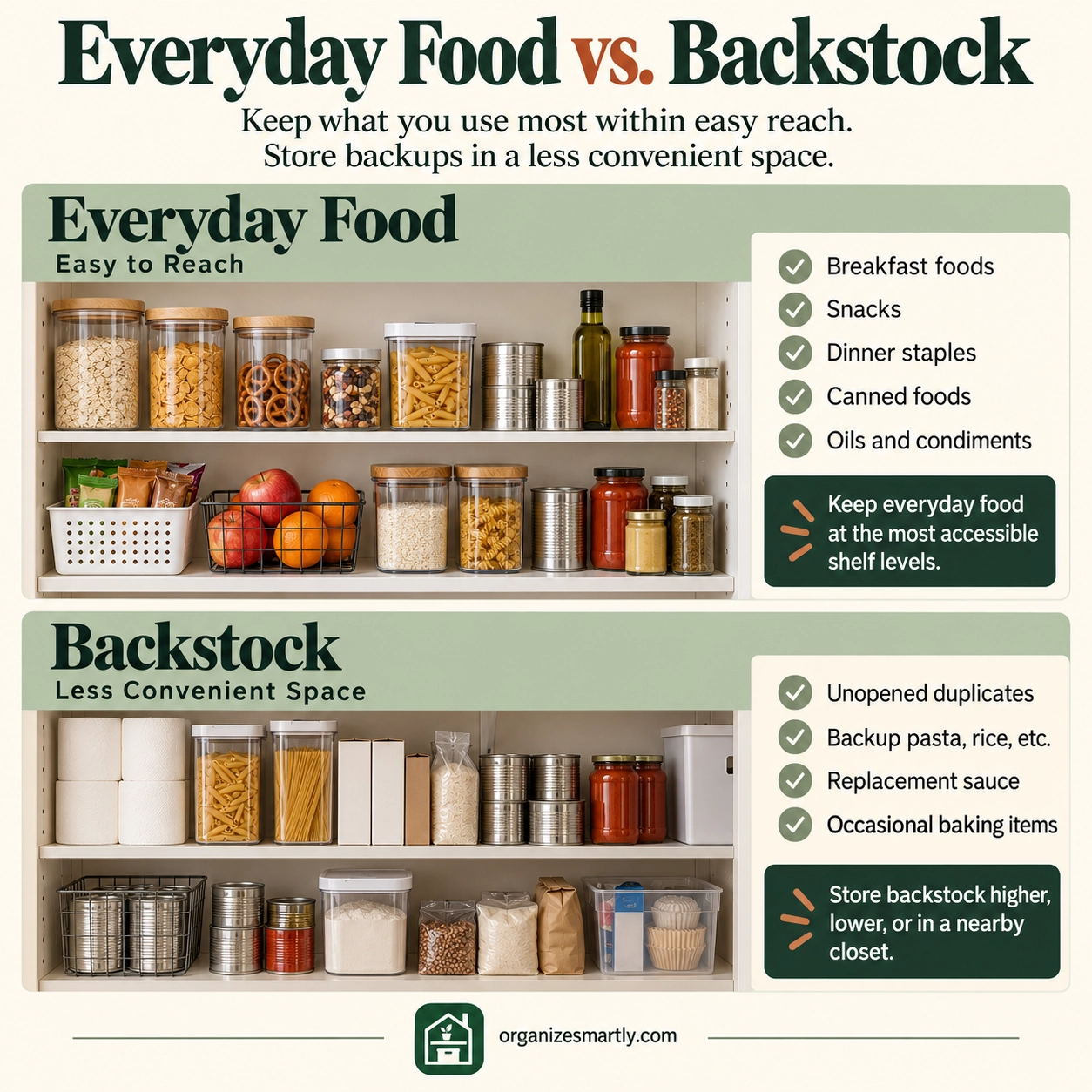
Once you know where food will live, group it by how your household uses it.
Possible zones include breakfast, snacks, dinner staples, canned and jarred foods, baking, oils and condiments, and backstock.
You may need fewer categories. A simple system that people actually maintain is more useful than a highly detailed one that collapses after the next grocery trip.
Keep Everyday Food Easiest to Reach
Give frequently used food your most convenient storage positions.
If oatmeal gets used every morning, it should not live behind holiday baking supplies. If pasta is a weekly staple, it should not require moving three unrelated bins.
The principle is simple: frequent-use food gets frequent-use space.
Put Backups in Less Convenient Space
Top shelves, lower shelves, and secondary storage areas are useful for things you do not need every day.
That might include unopened duplicates, occasional baking supplies, party snacks, and replacement condiments.
This keeps your prime pantry area focused on active inventory.
Avoid Too Many Tiny Categories
Micro-categories can make a shelf look organized while making it more annoying to use.
You probably do not need separate bins for crackers, pretzels, granola bars, cookies, and chips unless your household keeps enough of each to justify it.
A broader snacks zone may work better.
Use categories that match how groceries enter and leave your home.
Make Food Visible Before Adding More Capacity
Before deciding you need another cabinet or cart, improve visibility in the space you already have.
Poor access often looks like a storage shortage.
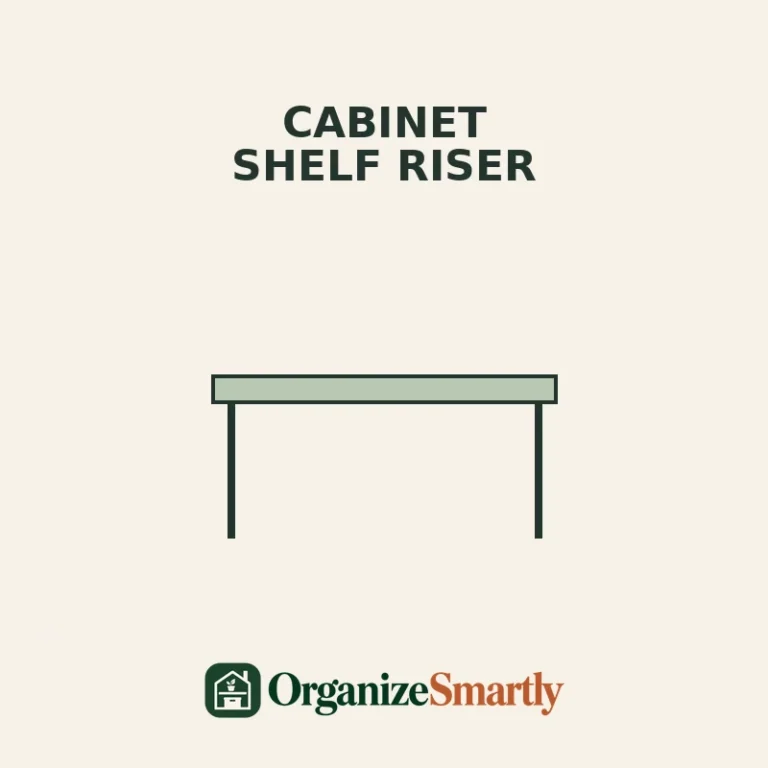
Use Shelf Risers for Short Cans and Jars
A shelf riser can create a second level where short items leave unused vertical space.
Kitchen
SONGMICS Cabinet Organizer Shelf
A shelf riser is one of the simplest ways to turn unused cabinet height into usable storage. It works especially well for dishes, mugs, small pantry items, and short containers that otherwise leave empty space above them.
Check on Amazon (opens in a new tab)Use Shallow Bins for Loose Packets and Snacks
A shallow bin can group snack packets, pouches, or small baking ingredients.
The key is shallow. If the container becomes a deep box full of hidden food, it has merely moved the visibility problem into another container.
Kitchen
ClearSpace Pantry Organizers and Storage and Cabinet Organizer, 2 Pack
Shallow clear bins can group loose pantry categories while keeping contents easier to see. They help most when they reduce scattered packets without creating another deep container to search.
Check on Amazon (opens in a new tab)Clear bins can make contents easier to see in some kitchens, but they are not automatically better than opaque containers. Layout and access matter more than appearance.
Use Turntables Where Rows Hide Each Other
A turntable can help when bottles and jars would otherwise form several rows.
Kitchen
Copco Basics 12-Inch Non-Skid Lazy Susan
A turntable does not necessarily create more cabinet volume, but it can turn unreachable back-row storage into usable storage. It is strongest when access, rather than total capacity, is the problem.
Check on Amazon (opens in a new tab)Use Additional Containers Only When They Solve a Problem
Containers can help when original packaging is awkward, damaged, difficult to stack, or needs added protection. They are not a requirement for an organized pantry.
USDA/FSIS advises checking packages of dry foods such as rice, cereal, pasta, and dried mixes for holes that could allow moisture or insects inside. It notes that plastic or glass containers can provide additional protection.
If the original package is intact, fits the shelf, and works for your household, keeping the food in it may be the simplest option.
Use Doors and Vertical Space Carefully
Door storage can add capacity without using floor space, but only when the installation fits and the door still works normally.
Over-the-Door Storage
An over-the-door organizer can work for lightweight shelf-stable foods when you have a suitable door nearby.
Before buying one, check door thickness, top clearance, handle clearance, organizer depth, whether the door can still close, and the manufacturer’s load guidance.
For renters, removable designs can be appealing, but check both the specific installation method and your lease requirements.
Kitchen
Delamu Pantry Door Organizer, Adjustable Metal Over-the-Door 6-Tier Rack
An over-the-door organizer can add pantry capacity without taking floor space, but only when the door, clearances, mounting method, and loaded depth are compatible.
Check on Amazon (opens in a new tab)Cabinet-Door Storage
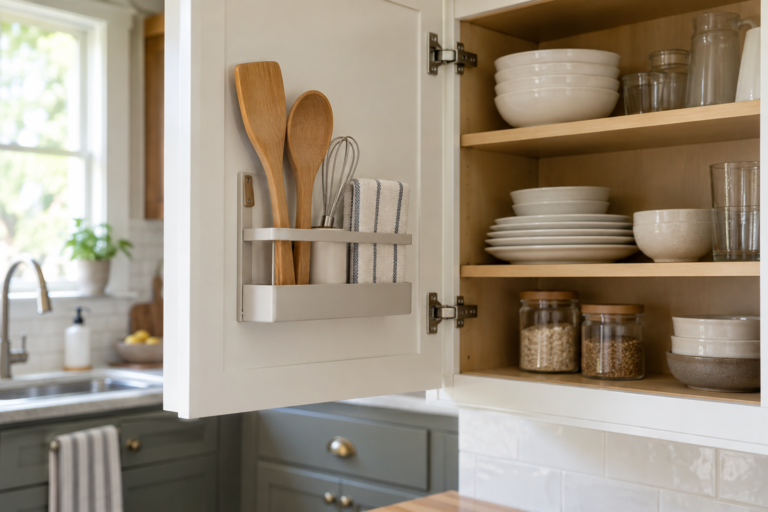
Shallow storage inside a cabinet door may work for packets or lightweight items.
Measure the cabinet in the closed position, not just with the door open. Interior shelves often occupy the same space an attached organizer needs once the door swings shut.
Wall Shelving When Renter Rules Allow
An unused wall can sometimes hold shallow food storage, but wall-mounted shelving introduces installation and load considerations.
Renters should check lease requirements before drilling or mounting hardware. If permanent shelving is not appropriate, freestanding storage may be easier to remove later.
Create a Pantry Without Sacrificing Your Kitchen
If your existing cabinetry genuinely cannot hold the food you use, added storage can help.
Choose based on space cost, not just storage capacity.
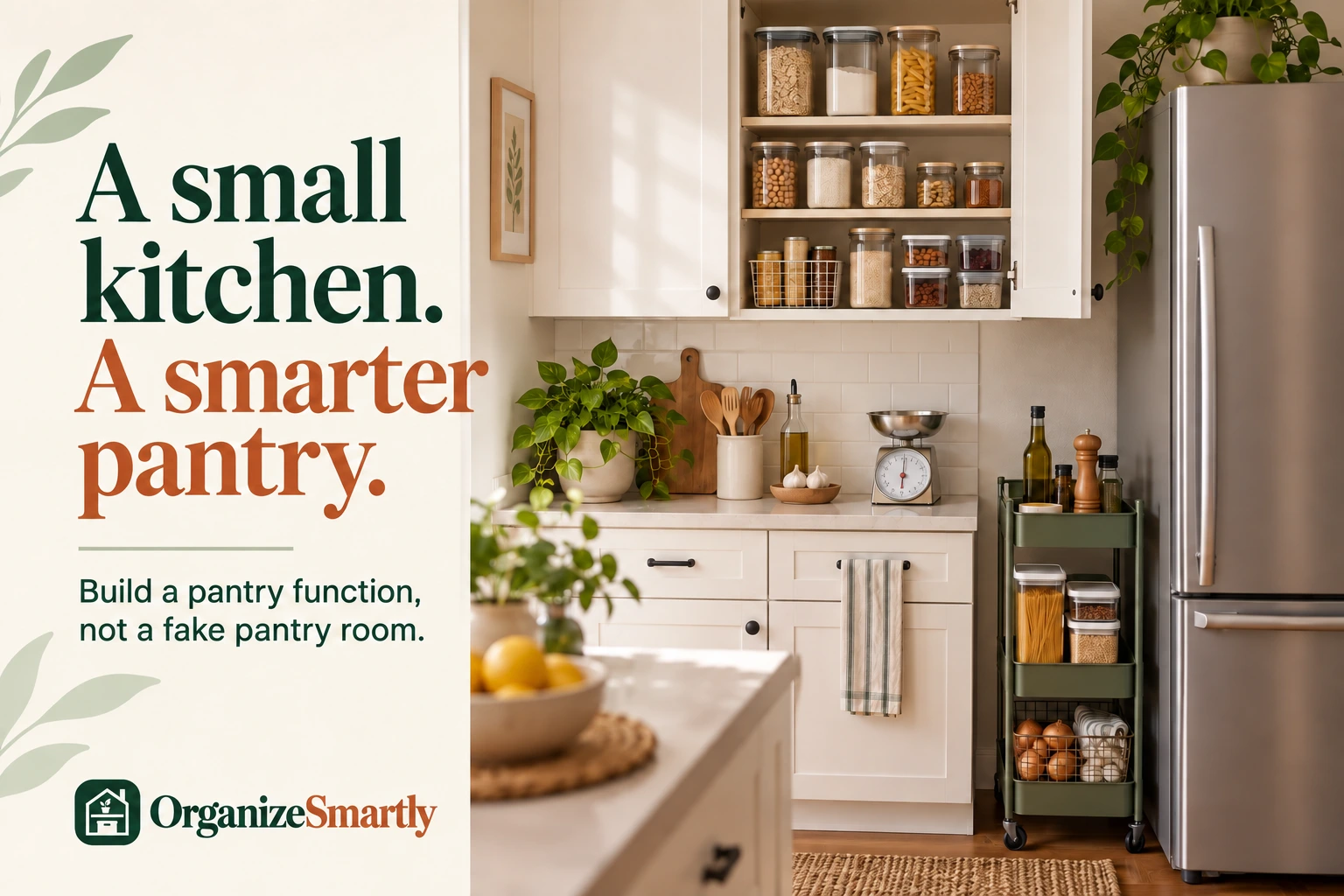
Slim Rolling Cart
Kitchen
SPACEKEEPER Slim Rolling Storage Cart
A slim cart can convert a dead gap beside a refrigerator or cabinet into usable storage without permanent installation. The important part is buying for the actual gap rather than choosing a cart first and hoping it fits later.
Check on Amazon (opens in a new tab)Narrow Freestanding Pantry Cabinet
Small Bookcase or Shelving Unit
A freestanding shelf can function as open pantry storage.
Use furniture designed for the intended load and follow the manufacturer’s stability or anti-tip instructions where applicable.
Sideboard or Closed Storage Piece
A sideboard can work in an eat-in kitchen or adjacent dining area.
The best pantry substitute is not the one that holds the most. It is the one that adds useful capacity without making the rest of the kitchen harder to use.
Keep Backstock From Taking Over
Backup inventory needs boundaries in a small kitchen.
Set a Physical Backstock Limit
Choose one shelf, bin, or defined section for backups.
When that space is full, treat it as useful information. You probably do not need another backup yet.
Keep One Backup Zone
Avoid scattering extras wherever an empty space appears.
A jar behind the mixing bowls, another in a hall closet, and three cans above the refrigerator create hidden inventory.
One defined backup zone makes it easier to check what you already own before shopping.
Shop to the Space You Have
Large packages may sometimes offer a lower unit price, but they are not automatically the better choice for every household.
If a bulk package forces groceries onto the counter, blocks everyday cookware, or creates long-term overflow, the storage tradeoff matters.
Buy quantities your household can realistically use and your kitchen can reasonably store.
Store Pantry Food in a Safe Place
Food-storage safety should determine where pantry food can live, not merely whether an empty shelf exists there.
USDA/FSIS advises storing commercially canned foods and other shelf-stable products in a cool, dry place. It specifically advises against storing them above the stove, under the sink, in a damp garage or basement, or in places exposed to temperature extremes.
For dry foods such as rice, cereal, pasta, and dried mixes, USDA/FSIS also recommends a cool, clean, dry location and checking packaging for holes that could allow moisture or insects inside.
In practice:
- Do not choose a storage location simply because it is empty.
- Avoid hot or damp locations.
- Keep food separate from household cleaners and chemicals.
- Follow package directions for anything that requires refrigeration after opening.
- Products labeled for refrigeration should not be treated as pantry food.
For perishable cold foods, USDA/FSIS recommends keeping cold food at 40°F or below.
This article focuses on ordinary shelf-stable pantry foods. Perishable foods need a different storage system.
Use a 10-Minute Weekly Pantry Reset
A small pantry system does not need an elaborate maintenance routine.
Once a week, or before grocery shopping:
- return stray pantry food to its zone
- bring older items forward where practical
- identify nearly empty staples
- check your backup area
- wipe visible spills
- note duplicates before buying more
This is not about making every shelf camera-ready. It is about preventing the system from slowly becoming invisible again.
No-Pantry Setup Examples
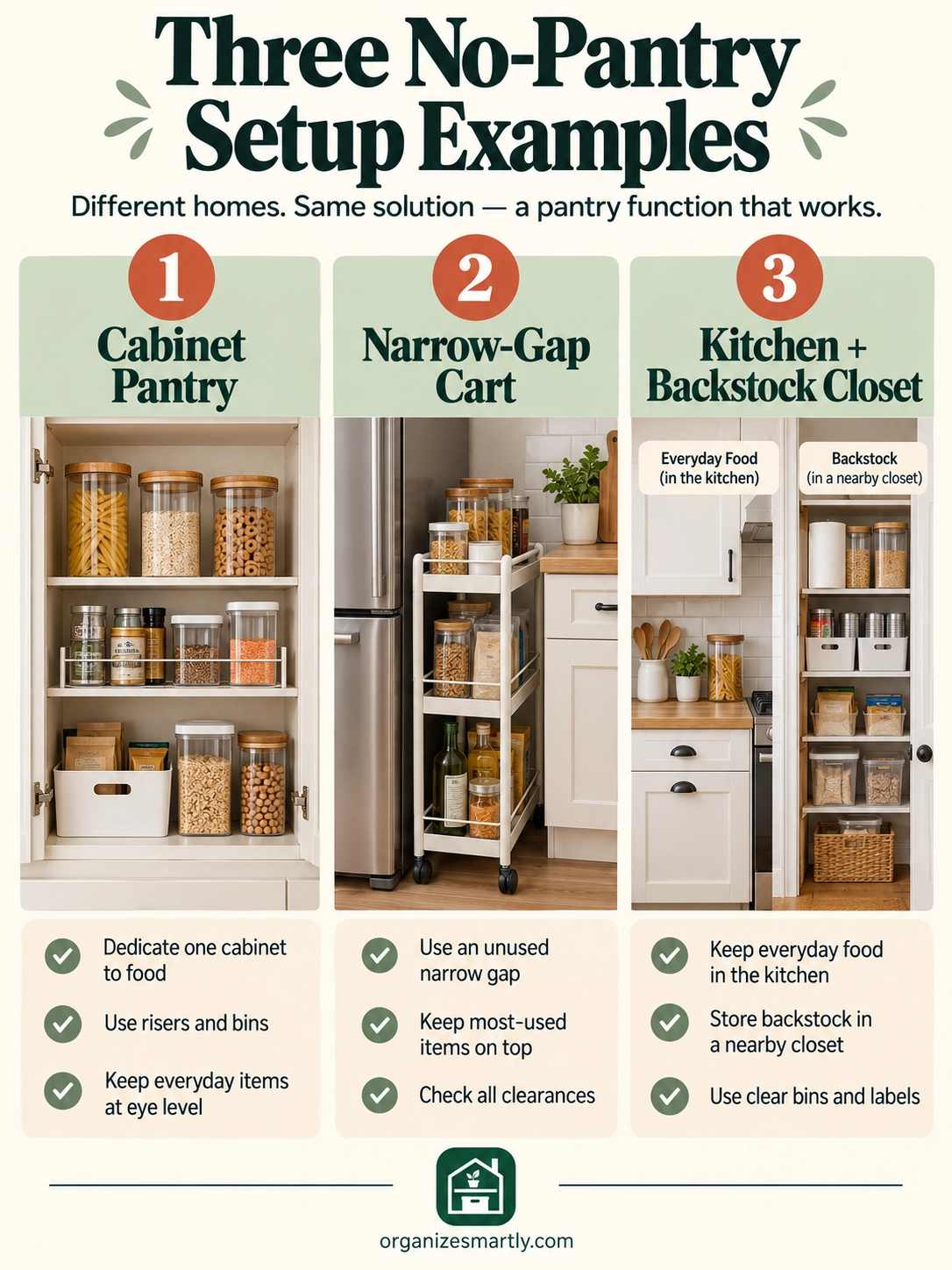
Tiny Apartment With Only Cabinets
Situation: No floor space for extra furniture, no pantry, and limited upper and lower cabinets.
Setup:
- Free one upper cabinet for everyday pantry food.
- Keep breakfast, snacks, pasta, rice, and other frequently used items together.
- Add a shelf riser only where short items leave useful vertical space.
- Put unopened duplicates on a less convenient shelf.
- Keep cookware and dishes in their own zones rather than mixing them into the food cabinet.
The goal is not to force every grocery item into one cabinet. It is to give active pantry food a predictable home.
Small Kitchen With One Narrow Gap
Situation: Existing cabinets are full, but there is unused width beside a refrigerator or another fixed element.
Setup:
- Measure the true usable gap.
- Test surrounding door and appliance clearances.
- If an appropriately sized cart fits, use it for selected everyday dry goods.
- Keep heavy or awkward items in stable existing storage.
- Limit the cart to a few defined categories instead of turning it into miscellaneous overflow.
Kitchen With No Spare Cabinet but a Nearby Closet
Situation: The kitchen cannot give up a cabinet, but a suitable hall or dining-area closet is nearby.
Setup:
- Keep everyday cooking staples in a compact kitchen zone.
- Use the nearby closet for appropriate unopened backstock.
- Group the closet inventory into broad categories.
- Give backups a clear physical limit.
- Check that zone before grocery shopping.
This split system works only if the secondary area stays controlled. If it becomes a forgotten stockroom, it recreates the same visibility problem somewhere else.
Frequently Asked Questions
How Do You Organize a Kitchen if You Don’t Have a Pantry?
Start by gathering your shelf-stable food, separating everyday items from backstock, and choosing one primary food-storage zone. Improve visibility before adding more storage, and give backup inventory a defined limit.
Where Should I Store Food in a Small Kitchen?
Put frequently used shelf-stable food in the most convenient suitable location available, then use less convenient space for backups. Possible options include a kitchen cabinet, deep drawers, freestanding shelving, a rolling cart, a narrow cabinet, or a suitable nearby closet for backstock.
Can I Use a Kitchen Cabinet as a Pantry?
Yes. A cabinet can function as your main pantry zone if it keeps everyday shelf-stable foods visible and accessible. Choose the cabinet based on convenience as well as size.
What Is the Best Pantry Alternative for a Small Apartment?
There is no single best option. Match the solution to the space: spare cabinet → cabinet pantry; deep drawers → packaged foods; narrow gap → slim cart; open wall and floor space → shelving or a freestanding cabinet; suitable nearby closet → backstock; no floor space → appropriate door or vertical storage.
How Do I Store Dry Goods Without a Pantry?
Keep dry goods together in a defined, suitable storage area and make the inventory easy to see. USDA/FSIS advises storing foods such as rice, cereal, pasta, and dried mixes in a cool, clean, dry place and checking packaging for holes that could allow moisture or insects inside.
Is It Okay to Store Food Above the Stove?
USDA/FSIS advises against storing commercially canned foods and other shelf-stable products above the stove because the area can expose them to excessive heat. It also advises against storage under the sink and in damp or temperature-extreme locations.
How Do I Keep a Pantryless Kitchen From Getting Cluttered Again?
Give everyday food and backups clear physical limits. Before shopping, take a few minutes to check what you already have, return stray food to its zone, bring older items forward, and avoid adding more backstock when its designated space is already full.