Bathroom Vanity Organization Ideas for Drawers and Cabinets
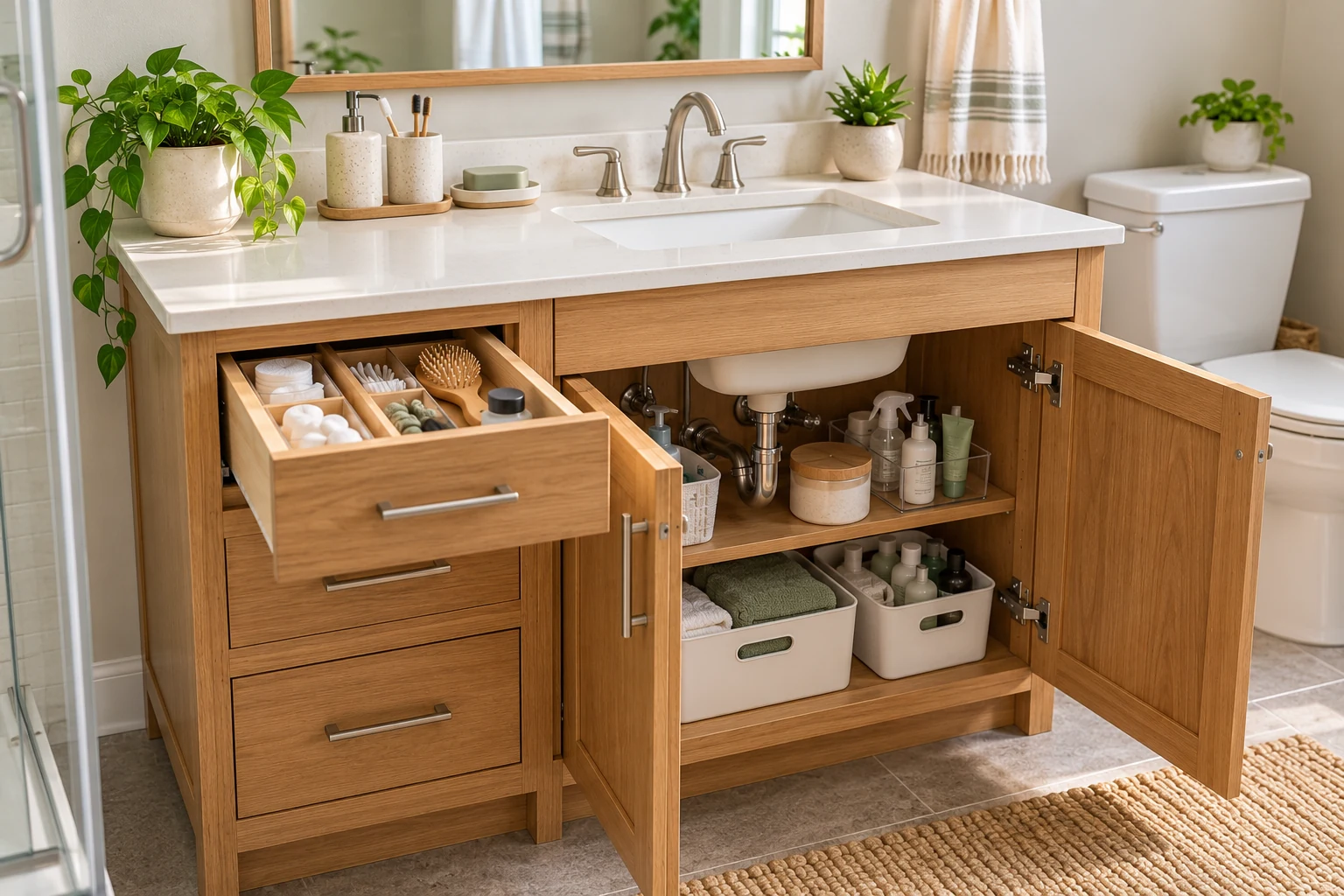
Your bathroom vanity can have drawers, cabinets, and plenty of storage space but still be frustrating to use.
Maybe your everyday skincare gets buried behind half-empty bottles. Small grooming supplies disappear inside a drawer, or the cabinet under your sink has plenty of depth but very little space you can actually reach.
The solution isn't necessarily another organizer. It's figuring out what belongs in your vanity, which spaces are genuinely usable, and how to make everyday items easy to find and put away.
These bathroom vanity organization ideas focus on the drawers and cabinets you already have. Start with what you own, check the fit, and add storage products only when they solve a specific problem.
Quick Navigation
- What Actually Belongs in Your Bathroom Vanity?
- Start With the Vanity You Have
- Bathroom Vanity Drawer Organization Ideas
- How to Organize a Vanity Cabinet Without Drawers
- Make Under-Sink Space Work Without Blocking Access
- Sharing a Vanity? Make Everyday Items Easy to Find
- Try Your Setup Before Buying Another Organizer
- When Your Storage Problem Is Outside the Vanity
- A Better Vanity Is One That's Easier to Use
What Actually Belongs in Your Bathroom Vanity?
Before arranging anything, decide what deserves space near your sink.
Take the contents out of one drawer or cabinet at a time. Group similar items so you can see what you've been keeping there. You don't need to empty the entire bathroom to get started.
Then sort items into three groups:
- Keep within reach: Suitable products you regularly use while getting ready, such as daily grooming supplies or skincare.
- Store farther back: Less frequently used supplies that can safely remain in the vanity without blocking access to everyday items.
- Relocate or remove: Items that don't belong in this storage environment, products you no longer use, and extras that are making the space harder to manage.
Don't let convenience override a product's storage instructions. Heat and moisture from bathrooms can damage some medicines, according to MedlinePlus. Check medicine labels and ask a pharmacist about appropriate storage rather than automatically placing medications in a vanity drawer.
Cosmetics also need attention. The FDA explains that moisture and temperature changes can affect their shelf life. Follow product directions and reconsider anything that shows signs of deterioration.
The goal isn't to fill every available compartment. It's to give appropriate everyday essentials a reliable home.
Start With the Vanity You Have
Different vanity layouts create different storage problems. Before choosing bins, dividers, or shelves, look at how your vanity actually opens.
| Your vanity has… | Start by checking… |
|---|---|
| Several drawers | Interior height, drawer travel, and whether everyday items fit without catching |
| One deep cabinet | The opening, reachable depth, and whether items at the back can be retrieved |
| Drawers beside a cabinet | Which items belong in each area based on size and frequency of use |
| A cabinet below the sink | Pipes, valves, usable space, and access for inspection or maintenance |
| A panel that looks like a drawer | Whether it's a functional drawer or a fixed false front |
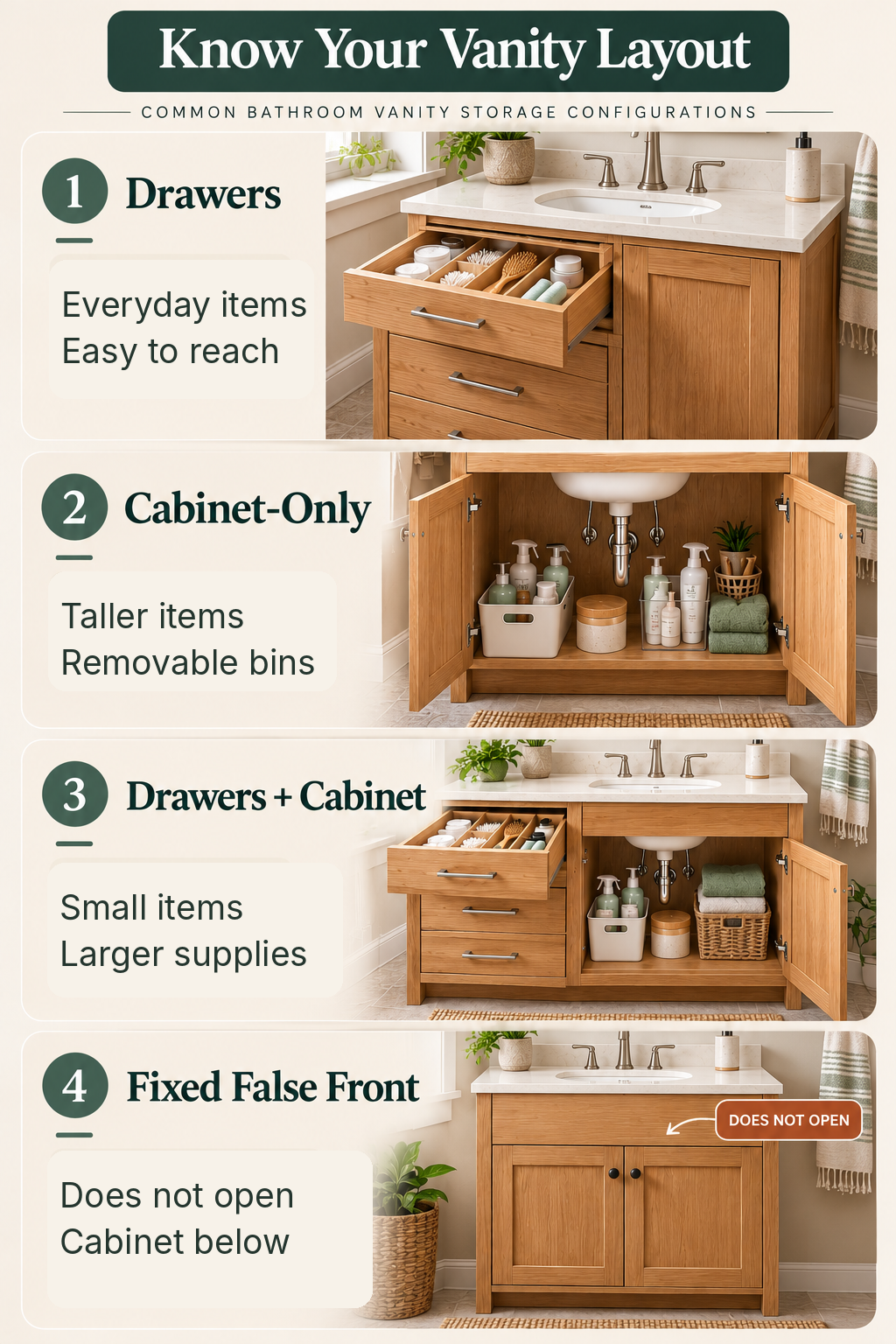
A panel beneath the sink may resemble a drawer but be fixed in place to accommodate the basin. Don't assume it opens or try to force it.
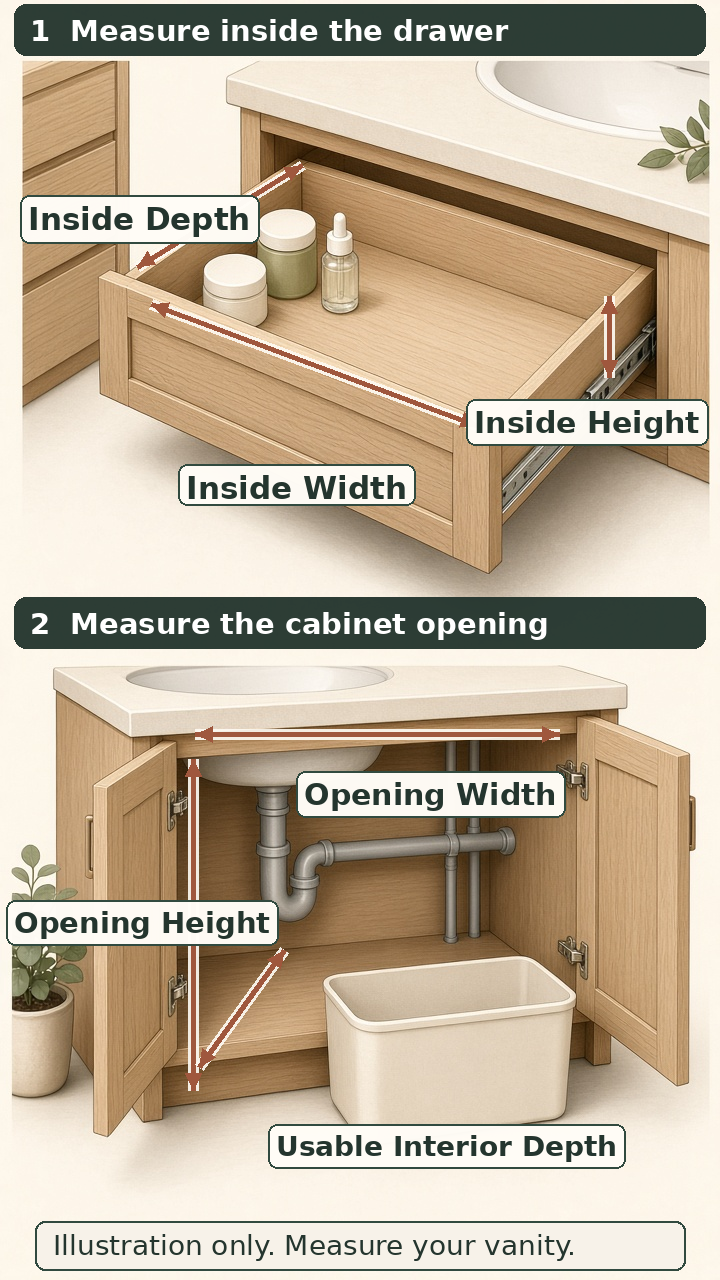
Measure the usable space, not just the outside
A vanity's external dimensions tell you little about whether an organizer will work inside.
For drawers, check the usable interior width, front-to-back depth, and vertical clearance. Notice any notched sections, protrusions, rails, or other features that interrupt a simple rectangular layout.
For cabinets, measure the opening as well as the space behind it. A container may fit inside the cabinet but still be impossible to insert, remove, or pull forward through the door opening.
Before buying anything, ask:
- Can the container pass through the opening?
- Will the drawer or cabinet door close normally?
- Can I remove a stored item without moving several others?
- Will plumbing, hinges, or other hardware interfere?
- Is the storage area dry and suitable for its intended contents?
You don't need a complicated measurement worksheet. Record the measurements that determine whether your proposed arrangement will function.
Bathroom Vanity Drawer Organization Ideas
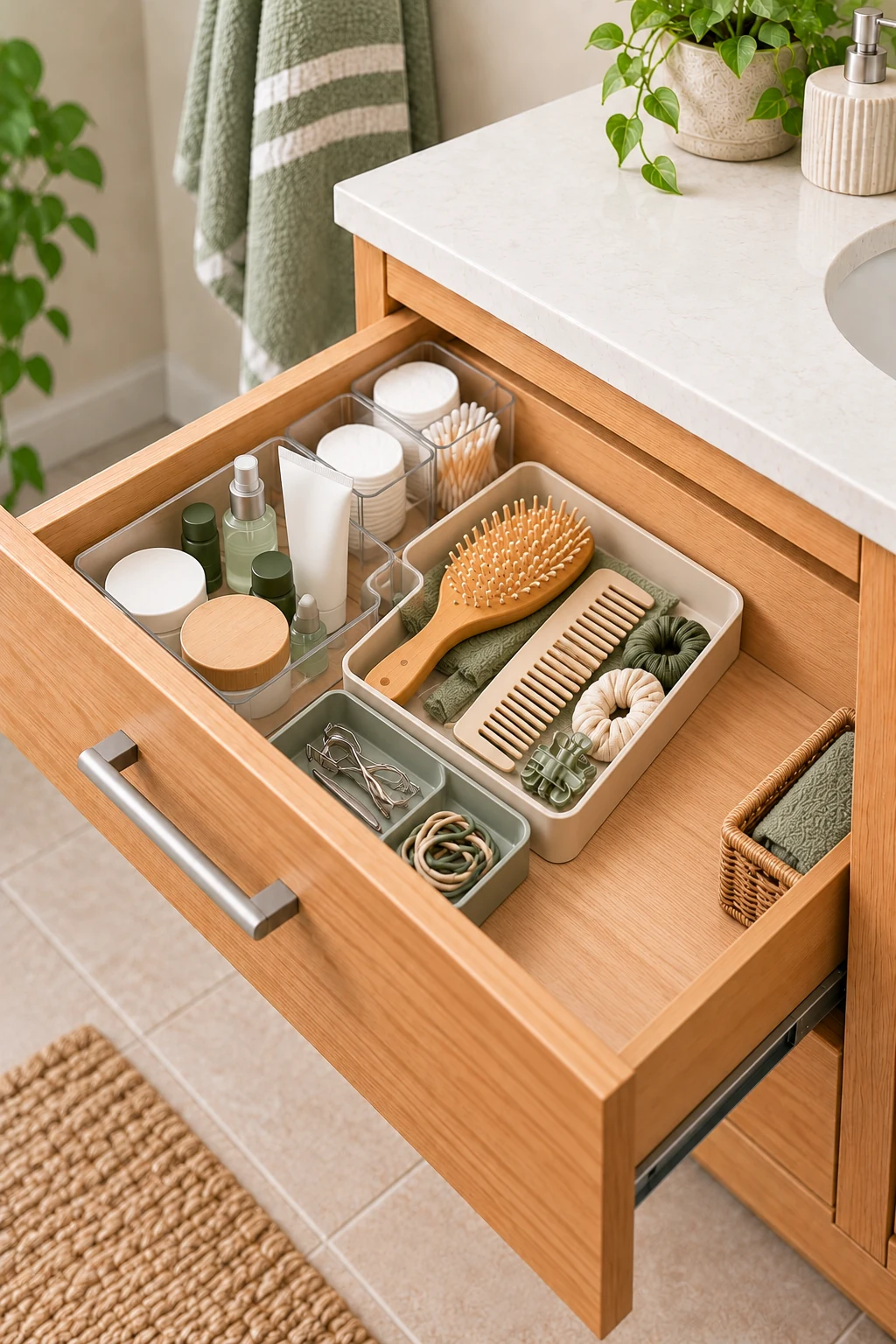
Drawers are useful for smaller everyday items because their contents can come forward when you open them. The problem starts when everything mixes together or an organizer makes the drawer harder to close.
Give daily essentials the easiest position
Place the items you use most frequently where you can see and reach them without searching.
For example, a drawer might have one small group for daily skincare, another for basic grooming tools, and a separate space for items used less often.
Avoid dividing everything into tiny compartments simply because a tray has them. If a product needs to be lifted out awkwardly or repacked after every use, its compartment may be too restrictive.
Keep enough room to handle the items comfortably.
Use drawer dividers only where they help
Existing small containers or adjustable dividers can prevent similar items from mixing.
Try arranging your products before deciding how many dividers you need. A few well-placed sections may be more practical than filling the entire drawer with matching inserts.
Check that the organizer sits below the drawer's available height. Tall dividers, stacked trays, and upright bottles may interfere with closure even when they fit the drawer's width and depth.
A practical test: Put your everyday items into their proposed sections, close the drawer normally, then reopen it and remove the item you use most. If the organizer shifts, catches, or makes retrieval awkward, simplify the arrangement.
If your test shows that dividers would help, compare two different approaches rather than assuming you need both. Loose trays let you rearrange small groups; adjustable dividers create sections inside a drawer that has enough unobstructed room for them.
Measure First: Compare the trays you plan to use with the drawer’s usable width, depth and height. Allow for the contents and any pads you use, then check normal closure and removal.
Best For: Small grooming items or accessories that repeatedly mix together and are easier to find in separate trays.
Skip If: Your existing containers already work, the trays block access or you have little use for the other pieces in a 25-piece set.
Bathroom
Vtopmart 25 PCS Clear Plastic Drawer Organizers
A 25-piece set of removable clear trays in four sizes for organizing small grooming supplies and accessories. Use the pieces that actually suit your drawer rather than trying to fit the entire set into one space.
Check on Amazon (opens in a new tab)Measure First: Check the usable drawer span in the intended installation direction against the listed 17–22 in adjustment range. Confirm the selected divider’s height and fit with the seller before ordering if clearance is tight; published height figures differ.
Best For: A sufficiently long, unobstructed drawer where adjustable sections make more sense than several separate trays.
Skip If: The drawer does not meet the adjustment range, the dividers interfere with closure or pressure against the drawer sides would be unsuitable.
Bathroom
SpaceAid Bamboo Drawer Dividers with Inserts and Labels
Four adjustable bamboo dividers with smaller inserts for making sections in a compatible drawer. This alternative works differently from loose trays and depends on the drawer’s available installation span.
Check on Amazon (opens in a new tab)Deep drawers need a different approach
A deep drawer offers more vertical space, but that doesn't mean every item should be stacked.
Keep frequently used items visible or easy to lift out. Place taller items upright only when they fit and won't be knocked over by normal drawer movement.
Reserve less convenient spaces for supplies that don't need to be accessed repeatedly.
When stacked storage forces you to remove one container to reach another every morning, consider separating those items instead.
The best drawer setup is one you can use without rebuilding it after every routine.
How to Organize a Vanity Cabinet Without Drawers
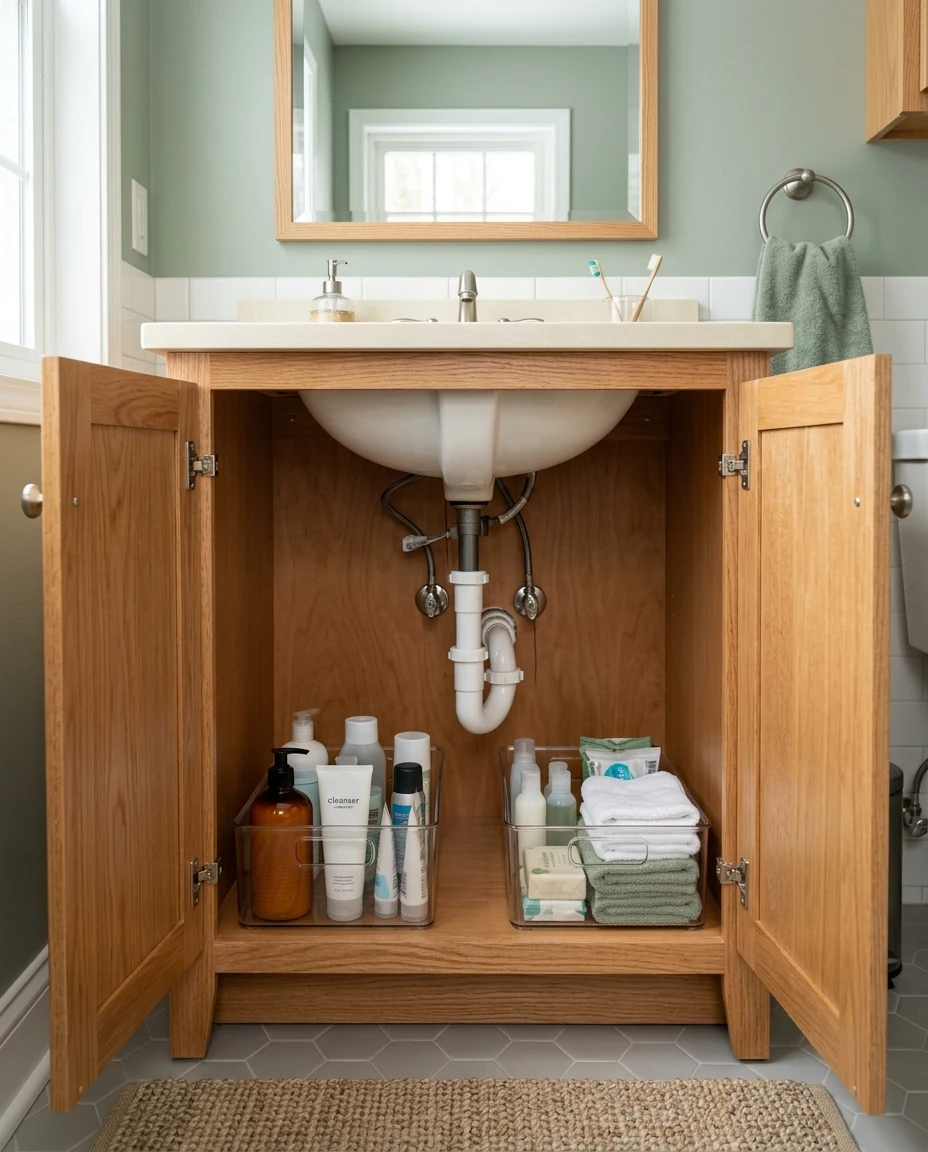
A cabinet-only vanity often has one large storage cavity rather than several convenient compartments.
That sounds flexible, but small products can get lost at the back while tall bottles and bulky supplies compete for the same space.
Create reachable groups inside the cabinet
Instead of lining up every product individually, organize suitable supplies into a few manageable groups.
A possible arrangement is:
- Front: Frequently used items that need easy access.
- Middle: Items used occasionally, provided they remain visible and reachable.
- Back: Less frequently needed supplies that can be retrieved without blocking plumbing or requiring awkward lifting.
These aren't fixed zones. In a very shallow cabinet, there may be no meaningful front or back. In a cabinet with central plumbing, the most useful locations may be on either side.
Choose the arrangement that works with your actual cabinet.
Try a removable container before installing anything
A simple, appropriately sized bin can make small items easier to retrieve from a deep cabinet.
For example, a container holding several grooming supplies may be easier to pull forward than reaching separately for each bottle.
Use a bin you already own to test the idea. If it works, you may not need to buy anything.
A container with handles can be convenient, but handles also require clearance. Check that the container passes through the opening and can be lifted or pulled out without hitting the sink plumbing, hinges, or door.
Don't assume that a two-tier organizer or pull-out system is automatically better. Its frame, rails, and other components may consume usable space.
If a removable bin passes your test, choose the shape that helps with your actual supplies. A divided bin may help keep small items separate; a shallower open bin may make smaller supplies easy to see. You don't need both styles for the same job.
Measure First: Check the cabinet opening, usable depth, bin height and reach to the handle. Make sure the entire bin can pass the door, hinges and plumbing without awkward lifting.
Best For: Small supplies that benefit from separate groups in a removable cabinet bin.
Skip If: The handle is hard to reach, the bin blocks plumbing access, or its divided layout makes your items harder to retrieve.
Bathroom
ClearSpace Pantry Organizers and Storage and Cabinet Organizer, 2 Pack
Two clear storage bins with divider sections for grouping small items in a cabinet. The selected product listing shows a handle on one side; check whether that handle will be convenient in your cabinet layout.
Check on Amazon (opens in a new tab)Measure First: Check the selected bin’s footprint, the cabinet opening and enough free space to grip and lift it. Compare the three-inch bin height with the size and stability of the items you want to store.
Best For: Smaller toiletries or grooming supplies you prefer to group inside a shallow removable bin rather than divide into sections.
Skip If: You need taller sides, find the end handles awkward to grip, or already have a container that does the same job.
Bathroom
mDesign Kitchen Cabinet and Pantry Storage Organizer Bins, Shallow Clear 4-Pack
A four-pack of shallow clear storage bins with cutout-style handles, useful for grouping smaller cabinet supplies without adding a tall organizer.
Check on Amazon (opens in a new tab)Keep cabinet storage simple enough to maintain
An arrangement that looks efficient when freshly organized can become frustrating if every item needs to be positioned precisely.
Try removing and returning the supplies you actually use. If one product constantly blocks another, separate them or give the more frequently used item a better location.
You should be able to use the cabinet without rearranging half its contents.
Make Under-Sink Space Work Without Blocking Access
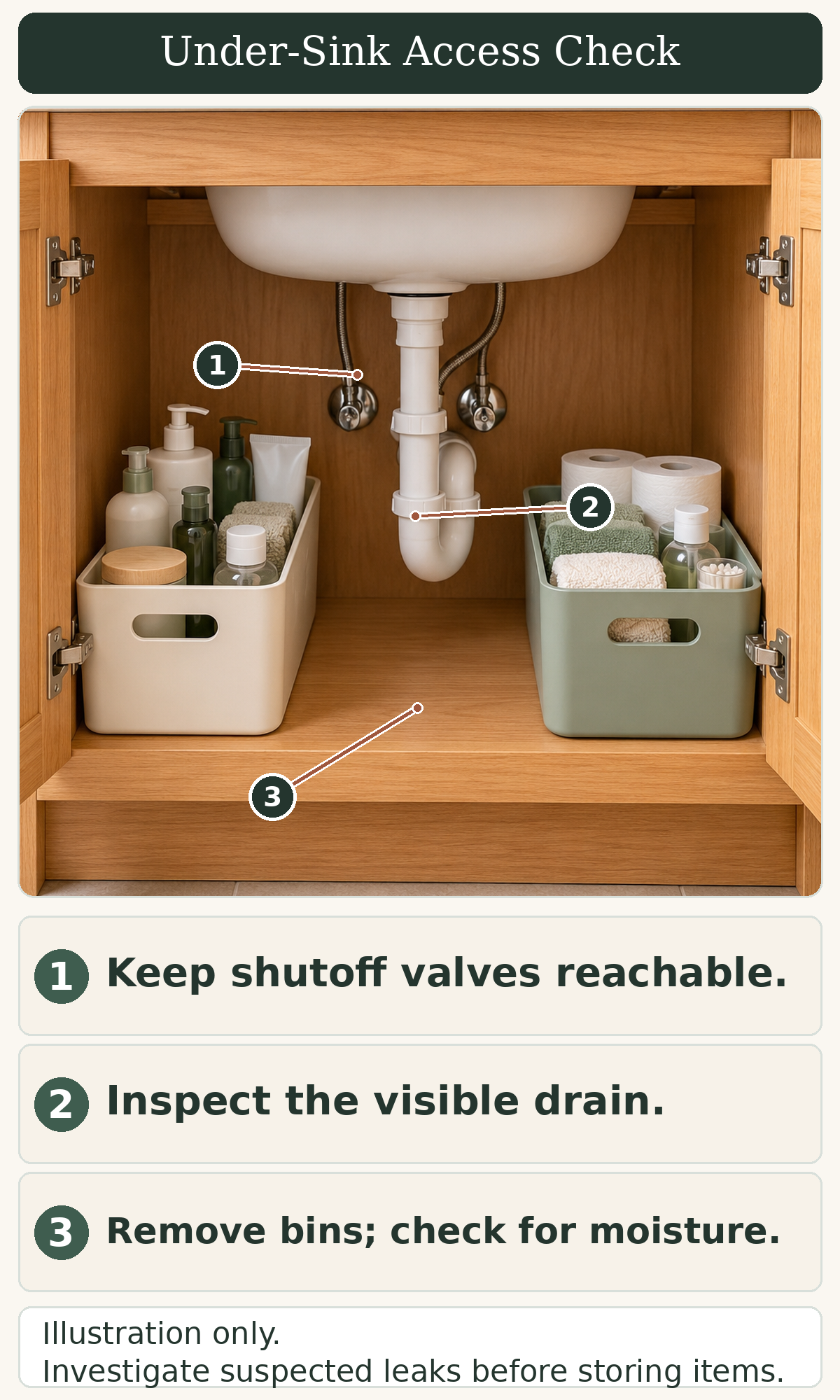
The space beneath a bathroom sink isn't usually an empty rectangle.
Drainpipes, supply lines, valves, hinges, and cabinet framing can interrupt otherwise usable space. The right storage arrangement works around those obstacles rather than hiding or blocking them.
Before placing organizers beneath the sink:
- Look for obstructions. Identify pipes, connections, valves, and cabinet hardware before measuring the space available for storage.
- Keep important access available. Don't place fixed storage where it prevents inspection or access to plumbing components that may need attention.
- Check for signs of water problems. If you notice active moisture, dripping, staining, or suspected leaks, address the underlying issue before treating that area as suitable storage.
- Test removal. Make sure a container can come out through the cabinet opening without colliding with pipes or other hardware.
For some vanities, small bins on either side of the plumbing may be more workable than a large shelf across the center. For others, an uncluttered cabinet with only a few essential items may be the better solution.
Avoid choosing an organizer simply because its product photo shows it beneath a sink. The plumbing layout and required access in your home may be different.
The goal here is basic storage suitability, not modifying plumbing or installing a new cabinet system.
Sharing a Vanity? Make Everyday Items Easy to Find
When two people use the same vanity, a storage system can become confusing even if there seems to be enough space.
You can organize shared storage in more than one way:
| Approach | When it may help | Watch out for |
|---|---|---|
| By person | Each person has distinct everyday products | One side may need more space than the other |
| By routine | Morning and evening supplies are used at different times | Some products may be needed in both routines |
| By item type | Both people regularly use the same categories of supplies | Ownership of individual items can become unclear |
Choose the simplest approach that fits the actual number of drawers, users, and supplies.
If one person uses far more products, an equal number of compartments might not be the most functional allocation. Consider the space and access each person really needs.
Keep commonly used supplies in a predictable place. If someone has to ask where an item went after every cleanup, the organization system needs adjusting.
Try Your Setup Before Buying Another Organizer
Once the vanity looks organized, test whether it works.
Go through a normal getting-ready routine, using the items in their proposed locations.
Open the drawer or cabinet, retrieve what you need, and return it afterward. Notice what slows you down.
| If this keeps happening… | Try this before buying |
|---|---|
| Small products disappear in a drawer | Group them into fewer, clearer sections |
| A drawer catches when closing | Remove or shorten the obstructing organizer; relocate tall items |
| You have to move one bin to reach another | Put frequently used supplies in the easier position |
| Cabinet items disappear at the back | Use an existing removable container or move them forward |
| A cabinet door hits stored items | Reduce the depth or change the arrangement |
| The countertop fills up after every routine | Give suitable everyday items a reachable return location |
| The space under the sink is difficult to access | Reduce stored items and preserve plumbing access rather than adding more storage |
| Containers consume too much space | Remove unnecessary dividers or use fewer containers |
Only consider a new organizer after you understand the problem it needs to solve.
When an organizer is worth considering
A drawer divider may help when small items repeatedly mix together. A removable bin may help when small supplies get lost inside a deep cabinet. A pull-out organizer might be useful where the cabinet layout, dimensions, hardware, and access requirements support it.
Before buying, compare the selected product's listed dimensions with your own measurements. Check any available manufacturer installation guidance, and verify the exact size or variant you plan to order.
Think about what the organizer adds and what it takes away. A product that uses much of the available width, blocks a cabinet door, or requires extra steps to access everyday items may not improve your setup.
And sometimes the best choice is to use fewer things in the space.
When Your Storage Problem Is Outside the Vanity
Not every bathroom storage problem should be solved inside the sink cabinet.
If you don't have a vanity at all, start with our pedestal sink storage guide to compare possible locations around, beside, or away from the sink.
If you're trying to store toiletries used while bathing, our shower storage guide explains how to decide what needs to remain in the wet zone and what can be carried in.
For a rental bathroom where you need storage beyond the existing vanity, explore renter-friendly bathroom storage ideas before choosing new hanging or freestanding solutions.
The point isn't to move every extra item to another part of the room. It's to avoid forcing unrelated storage functions into one crowded cabinet.
A Better Vanity Is One That's Easier to Use
You don't need perfectly matching bins or a completely empty countertop to make your bathroom vanity work better.
Start by deciding what belongs there. Give frequently used items the easiest access, respect the physical limits of your drawers and cabinets, and test the arrangement during normal use.
Then adjust only what isn't working.
A useful vanity organization system should make everyday routines simpler, not give you another set of containers to manage.
Keep Building a Home That Fits
Explore practical organization guides built around real measurements, everyday routines, and usable space.