Spice Storage Ideas for Small Kitchens: Choose What Fits Your Space
Spice storage gets treated like a rack problem. In a small kitchen, it is usually a routing problem.
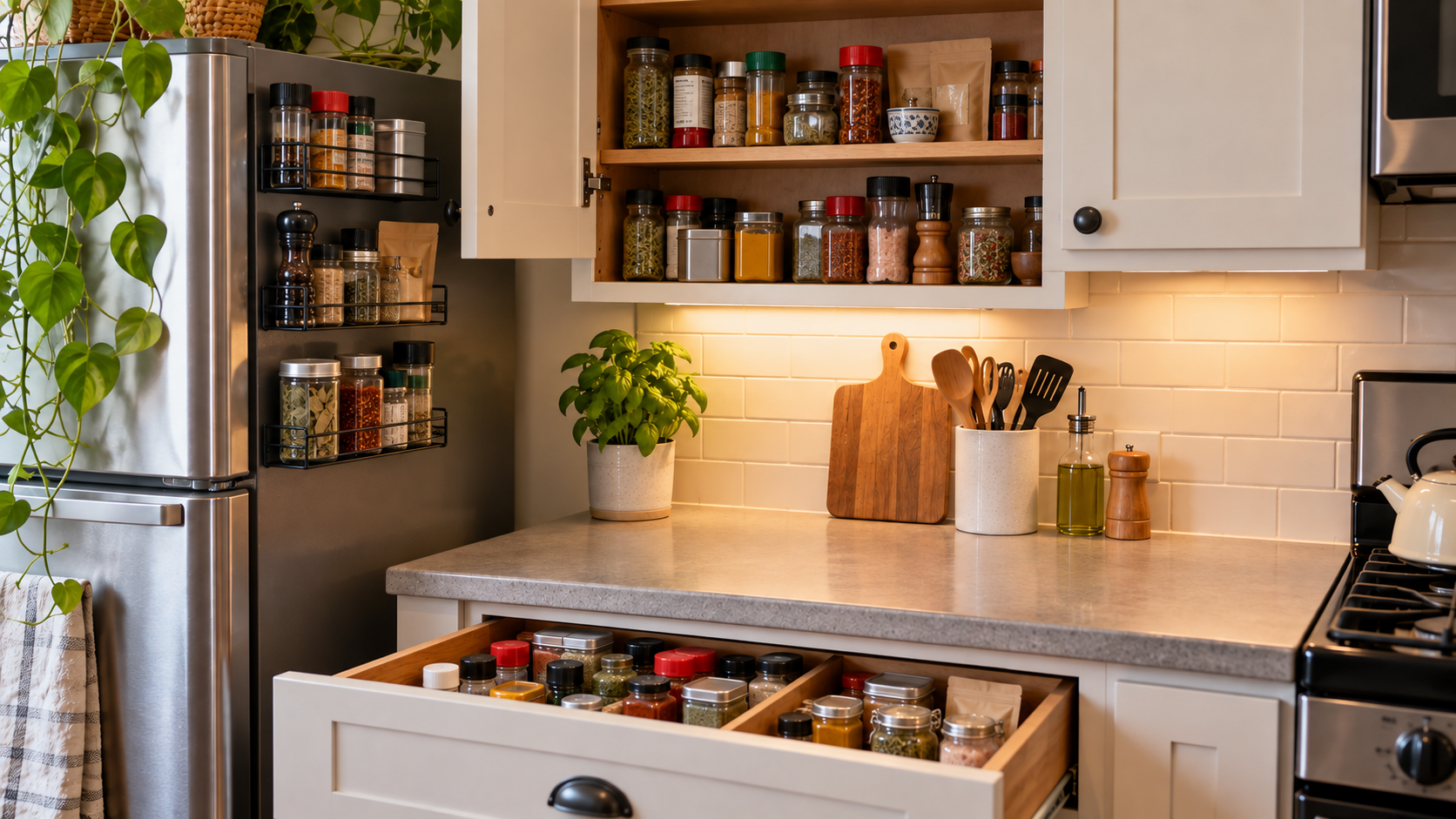
A drawer can look perfect until the jars stop it from closing. A cabinet can technically hold the whole collection while hiding half of it behind the front row. A wall rack can free cabinet space but land in an awkward reach zone. A countertop organizer can make spices easy to grab while quietly taking over the work surface you were trying to protect.
So before you buy another organizer, use a simpler rule:
Count first. Measure second. Route third. Buy last.
The goal is not to find the most attractive spice-storage idea. It is to choose the route that fits the spices you actually use, the containers you actually own, and the usable space your kitchen actually has.
If spices are only one part of a larger space problem, start with OrganizeSmartly’s broader small-kitchen organization guide: small kitchen organization ideas
Affiliate disclosure: This guide contains affiliate links. If you purchase through one of our links, OrganizeSmartly may earn a commission at no additional cost to you. We recommend products based on problem-solution fit, dimensions, and practical usefulness. Read the disclosure.
Start With the Spice Collection, Not the Rack
Before comparing drawers, cabinets, doors, walls, magnetic surfaces, or the counter, take a quick Capacity Snapshot. This prevents a common small-kitchen mistake: choosing an organizer first and trying to make the collection conform to it afterward.
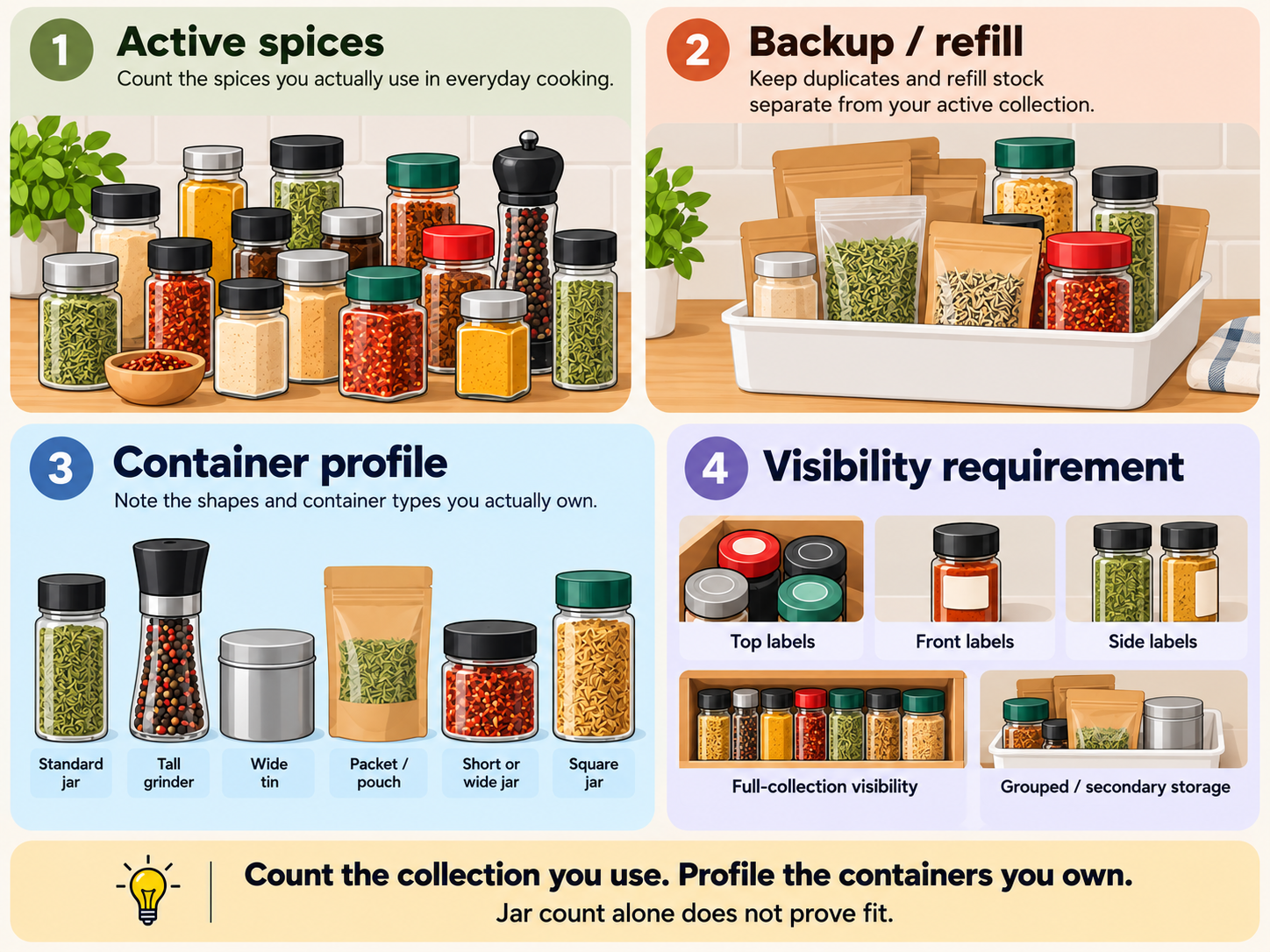
Count the active collection
Count the spice, herb, and seasoning containers that need everyday working storage. Use your real number. There is no useful universal cutoff for what counts as a small, medium, or large spice collection because container size, shape, and storage route matter just as much as the count.
Do not count only matching jars if your actual collection includes grinders, tins, packets, or unusually wide containers. The storage system has to fit the collection you own, not the tidier collection that exists in product photos.
Separate working spices from refill stock
Next, separate the containers you cook from regularly from backup bags, duplicate bottles, and refill stock.
That distinction matters because backup inventory can make a working spice collection look larger than it needs to be. A route that comfortably holds the active set may be perfectly adequate even if bulk refills live somewhere else.
If the real problem is where to keep food backstock in a kitchen without a pantry, that is a different storage decision. Use the pantryless-kitchen guide here: organize small kitchen without pantry
Record the container profile
Jar count alone is weak capacity information. Note the containers that could change fit:
- tall grinders;
- wide tins;
- packets or pouches;
- unusually short or tall jars;
- mixed round and square containers;
- labels that are readable only from the top, front, or side.
If you later consider an organizer advertised to hold a certain number of jars, the important question is not simply how many jars it holds. It is what size and orientation that capacity assumes.
Decide what must be visible at a glance
Some cooks want every spice visible at once. Others can comfortably keep frequently used seasonings in the easiest position and lower-frequency items behind or below them.
Decide what you need before choosing the route. If top labels are easiest for you to scan, a drawer may have an advantage. If front labels matter more, a cabinet, pull-out concept, door rack, or wall system may be easier to read. If you regularly forget spices that disappear into a back row, visibility is not a cosmetic preference. It is part of whether the route works.
Measure the Storage Routes Your Kitchen Actually Has
Small kitchens punish optimistic measuring. A space can look available and still fail once hinges, drawer slides, shelf lips, door swing, appliance clearance, or operating space enter the picture.
Measure usable space, not nominal space.
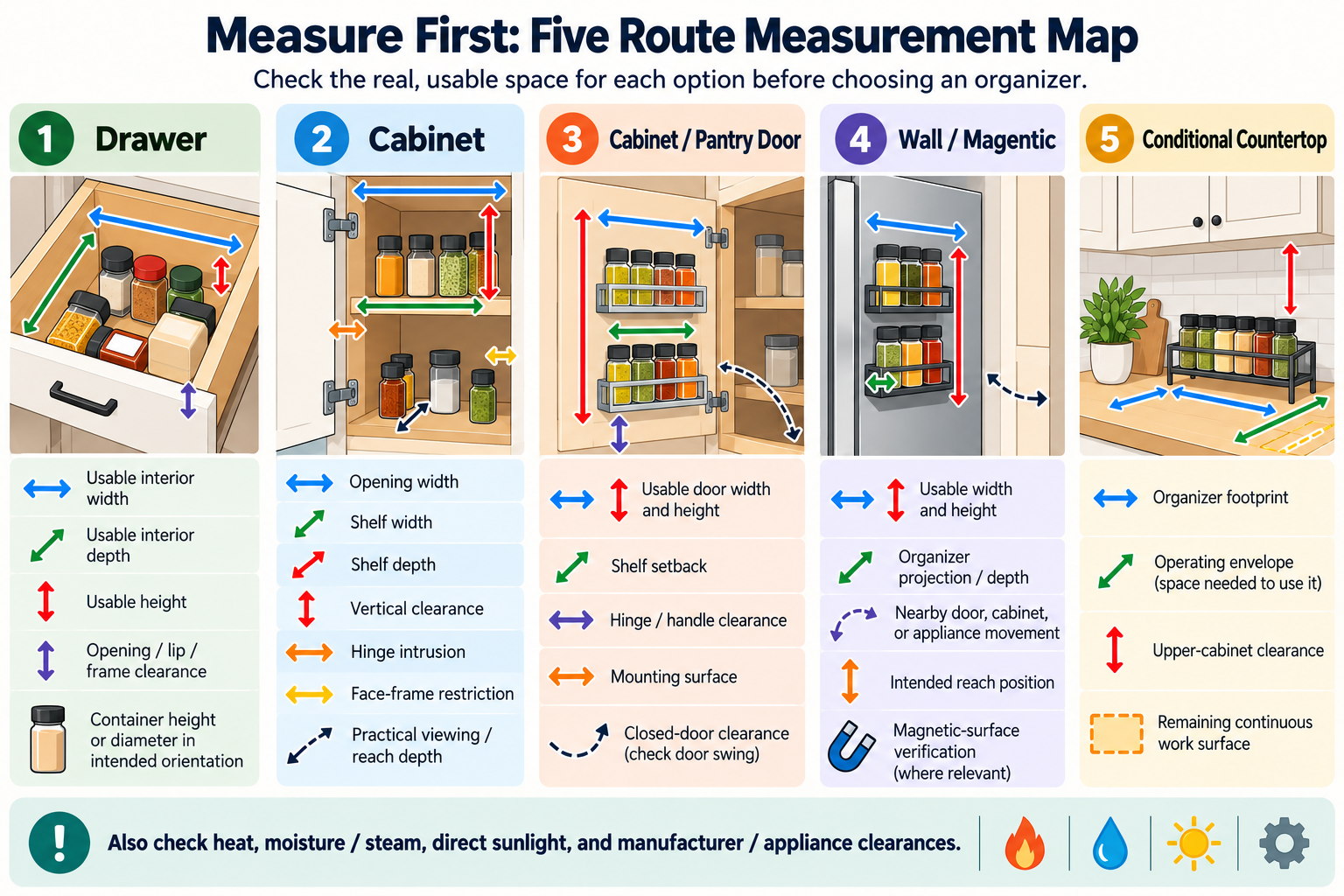
For a drawer, record the interior width, depth, and usable height. Check the opening geometry too. A jar may fit inside the drawer box but still catch on the frame or prevent normal closure.
For a cabinet, measure the opening width, shelf width and depth, vertical clearance, shelf spacing, hinge intrusion, and any face-frame restriction. Also consider whether you can actually see and reach the back of the proposed storage zone.
For the inside of a cabinet or pantry door, measure the usable door area and the clear depth between the closed door and the shelves or stored items behind it. Check hinges, handles, and shelf setback.
For a wall or magnetic route, measure the usable width and height plus how far a future rack would project into the room. Check nearby door, cabinet, and appliance movement. If the route depends on a refrigerator or other appliance surface, confirm that the exact panel is magnetic before treating it as available storage.
For the countertop, measure the organizer’s footprint and any extra operating space it needs to rotate, open, or pull out. Then look at what remains. The relevant question is not whether a spice rack fits on the counter. It is whether the counter still works after the rack arrives.
Use the Spice Route Fit Test
Once you know the collection and the available routes, compare every option using the same six questions.
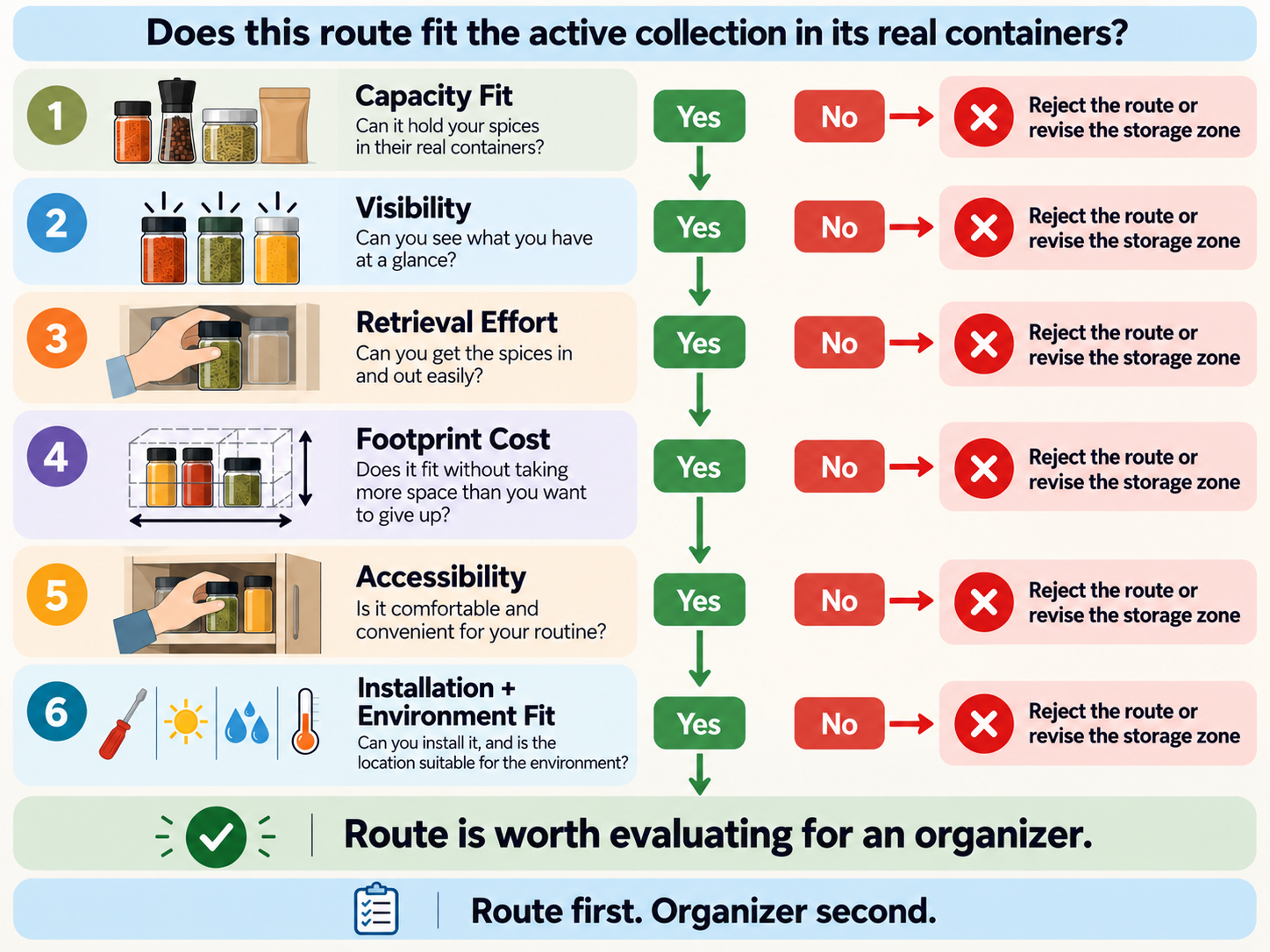
1. Capacity Fit
Can the usable zone hold the active collection in its real containers without hidden second layers, unstable stacking, or immediate overflow?
2. Visibility
Can you identify the spice you want without unloading unrelated containers or repeatedly rotating the collection?
3. Retrieval Effort
What does one normal retrieval require? Consider opening, pulling, bending, reaching, lifting, or moving blockers. A route that looks efficient while empty may become annoying after the twentieth daily use.
4. Footprint Cost
What scarce kitchen resource does the route consume? A drawer uses drawer volume. A cabinet uses shelf space. A door system uses closure clearance. A wall rack uses vertical real estate. A countertop system spends work surface.
5. Accessibility
Is the route comfortable for the person using it? AARP’s HomeFit kitchen guidance emphasizes reducing unnecessary bending, stooping, and stretching and keeping frequently used items within easier reach. That does not make one route universally accessible. It means the best route depends on the intended user’s reach, visibility, and retrieval pattern.
6. Installation + Environment Fit
Does the location work physically and practically? Consider the mounting method, supported surface, lease restrictions where relevant, door or appliance clearance, and the storage environment.
A route fails the test if it solves capacity by creating a worse visibility, retrieval, access, installation, prep-space, or storage-environment problem.
When a Spice Drawer Is the Best Route
A drawer can be an efficient spice route when the active collection fits in one usable layer and the jar orientation makes labels easy to scan.
The drawer does not need to look like a matching-jar catalog. It needs to close normally, keep containers stable enough for everyday use, and let you find what you need without digging.
Measure First
- usable interior width and depth;
- usable interior height, not just drawer-front height;
- any lip, slide, or frame geometry that affects closure;
- jar height or diameter in the intended orientation;
- the footprint of any insert considered later.
Best For
- a collection that fits in one available drawer without pushing out a higher-priority category;
- users who find top labels or angled labels easy to scan;
- kitchens where closed storage keeps the counter clear;
- a drawer position that is comfortable for the intended user.
Skip If
- tall jars or grinders exceed usable height;
- an angled layout prevents normal closure;
- mixed containers become unstable or difficult to read;
- the collection requires hidden layers;
- dedicating the drawer would create a bigger kitchen-tool storage problem;
- the drawer location requires uncomfortable bending or reaching for frequent use.
Kitchen
YouCopia SpiceLiner Spice Drawer Organizer, Gray, 10-ft Roll
Cut-to-fit freestanding liner keeps spice bottles in one visible drawer layer without drilling or adhesive. Manufacturer states 30+ bottles; actual fit depends on drawer geometry and the containers you own.
Check on Amazon (opens in a new tab)When a Cabinet Works Better
A cabinet can make sense when the active collection fits on a shelf that is easy to reach and the layout prevents the back row from becoming a spice graveyard.
The cabinet route is not one single solution. Later, the chosen route might use a tiered riser, rotating organizer, or pull-out category. For now, choose the cabinet only if the underlying shelf geometry and retrieval pattern work.
Measure First
- cabinet opening width;
- shelf width and depth;
- vertical clearance and shelf spacing;
- face-frame restrictions;
- hinge intrusion;
- practical reach depth and viewing angle;
- container dimensions;
- the full footprint and operating space of any organizer considered later.
Best For
- collections that fit without several invisible rows;
- shelves where tiering, rotation, or pull-out access could improve visibility without consuming a more valuable zone;
- users who can comfortably reach the chosen shelf.
Skip If
- the back row remains effectively invisible;
- retrieving one spice means removing several containers first;
- the plan depends on unstable stacking;
- frequent-use spices land on an uncomfortable shelf;
- hinges, face frames, or shelf geometry conflict with the storage method.
If the problem expands from spice storage into general cabinet zoning, deep-cabinet organization, or shelf mechanics, continue with the kitchen-cabinet guide: organize kitchen cabinets small kitchen
Kitchen
SONGMICS Cabinet Organizer Shelf
A shelf riser is one of the simplest ways to turn unused cabinet height into usable storage. It works especially well for dishes, mugs, small pantry items, and short containers that otherwise leave empty space above them.
Check on Amazon (opens in a new tab)Because this option rotates on a track rather than acting as a static shelf, judge it by both shelf footprint and operating room, not footprint alone.
Kitchen
YouCopia MagicTrack Spice Turntable
A tool-free cabinet turntable brings rear spices forward by rotating on a rectangular track. Manufacturer states up to 24 spice bottles; actual fit depends on the user’s jar profiles and room to rotate.
Check on Amazon (opens in a new tab)Because this option is a mounted pull-out rather than a freestanding shelf accessory, treat mounting compatibility and unobstructed movement through the measured cabinet opening as part of fit.
Kitchen
LYNK PROFESSIONAL Elite 432821 / 432821DS Slide-Out Spice Organizer
A screw-mounted pull-out brings spices at the back of a deeper upper cabinet forward. Manufacturer specifies two-screw installation; measure the opening and full extension path.
Check on Amazon (opens in a new tab)When the Inside of a Door Earns the Space
The inside of a cabinet or pantry door can use a shallow layer that is otherwise wasted. That makes it attractive in a small kitchen, but the route has one non-negotiable requirement: the door still has to work as a door.
A rack that fits the door dimensions but collides with a shelf is not a fit. Neither is one that affects the hinge, prevents smooth closure, or depends on a mounting method that is not appropriate for the surface or lease.
Measure First
- usable door width and height;
- door thickness where relevant;
- clear depth between the closed door and shelves or stored items;
- hinge and handle clearance;
- shelf setback;
- mounting surface and material;
- whether the door can close and swing normally after installation.
Best For
- shallow, lightweight spice storage;
- kitchens that need to preserve drawer, shelf, or counter space;
- setups where the mounting method is permitted and supported.
Skip If
- the rack would contact shelves or stored items;
- the door would no longer close smoothly;
- hinge movement would be affected;
- the mounting surface or load requirement cannot be verified;
- the method conflicts with the lease, finish, or surface;
- repeated door movement makes the chosen system impractical.
Do not treat “no-drill” as automatically renter-safe. Adhesive systems have product-specific surface, weight, preparation, removal, and environmental requirements. Even established adhesive-system manufacturers publish compatibility limits. Verify the exact product later rather than turning “adhesive” into a blanket permission slip.
For broader reversible and renter-focused kitchen storage ideas, see: small apartment kitchen storage ideas
When Wall or Magnetic Storage Makes Sense
Vertical storage can help when drawer and cabinet capacity is scarce, but “unused wall” is not the same as “good spice-storage location.”
A wall route has to pass four checks at once: usable dimensions, comfortable reach, safe installation, and an appropriate storage environment.
A magnetic route adds another check: the exact surface must actually be magnetic, and the organizer cannot interfere with appliance doors, handles, hinges, ventilation, or manufacturer-required clearances.
Wall Route: Measure First
- usable wall width and height;
- rack width, height, and projection;
- nearby cabinet, door, and appliance movement;
- intended reach position;
- mounting surface and future fastener requirements;
- exposure to stove heat, sink or dishwasher moisture and steam, or direct sunlight.
Magnetic Route: Measure First
- whether the exact panel is magnetic;
- usable magnetic area;
- rack width, height, and depth;
- appliance-door swing, hinges, and handles;
- nearby wall or cabinet clearance;
- manufacturer guidance where placement could affect appliance operation;
- heat, moisture, and light exposure.
Best For
- kitchens with limited drawer and cabinet capacity;
- a genuinely usable wall or magnetic surface;
- shallow storage that improves visibility without creating a movement conflict;
- locations that are comfortable to reach and away from problematic heat, moisture, or direct sunlight.
Skip If
- the mounting surface cannot be verified;
- lease or surface restrictions rule out installation;
- the rack projects into a walkway or door/cabinet path;
- the location is awkward to reach;
- a magnetic rack interferes with appliance use or required clearance;
- the location is exposed to problematic heat, steam, moisture, or direct sunlight;
- future load or mounting requirements are unknown.
Kitchen
HuggieGems Magnetic Spice Storage Rack
A magnetic rack can add removable vertical storage without drilling, making it especially useful for renters. It works best on an exposed refrigerator side where it will not interfere with doors or required appliance clearance.
Check on Amazon (opens in a new tab)Countertop Spice Storage Is a Conditional Route
Countertop spice storage is not automatically wrong. It is simply expensive in a small kitchen because it spends work surface.
A small active spice set may earn permanent counter residency when the footprint is controlled, the location is appropriate, and every other route creates a worse problem. But the countertop should not become the default answer just because the organizer is easy to see.
Measure First
- organizer footprint;
- full operating envelope if it rotates, opens, or pulls out;
- remaining continuous work surface after placement;
- upper-cabinet clearance;
- exposure to stove heat, sink or dishwasher moisture, steam, or direct sunlight;
- whether the active set can realistically stay within the planned footprint.
Best For
- a small working set that genuinely earns the space;
- a location that is easy to wipe and reset;
- kitchens where drawer, cabinet, door, and wall routes are all worse fits.
Skip If
- it cuts into reserved prep space;
- it turns the counter into default storage again;
- the collection is likely to overflow the footprint immediately;
- the location has problematic heat, moisture, steam, or sunlight exposure;
- the real problem is broader counter allocation rather than spice storage.
If a spice rack would compete with chopping, mixing, plating, or another core task, use the Prep-Space Budget from the counter-organization guide instead: organize kitchen counters small kitchen
Keep the Storage Location Cool, Dry, and Away From Problem Exposure
The most convenient location is not automatically the best place for dried herbs and spices.
Penn State Extension advises storing dried herbs in airtight containers in a cool, dry, dark area away from moisture and specifically cautions against stove-, sink-, and windowsill-adjacent storage. McCormick similarly advises keeping herbs and spices tightly capped and away from heat, moisture, and direct sunlight, including locations over the stove, dishwasher, sink, or near a window.
That does not create a universal number of inches every spice jar must stay from a stove or sink. The sources do not provide a single residential clearance rule that applies to every kitchen. Use the principle instead: avoid locations where heat, moisture, steam, or direct sunlight are a meaningful part of the storage environment.
Also follow any special storage instructions on the package or from the manufacturer. Specific product directions override generic advice.
The practical consequence for A07 is simple: convenience comes after environment fit. A magnetic rack beside an appliance, a wall rack near the range, or a countertop caddy beside the sink may be easy to reach and still fail the route test if the location exposes the spices to conditions the storage guidance says to avoid.
Compare the Routes Side by Side
No route is the universal winner. Use this comparison to narrow the options that fit your kitchen.
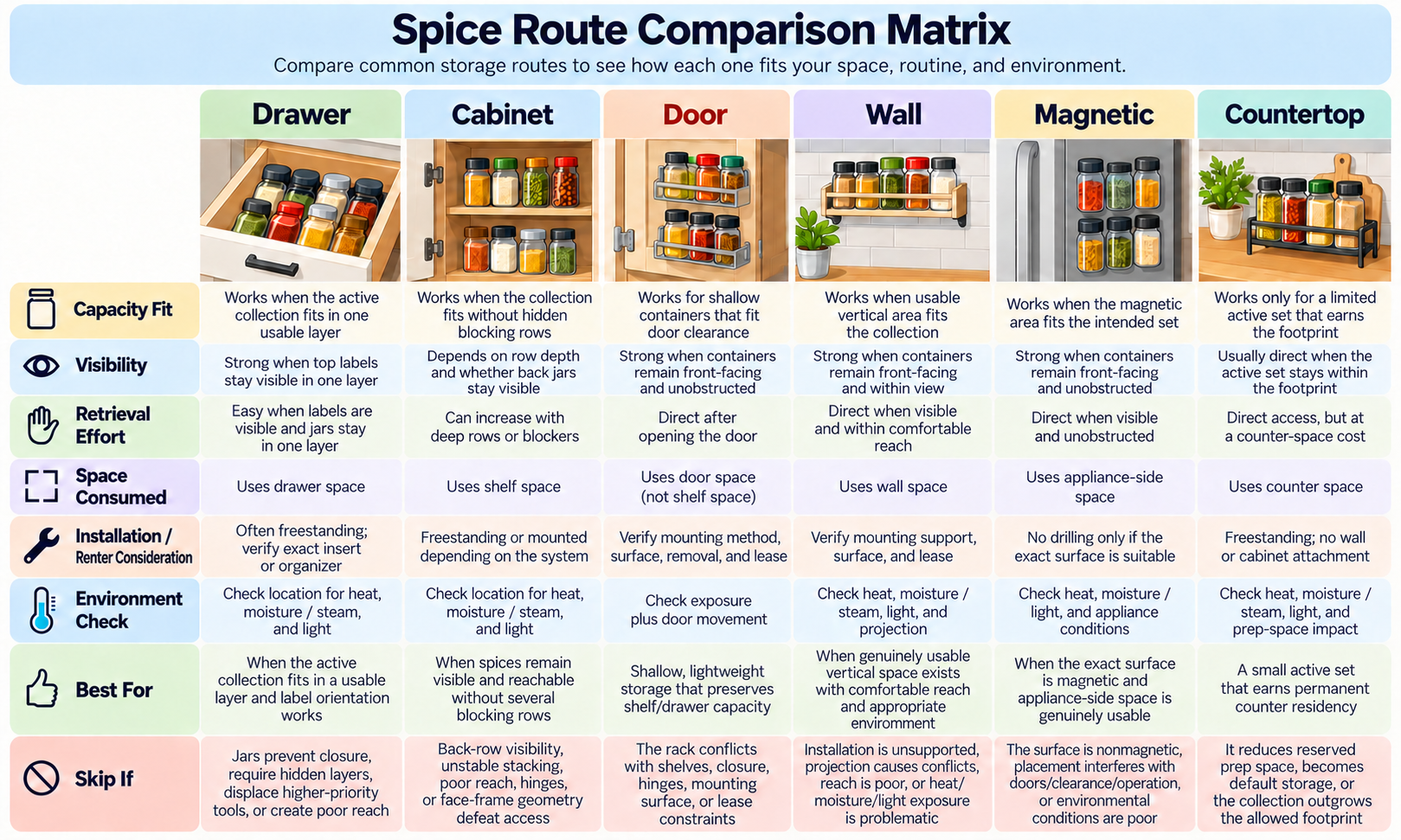
| Route | Capacity Fit | Visibility | Retrieval Effort | Space Consumed | Installation / Renter Consideration | Environment Check | Best For | Skip If |
|---|---|---|---|---|---|---|---|---|
| Drawer | Depends on usable width, depth, height, and container orientation | Can show top or angled labels clearly in one layer | Drawer pull plus direct pick when unobstructed | Drawer volume | Freestanding insert can avoid attachment; exact product dimensions still matter | Check location for nearby heat/moisture | One-layer collections and top-label visibility | Jars prevent closure, collection needs hidden layers, drawer is uncomfortable to reach |
| Cabinet | Depends on shelf geometry and practical reach depth | Good only if back rows remain identifiable | Low when jars are directly reachable; higher with blockers | Cabinet shelf space | Freestanding categories can avoid attachment; mounted/pull-out systems need later verification | Check shelf location for heat/moisture | Collections that fit without invisible rows | Multiple blockers, unstable stacking, inaccessible shelf |
| Door | Depends on usable door area plus closed-door clearance | Front-facing layout can improve visibility | Open door, then retrieve | Door layer and closure clearance | Conditional on surface, load, mounting method, removal, and lease | Check nearby heat/moisture/light | Shallow storage that preserves shelves/drawers | Door hits shelves, hinge/closure affected, mounting not verified |
| Wall | Depends on usable wall area and rack projection | Front-facing storage can be easy to scan | Direct when within comfortable reach | Wall area | Conditional on surface, fasteners, lease, and exact product | Must avoid problematic heat/moisture/direct sunlight | Kitchens lacking drawer/cabinet capacity | Awkward reach, movement conflict, unsupported mounting, poor environment |
| Magnetic | Depends on verified magnetic area and clearance | Front-facing layout can improve visibility | Direct when appliance-side position is usable | Magnetic appliance/surface area | No drilling only if the exact magnetic product/surface combination works | Check appliance guidance plus heat/moisture/light | Suitable magnetic surface with unused clearance | Nonmagnetic panel, appliance conflict, unknown load/stability, poor environment |
| Countertop | Limited by the footprint the kitchen can afford | Usually visible | Direct access | Prep/work surface | Freestanding; no attached installation | Check heat/moisture/light carefully | Small active set that earns the footprint | Reduces prep space, collection overflows, better route exists |
What to Reject Even if It Technically Fits
The strongest small-kitchen storage decisions come from rejecting options early.
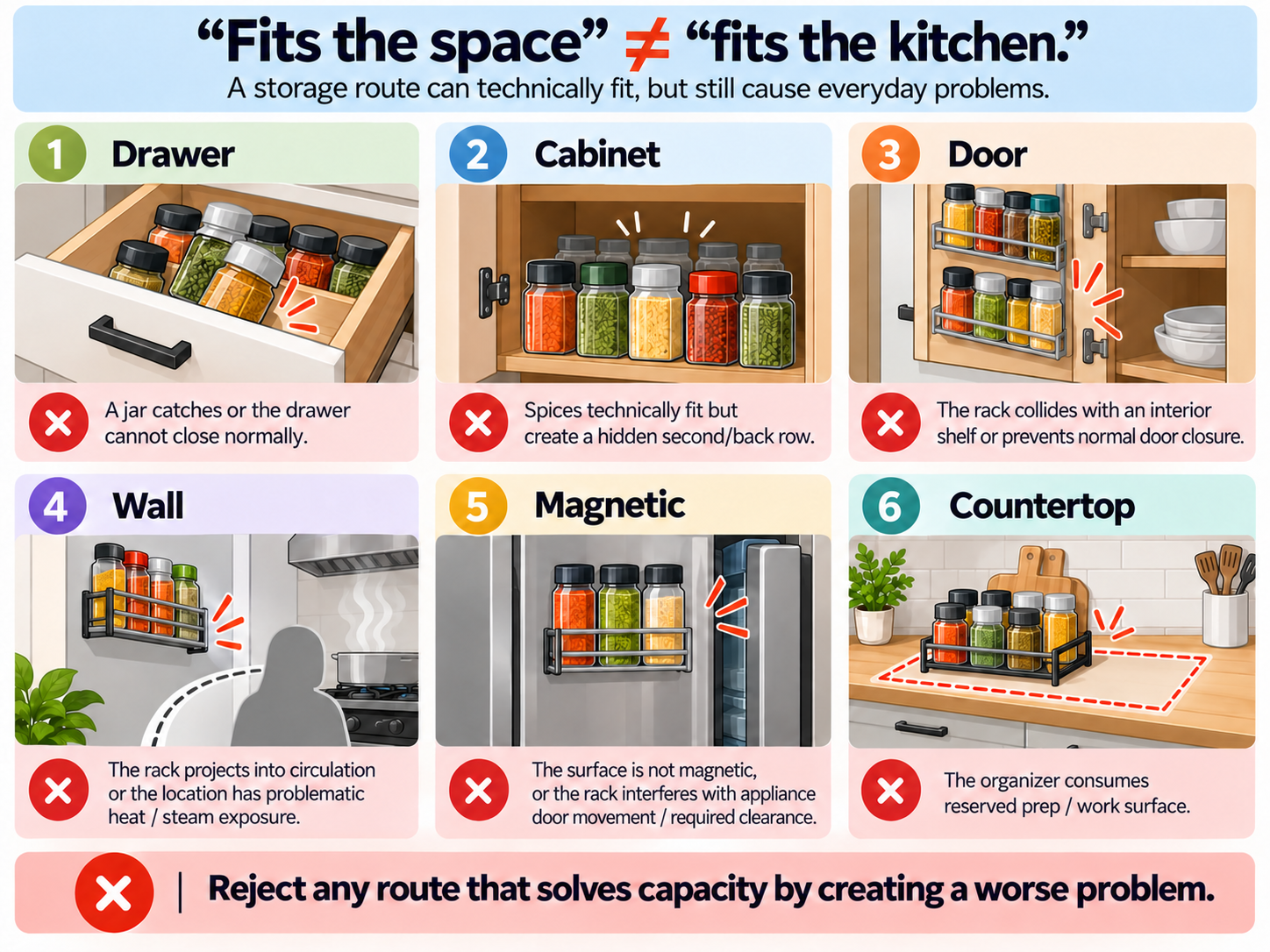
Reject a route if the drawer closes only when jars are forced into an unstable angle.
Reject a cabinet layout if the capacity works only by creating an invisible back row you will have to excavate later.
Reject a door rack if the measurements ignore shelf depth and the door cannot close normally afterward.
Reject a wall system if the rack projects into circulation, requires an uncomfortable reach, or depends on a mounting method you cannot verify.
Reject a magnetic system if the panel is not actually magnetic, the rack interferes with appliance movement, or required clearances are unclear.
Reject a countertop organizer if it “fits” only by taking away the prep area the kitchen needs to function.
And reject any product claim later if the capacity, dimensions, load, compatible surface, or installation requirements cannot be verified for the exact variant.
The Reject Gate is not pessimism. It is how you avoid buying a storage solution that creates the next storage problem.
Frequently Asked Questions
Where should spices be stored in a small kitchen?
Store them in the route that fits the active collection, container profile, usable dimensions, visibility needs, retrieval pattern, and storage environment. A drawer, cabinet, door, wall, or magnetic surface can all work in the right kitchen. The counter should be treated as a conditional route because it spends work surface.
For dried herbs and spices, favor a cool, dry location away from problematic heat, moisture, steam, and direct sunlight. Follow any specific package or manufacturer storage instructions.
Is it better to store spices in a drawer or cabinet?
Neither is universally better. A drawer can work well when the collection fits in one layer and top labels are easy to scan. A cabinet can work well when the shelf is comfortable to reach and jars remain visible without several hidden rows.
Choose between them by measuring the actual spaces and comparing visibility and retrieval effort, not by assuming one route is automatically more organized.
How do I organize a lot of spices in a small space?
Start by separating the active working collection from backup and refill stock. Then record the container profile and measure every realistic route before choosing an organizer.
If one route cannot hold the full active set without hidden layers or poor access, you can also organize by frequency: keep the highest-use spices in the most usable part of the selected route and lower-frequency items in secondary storage, provided the system remains easy to understand and reset.
Should spices be stored near the stove?
Avoid using stove-adjacent storage simply because it is convenient. Penn State Extension recommends cool, dry, dark storage for dried herbs and specifically advises against storage near the stove, sink, or windowsill. McCormick likewise advises keeping spices and herbs away from heat, moisture, and direct sunlight.
There is no universal distance rule in the approved sources, so do not invent one. Evaluate the actual exposure in the location you are considering.
Can I store spices on a cabinet door or wall?
Yes, conditionally. The route should pass clearance, reach, mounting, and environment checks first.
For a cabinet door, confirm that the rack will not hit shelves or stored items and that the door can still close and swing normally. For a wall, confirm the surface and mounting method, rack projection, comfortable reach, and exposure to heat, moisture, and direct sunlight.
If you rent, do not assume an adhesive or no-drill system is automatically safe for every finish or lease. Verify the exact product and surface instructions later.
Do I need matching spice jars?
No. Matching jars are not a requirement for an organized spice system.
Standardized containers may become useful if mixed jar sizes are the specific reason a measured route cannot fit or remain readable. But decanting should solve a real fit or visibility problem, not become a separate organizing project by default.
Choose the Route Before the Organizer
Good spice storage is not the route that holds the largest theoretical number of jars. It is the route that holds your working collection in usable space, keeps the spices visible enough for the way you cook, makes retrieval reasonable, fits the person using the kitchen, and avoids creating a new problem elsewhere.
Count first. Measure second. Route third. Buy last.
Once the route is clear, product selection becomes much easier because you can verify an organizer against a real set of requirements instead of buying first and hoping the kitchen cooperates.